
Short answer
Look for the dipstick before anything else.
How to check transmission fluid level depends on one thing: whether your car still has a dipstick.
If it does, it's a five-minute job you do at home with the engine running and the car warmed through. If it doesn't, the level can only be read on a lift, at a controlled fluid temperature, and that's a job you pay for.
OilAndMiles.com - Nearly every guide opens the same way: warm the car up, pull the transmission dipstick, wipe it, put it back, read it. For a large number of drivers that instruction is useless, because the car has no transmission dipstick to pull.
Manufacturers began deleting them years ago. On those cars the level was never meant to be something you check: it's read through a plug underneath, with the car in the air.
So the first question isn't how to check transmission fluid level. It's whether your car lets you, and that answer decides whether this costs nothing or costs an hour of labor.
Does your car have a transmission dipstick?
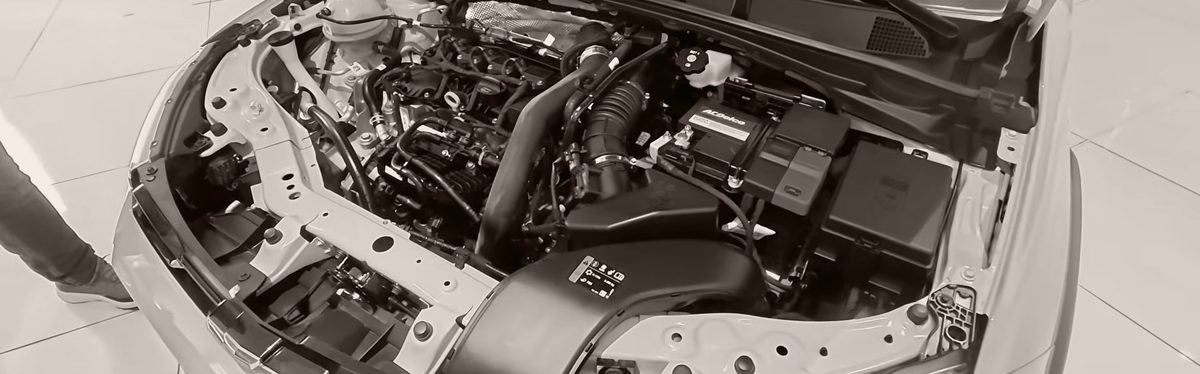
Not all of them, and fewer every year. One look settles it. Open the hood with the engine cold and look for a second dipstick.
The engine oil one is usually nearer the front and often has a brightly colored loop.
A transmission dipstick, where fitted, tends to sit further back: toward the bulkhead on a front-wheel-drive car, or along the transmission tunnel on a rear-wheel-drive one. Its handle is often marked with a gear symbol or the letters ATF.
Once the dipstick is out, what you're reading is the level. The color of the fluid is a separate question, and a far less reliable one than most guides admit. A low level is also the most common cause of a transmission slipping, which is worth checking early.

Use this image
Free to republish under CC BY 4.0: credit Oil & Miles and link to this page. The snippet does both.
<a href="https://oilandmiles.com/articles/how-to-check-transmission-fluid-level"><img src="https://oilandmiles.com/assets/img/diagrams/dipstick-where-to-look.svg" alt="A photograph of a modern engine bay with two markers drawn on it: a ring around the engine oil dipstick, a small bright loop standing out of a tube on the engine, shown enlarged alongside, and a dashed box across the strip behind the engine marking the area where a transmission dipstick sits on cars that have one" width="1000" height="761"></a> <p>Diagram: <a href="https://oilandmiles.com/articles/how-to-check-transmission-fluid-level">Oil & Miles</a>, CC BY 4.0</p>Do it with the engine cold, and give it a minute rather than a glance. Handles are made conspicuous on purpose, but they sit low, against dark plastic, and a bright loop can disappear under a trim cover. If a cover lifts off by hand, look underneath it before you decide.
If you find one, you can do everything in the next section yourself. If you look carefully and there's nothing there, the transmission is sealed, and the level is read through a plug underneath the car instead.
What if the tube has been capped?
There's a third possibility worth knowing about: some cars have a dipstick tube that has been capped, or a filler that requires a special tool to open. Those are sealed in practice even though something dipstick-shaped is visible.
| Has a dipstick | Sealed, no dipstick | |
|---|---|---|
| How you read it | Pull it, wipe it, refit it, read it | Open the level plug and watch for a trickle |
| Engine | Running, warmed through, ending in Park | Idling, vehicle dead level, in Park or Neutral depending on the maker |
| Temperature | Hot marks at 158–176 °F, after at least 15 miles | A narrow window, and it differs by transmission |
| Where | Your own driveway | On a lift |
| Cost | Nothing | Shop labor |
Cold, a dipstick can read empty on a full transmission. Below 50 °F (10 °C) the fluid may not reach the stick at all, and topping off on that reading is how an overfill starts.
We deliberately don't publish a list of which cars have a dipstick and which don't. It changes by model year and by which transmission was fitted, so any list is wrong somewhere on the day it is written. Looking takes two minutes and is never out of date.
How to check transmission fluid level with a dipstick?
The procedure itself is simple. What trips people up is the state the car has to be in, and it's more specific than most guides admit.
So here is the whole thing in the manufacturer's own order, from the 2022 Ram 2500 and 3500 owner's manual. We have added nothing and dropped nothing, because the order is the procedure. 7 steps below:
- Get it properly hot. The manual wants the fluid at 158–176 °F (70–80 °C), which normally takes at least fifteen miles of driving. This truck shows transmission temperature in the instrument cluster; if yours doesn't, the manual's own rough test is that at operating temperature the fluid is too hot to hold comfortably between your fingertips.
- Park level. On ground that is flat in both directions, not just front to back.
- Idle sixty seconds, and leave it running. The engine stays on for the whole of the rest of the check, because the reading depends on the converter and the circuits being full.
- Parking brake on, foot on the brake. Both, before anything is moved, because the next step puts the transmission into gear.
- Through every gear, ending in Park. Move the selector into each position in turn and give the transmission time to engage in each one, so every circuit is fed before the level settles.
- Pull it, wipe it, seat it. Unlock the cap, draw the dipstick out, wipe it clean, then push it back until it seats fully. A stick that's not fully home reads short.
- Pull it again and read both sides. The reading only counts if both sides carry a solid film of oil, and the level belongs between the upper, "HOT" pair of holes. One clean side means the stick wasn't seated and the number isn't real.
One condition the manual attaches to that: if you add fluid down the dipstick tube, wait a full two minutes for it to drain before reading again.
The three steps people get wrong
Three of those steps are where the reading gets lost, and each one produces a confident number that's not the level in the pan:
- The engine stays running. Engine oil is checked with the engine off; transmission fluid usually isn't, because the torque converter and the circuit need to be full for the level in the pan to mean anything. Check it stopped and you'll read a level that doesn't exist while driving.
- Warm doesn't mean idled in the driveway. Fifteen miles is what it takes for the fluid, not the coolant gauge, to reach temperature. The engine can be at operating temperature while the transmission is still well short of it.
- Cold, the reading isn't just low; it can be absent. The same manual warns that below 50 °F (10 °C) the fluid may not register on the dipstick at all, and says plainly not to add any until the temperature has come up. That's the trap: a correctly filled transmission reads empty on a winter morning, the owner tops it up, and now it is genuinely overfilled.
What happens if you overfill it?
Overfilling isn't a harmless mistake you can leave. Too much fluid gets whipped into foam by the rotating parts, and foam doesn't transmit hydraulic pressure the way liquid does.
The symptoms that follow, slipping and harsh shifts and overheating, look exactly like the low level the owner thought they were fixing.
Guarding against that is why some dipsticks carry two sets of marks. An upper pair answers the hot check, a lower pair a cold one, on that manufacturer's transmission at 60–70 °F (16–21 °C). Read the wrong pair and you get the wrong answer.
| What you did | What it reads | Why |
|---|---|---|
| Checked cold | Low, or nothing | Below 50 °F the fluid may not reach the stick. A full unit reads empty |
| Engine switched off | High | The converter drains back into the pan and the level rises with it |
| Only idled, not driven | Low | The coolant gauge reaches temperature long before the fluid does |
| Read on the wrong marks | Wrong either way | Two pairs of holes answer two different questions. Hot is the usual one |
| Topped up on a bad reading | Now genuinely wrong | Overfilled fluid foams, and foam behaves nothing like liquid under pressure |
Every one of those is the same mistake underneath: reading the stick before the transmission was in the state the reading assumes.
How to add transmission fluid, and how much to add
Through the dipstick tube on a car that has one, and not at all on a car that doesn't. The honest answer to how much transmission fluid to add is that there's no one number, which is the part most guides skip. Four things decide how it goes:
- On a dipstick car, it goes down the dipstick tube. The Ram manual is explicit about the sequence: add fluid through the tube, then wait a minimum of two minutes for it to drain into the transmission before reading again. A funnel with a long neck is the whole tool list.
- There's no set amount. The gap between the low and high marks is small, and a transmission holds several quarts, so a quantity that would be right on one car overfills another. Add a little, wait the two minutes, re-read, repeat.
- Not while it's cold. The same manual says plainly not to add any fluid until the temperature has come up, because below 50 °F (10 °C) a full transmission can read empty.
- On a sealed car, you can't. The fluid goes in at a plug underneath, against a temperature window. Hyundai's own procedure calls for a fluid pump or a suction gun to push it in through the fill plug until it appears at the level plug. That's a workshop job by design.
Use only the fluid the manual names. Transmission fluids aren't interchangeable between makers, and Stellantis warns in its own procedure that the 8HP fluid is not compatible with the ATF the same company uses elsewhere.
What are you paying for if it's sealed?
Sealed doesn't mean the fluid never needs looking at. It means the level is read at a plug in the side of the housing rather than on a stick, and that reading only works under conditions you can't produce on a driveway.
Take the ZF 8HP, one of the most widely fitted modern automatics, as the example. There's no dipstick: the fill hole itself is the level indicator, and the level is right when only single drops come from it.
Getting to that reading needs the car horizontal on a lift, the engine running, and a test device connected to the transmission's own temperature sensor.
Stellantis publishes its own version of the same job, and it's worth reading for how little of it happens with your feet on the ground. 6 steps below:
- On a level hoist. Ramps on a driveway won't do it. Every figure in the procedure assumes the case is sitting horizontal. The slight camber built into most roads and driveways is enough to move the fluid to one side and change what comes out of the plug.
- Engine running, start to finish. It starts before anything else is touched and it doesn't stop until the job is over. Switch it off at any point and the torque converter empties back into the pan, so the level sitting in front of you is no longer the level the transmission runs on.
- Fill plug out. It sits at the right rear of the transmission case, reached from underneath. Fluid goes in through that same hole, and it keeps going in until it starts to trickle back out of the opening rather than soak away.
- Wheels eight inches clear. The car stays in the air with nothing touching the ground, because the next step drives the transmission through its gears and the wheels turn while it happens.
- Every gear, five seconds each. Reverse, then Drive, then second gear, then Neutral held at 2,000 rpm, then back to Park. Each position fills a different circuit, and the fluid only settles to its true level in the pan once all of them have been fed.
- Now read it, and correct it. Whatever sits above the opening drains out, whatever is missing goes in, and the plug is torqued back. Any reading taken before this point was measuring a transmission in the wrong state.
So the bill isn't for skill or parts. It's for a lift, a scan tool and someone's time, and the honest answer to "can I check my own transmission fluid" on these cars is no, not properly.
What a transmission fluid check costs
| Your car | What is involved | Typical cost |
|---|---|---|
| Has a dipstick | Fifteen minutes and a clean rag | Nothing |
| Sealed, checked on its own | Lift time, scan tool, a technician | Roughly half an hour of labor |
| Sealed, checked during other work | Added to a job the car is already up for | Often little or nothing extra |
Labor rates at an independent shop ran $120 to $160 an hour in 2026, and higher at a dealer.
Half an hour of that is $60 to $80 at an independent, which is the number to hold a quote against. A standalone level check on a sealed transmission is a small bill rather than a large one.
The useful move is the third row: if the car is going in for anything that puts it on a lift, ask for the transmission level to be checked while it's up there. That's where the cost mostly disappears.
When is checking transmission fluid worth doing?
On a dipstick car, occasionally, because it's free and it's the cheapest early warning you have.
On a sealed car, don't put it on a schedule. Check it when something has actually happened: a spot on the driveway, a change in how it shifts, or a repair that opened the circuit.
The signs of low transmission fluid are the same signs a failing transmission gives. That's exactly why the level gets checked first rather than last: slipping, a delay before the car takes up drive, harsh or late shifts, whining or grinding, overheating, and a burning smell.
Transmission specialists list the same low transmission fluid symptoms. The set is worth knowing for what it does not tell you: not one of those six separates a low level from the expensive causes. That's the whole reason the free check comes first.
We should say where that list comes from, because it isn't where you would expect. We went looking for a maker's document that publishes it, and read a 464-page owner's manual and four manufacturer service documents without finding one. We then searched the 206,324 complaints in the federal file that mention a transmission, and the symptoms are there in owners' own words and nowhere as a list a maker stands behind.
Makers publish the procedure and the damage warning. The symptom list is the trade's, not theirs.
If yours is dropping, the level is a symptom rather than the problem, and our guide to transmission fluid leak repair cost covers where it goes and what each source costs to fix.
And if a shop has offered to change the fluid while you're there, whether a transmission flush is necessary is a separate question with a much less obvious answer.
What owners report
Three complaints filed with the US regulator, picked because each one names a low level and describes what the car did first:
- A 2010 Ford Fusion whose low gear shifts had gone erratic. The owner writes that it will act as though it's in neutral and I have no power to get out in traffic, and that a dealer then found it low on fluid and replaced a seal.
- A 2011 Kia Sorento that suddenly lost acceleration power while turning left. The dealer said the fluid was low and filled it. The fault came back.
- A 2013 Ford Edge reported for a burning smell, where the owner found the fluid empty with no leaking and had to pour some in.
In every one, somebody else found the fluid low, after the symptom. None of the three owners found it by checking.
NHTSA consumer complaints, ODI numbers 10461303, 10552715 and 10640329, read from the public complaint file on September 6, 2026. Owner descriptions, not confirmed diagnoses.
What should you do with the reading?
Open the hood this week and find out which kind of car you own. That single fact decides everything else on this page, it takes two minutes, and most people don't know the answer until the day it matters.
If there is a dipstick, check it properly once: warmed through by a real drive, engine running, ending in Park, reading the hot marks. Note where the level sits so you have something to compare against later.
If there's no dipstick, do nothing until there is a reason. Then ask for the check to be added to work the car is already booked in for, rather than making a visit of its own.

The position the whole reading depends on
The guides don't agree either. Of the pages ranking for this question, one chain says to warm the engine and leave it running, a dealer says the same, and the most-upvoted owner procedure on the same results page begins by shutting the engine off. Three answers to one question, on one screen.
From the documents
What does your own manual say about the level?
It gives one temperature, one selector position and one way of reading the level, and none of the three matches the next maker's. That's the whole reason there's no universal procedure to learn:
2022 Ram 2500 and 3500, six-speed
Dipstick. Engine running, ending in PARK, fluid at 158–176 °F after at least fifteen miles.
Chrysler, ZF 8HP70 to 8HP95
No dipstick. Level hoist, engine running throughout, fluid at 86–122 °F, filled until it trickles from the plug.
BMW, the same ZF 8HP
Level can only be checked using a named test plan, and the car's logged data has to support that it ran. Do not use a finger in the filler hole.
Hyundai, rear-drive eight-speed
Engine running in NEUTRAL, fluid at 122–140 °F, two plugs rather than one, filled until it runs out in a steady stream.
Read the two eight-speeds against each other. Stellantis wants the fluid at 86 to 122 °F and stopping at a trickle; Hyundai wants 122 to 140 °F and a steady stream. The windows barely touch, and the readings are opposites.
Getting either one backwards leaves the transmission wrong while the job looks finished.
That disagreement is the point rather than a footnote. There's no universal number to memorize, and the practical way to hit the window is a scan tool reading the fluid temperature sensor live.
Notice that both sealed windows are cooler than the hot check on a dipstick transmission. Warming it up the way you would for a dipstick check would put you past the window entirely.
We priced this as shop labor rather than giving a figure per transmission. The window, the tool and the plug differ by maker, and we couldn't find one number that would be true for more than a handful of cars.
Conclusion
There's no universal way to check it
Whether the car still has a dipstick decides everything that follows, and past that point the makers don't agree: Ram wants the selector in Park, Hyundai wants it in Neutral, and both letters sit on the same display.
So the only reading worth trusting is the one taken the way your own manual describes it. A procedure borrowed from another car produces a number that looks right and means nothing.
So take the reading your own book describes, and treat a low one as a leak to find rather than a quart to add. Oil & Miles reads the maker's own procedure before it says what a check involves, across oil and fluids.
Common questions
Asked most often
Should the engine be running when I check transmission fluid?
On most automatics, yes, and that's the opposite of engine oil. The manufacturer procedure quoted above has the engine idling for the whole check, after cycling through the gears and ending in Park. Manuals do differ, so if yours says otherwise, follow yours.
Can I check it cold?
Only if your dipstick has cold marks, and even then the manual calls them a rough reference for setting the level after a service, not a second way to check. Ram says to check again once it is hot. Below about 50 °F the fluid may not reach the stick at all, which reads empty on a full transmission.
How do I check transmission fluid without a dipstick?
Through a level plug on the transmission housing, with the car level, the engine idling and the fluid inside a narrow temperature window. It needs a lift and usually a scan tool to read fluid temperature, which is why it is normally a workshop job rather than a driveway one.
Does "sealed for life" mean the fluid never needs changing?
It means the maker didn't schedule a change, which isn't the same claim. Whether to change it anyway is a real argument with evidence on both sides, and it's a different question from checking the level.
Where is the transmission fluid, and where does it go in?
In the pan under the car. On a dipstick car, where to put transmission fluid is the tube itself, poured from above through a long funnel. On a sealed car there's no way in from above: a fill plug on the side of the housing, reached from underneath, which is also where the level is read.
What if the level is low?
Find out why before topping off. Transmissions don't consume fluid the way an engine consumes oil, so a level that has genuinely fallen means it went somewhere, and adding more without finding the leak buys a few weeks. If the level is fine, it was the first of seven things worth checking.
What people ask next
- Transmission Slipping: What It Is, and What Waiting Costs 12 min
- Transmission Fluid Color Chart: Dark Isn't Always Bad 15 min
- CVT Transmission Problems: It Depends Whose CVT 15 min
- Bad Transmission Symptoms: Seven Causes Ranked by Cost 22 min
- Check Transmission Fluid Without a Dipstick: 3 Jobs 17 min
- Is a Transmission Flush Necessary? Needed, Upsell, or Risk 13 min
Sources
- The 2022 Ram 2500 and 3500 owner's manual, printed pages 361 and 362, for the six-speed dipstick procedure and its temperature windows. Manufacturer owner's manual
- ZF service information for the 8HP, document 50130 EN dated 11.2024, page 5, read on the maker's technical site, for the sealed procedure and the window ZF prints. Manufacturer service documentation
- Stellantis standard procedure, Check Oil Level, 8HP70/75/90/95, for the hoist, the fill plug position and the gear-cycling routine. Read from a published copy of the procedure text, September 6, 2026. Stellantis service documentation
- BMW Service Information bulletin SI B24 02 13, May 2013, for the named test plan and the requirement that logged data support it. Filed with the US regulator and read there. BMW, via NHTSA
- Hyundai Technical Service Bulletin 19-AT-011H, May 2019, covering the 2012–16 Genesis sedan and Equus and the 2013–16 Genesis coupe, for its own temperature window and the separate level plug. Filed with the US regulator and read there. Hyundai, via NHTSA
- The NHTSA consumer complaint file, the full flat file downloaded from the regulator, 2,238,354 complaints of which 206,324 mention a transmission, searched for a published list of low-fluid symptoms and for the three owner accounts quoted above, ODI numbers 10461303, 10552715 and 10640329. Read September 6, 2026. NHTSA
- US independent-shop labor rates compiled for this site in 2026, $120–$160 an hour. Oil & Miles
How this was compiled
Every temperature comes from the document named beside it. Ram and Hyundai publish both scales and we print theirs unchanged; ZF publishes Celsius only, so the Fahrenheit figure for the 8HP is our conversion of 30 to 50 °C.
We say which is which because a figure rounded twice stops matching the manual a reader is holding.
What we didn't do
- We don't list which cars have a dipstick and which don't. It varies by model year and by the transmission fitted, so a list would be wrong somewhere the day it was published, and a reader who trusts it would stop looking.
- We didn't average the sealed windows into one number. We used to call them approximate, and that was the wrong call: once the four procedures could be read side by side, the disagreement between them turned out to be the useful part. Each window is printed as its own document gives it.
Prices are ranges compiled in September 2026 for the US market and vary by region, vehicle and shop rate. Prices from $10 up are rounded to the nearest dollar, so $14.13 reads as $14 and $14.52 as $15. Below $10 they're exact. Procedures differ between manufacturers, where your owner's manual disagrees with anything here, follow the manual. This article is general information, not advice about your specific vehicle. See the disclaimer.