
Key takeaways
- Safety: If the brake pedal feels spongy or soft, or goes down further than normal, have the brakes checked immediately. If the red brake light stays on with the parking brake fully released, stop somewhere safe and have the car towed.
- A spongy pedal comes from air in the lines, a fluid leak, a worn master cylinder or old fluid.
- On some cars a known fix is a software update or a battery test, not a brake part.
- Soft right after brake work: a shop checks the bleed, and on the 2024 and 2025 Ram ProMaster, an over-tightened reservoir cap.
- Check the fluid level between MIN and MAX, and tell the shop when it started.
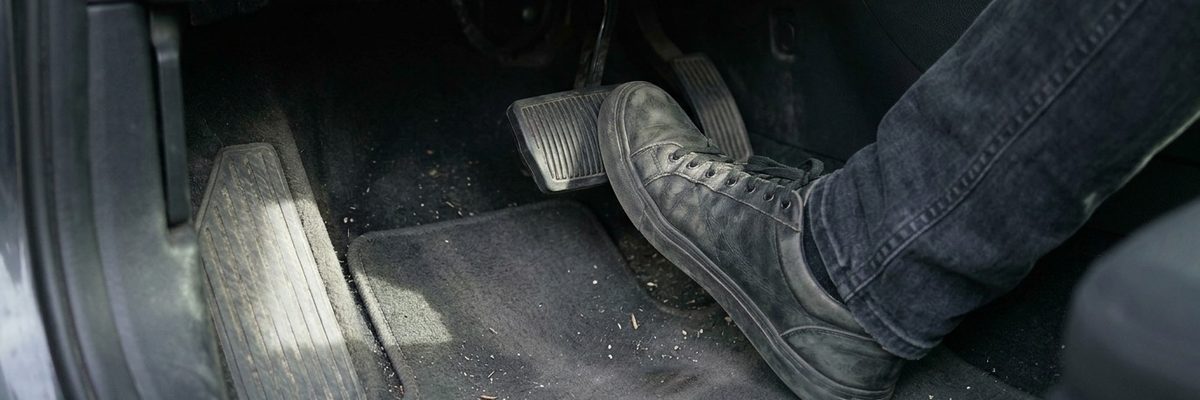
A spongy brake pedal feels soft, sinks further than it should or needs more travel before the car slows. The car may take longer to stop, so a pedal that feels this way should be checked before the next drive.
Is it safe to drive with spongy brakes?
If the brake pedal feels spongy or soft, or goes down further than normal, have the brakes checked immediately. That includes a pedal that goes down toward the floor, and the car may also take longer to stop.
A red brake light is a different case. If the red brake light stays on with the parking brake fully released, stop somewhere safe and have the car towed.
With the engine stopped or the fluid low, pressing the brake pedal may increase the stopping distance and take more pedal effort and travel, as on the 2018 Rogue. On trucks with dual hydraulic brake systems, which are two separate brake circuits, losing one system shows up as more pedal travel, more pedal force and the brake warning light, as on Jeep and Ram trucks.
Why does the brake pedal feel spongy?
It comes from one of five places: air in the lines, a fluid leak, the master cylinder, old fluid or, on some cars, a software or battery fault. A shop works out which one from the pedal's history and a check of the brakes.
- Air in the lines. Air compresses when you press the pedal, so the pedal feels soft and travels further. It gets in when the system is opened for a repair or through a leak, and a shop bleeds the system to remove it.
- A fluid leak. A brake fluid leak lets fluid out, and the pedal softens as the level drops. A shop looks for fluid at the lines, the calipers and the master cylinder.
- A worn master cylinder. It pushes fluid to the brakes when you press the pedal, and when it wears inside it can't build pressure, so the pedal feels soft.
- Old or wet fluid. Excess moisture in the brake fluid can cause a dangerous loss of braking efficiency, as on the 2019 RAV4, and old fluid is one reason for a brake fluid flush.
- A software or battery fault, on some cars. A soft pedal at start-up with code C0047:64 was fixed by reprogramming the ABS module, the anti-lock brake computer, on the 2020 Ford Explorer and Lincoln Aviator built on or before July 15, 2020, and the 2025 Ranger and Bronco have the same kind of fix. A spongy pedal with the check engine light on may come from a weak battery, so a shop tests the battery before it replaces any part, as on the 2023 and 2024 Chevrolet Colorado and GMC Canyon.
Some of these lines name one car because a carmaker published a bulletin for it. A dealer can say whether a bulletin covers your car's VIN.

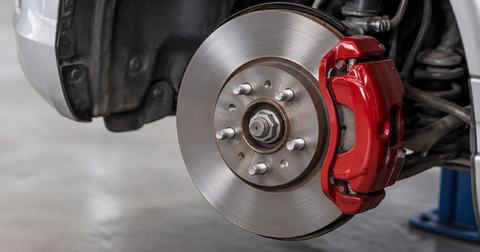
A brake hose at the caliper
When does the pedal feel spongy?
It can happen after brake work, with the engine off, with a warning light or at start-up. Which one helps a shop narrow the cause.
- After brake work. Air left in the lines is the first suspect, and on the 2024 and 2025 Ram ProMaster built on or before April 15, 2025, an over-tightened reservoir cap made the pedal travel further until the system was bled and the cap refitted.
- With the engine off. The pedal takes more effort and travel, because the booster uses engine vacuum, as on a Nissan.
- With a warning light. An ABS or brake lamp can come with the Ford software fault on the 2020 Explorer and Aviator.
- At start-up. A soft pedal can show up right after the car starts, as it did on the 2020 Explorer and Aviator.
A pedal that feels firmer on the second press or softer in the cold is worth reporting too. Mention it with the other details so the shop has the full history.
What can I check myself?
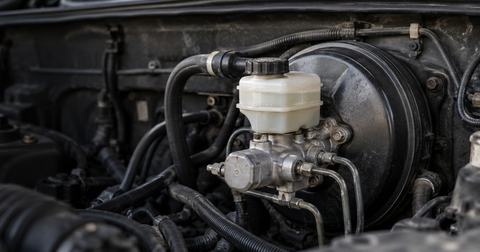
Look at the brake fluid level in the reservoir under the hood, which should sit between the MIN and MAX marks, and look for fluid on the wheels or on the ground under the car. On the 2018 Rogue, if the brake fluid is below the MIN mark, don't drive the car until the brakes have been checked. On the 2020 Ford Escape, a level below MIN means have the car checked as soon as possible.
Notice how the pedal feels on an ordinary start and whether it changes with the engine off. When you stop, notice unusual sounds, pulling to one side and increased pedal travel.

The brake fluid reservoir
What should I tell the shop?
Tell the shop what the pedal does and when it started, because that narrows the cause. A shop uses that history to decide whether to look for air, a leak, a worn part or a software fault.
- When it started. After brake work, after a bleed or suddenly.
- What the pedal does. It sinks, goes to the floor or feels firmer on a second press.
- What shows on the dash. The red brake light, the ABS light or a message.
- What changed. A brake job, a new part or a long time since the fluid was changed.
Ask the shop whether a bulletin covers your car's VIN and what it found. You can also look up open recalls for your VIN on NHTSA's recall lookup, and the VIN decoder shows the recalls tied to it. Ask too whether the other brake parts were checked in the same visit.
How is a spongy brake pedal fixed?
The fix follows the cause, and a shop works from the check to the repair in this order:
- Have the brakes checked immediately. A shop finds the cause before it replaces parts.
- Have the lines and the level inspected for a leak. A leak is fixed before the system is bled.
- Bleed the system after the repair. On a Kia Soul, new fluid comes from a sealed container and the drained fluid isn't reused.
- Update the software where a bulletin applies. On the 2020 Explorer and Aviator and the 2025 Ranger, the ABS module is reprogrammed.
- Test the battery on the named GM trucks. A weak battery is checked before any part is replaced on the Colorado and Canyon.
- Replace the fluid on the maker's schedule. A full flush removes the old fluid and the moisture in it.
Old brake fluid holds moisture, and excess moisture can cause a dangerous loss of braking efficiency. That's why the interval your maker prints matters, and the makers print different ones:
| Make | Interval |
|---|---|
| Honda | Every 3 years. |
| GM (Chevrolet, GMC) | Every 5 years. Older DOT 4 cars: every 2 years. |
| Nissan | Every 20,000 miles or 24 months on the normal schedule, every 10,000 miles or 12 months on the severe-use schedule. |
| Subaru | Every 24 months or 30,000 miles, and every 15 months or 15,000 miles in high humidity or mountain areas. |
| Kia | Replace every 48,000 miles or 48 months, inspect every 8,000 miles or 12 months. |
| Volkswagen | First change at 3 years, then every 2 years regardless of mileage. |
| Hyundai | Every 48,000 miles or 48 months on the 2022 Elantra. Some models print inspection only. |
| Ford | Every 3 years on the 2020 Escape. The 2018 F-150 prints none. |
| Toyota | Owner's manual prints no interval. |
| Mazda | US schedule prints no interval. |
In our shop it's mostly old brake fluid mixed with water, which a flush fixes, or a worn master cylinder, which needs replacing. If your make prints no interval in the owner's manual, ask a dealer or shop what it recommends for your car.
From the carmakers
Does a recall or bulletin cover my car?
None of these cards is a recall, and a dealer can say whether a bulletin covers your car's VIN. Each card applies only to the cars it names.
Service bulletin Ford SSM 54101
"A soft brake pedal following vehicle start-up."
Service bulletin Ram TSB 05-001-25
"Soft Brake Pedal."
Owner's manual Nissan Rogue 2018
"If the brake pedal suddenly goes down further than normal, the pedal feels spongy or the vehicle seems to take longer to stop, have your vehicle checked immediately."
Owner's manual Toyota RAV4 2019
"Contact your Toyota dealer as soon as possible."
Owner's manual Chevrolet Equinox 2022
"See your dealer if the brake pedal does not return to normal height, or if there is a rapid increase in pedal travel."
Service bulletin Kia CHA104
"Brake air bleeding procedure for ESC honking noise and soft/spongy brake pedal."
Conclusion
What to do next about spongy brakes
Check the fluid level, then tell the shop when the pedal changed and what it does, so the cause is found before parts are replaced. Ask whether a bulletin covers your car's VIN, and keep to your owner's manual for the brake fluid interval.
Oil & Miles checks each step here against carmakers' owner's manuals and service bulletins.
Common questions
Asked most often
Can I keep driving with spongy brakes?
If the brake pedal feels spongy or soft, or goes down further than normal, have the brakes checked immediately. If the red brake light stays on with the parking brake fully released, stop somewhere safe and have the car towed.
Will spongy brakes fix themselves?
No. The cause stays until a shop finds it, and a spongy pedal can mean the car takes longer to stop.
Why is my brake pedal soft but firm after I pump it?
A pedal that firms up when pumped is still a spongy pedal, so have the brakes checked immediately. Don't count on pumping the pedal to stop.
How much does it cost to fix a spongy brake pedal?
It depends on the cause, such as a leak repair or a fluid flush.
What people ask next

Sources
- Nissan Rogue 2018 owner's manual, for the pedal check, the brake warning light and the two hydraulic circuits and the booster. Nissan, read November 12, 2026
- Toyota RAV4 2019 owner's manual, for the loss of brake effectiveness and the moisture in the fluid. Toyota, read November 12, 2026
- Chevrolet Equinox 2022 and GMC Terrain 2016 owner's manuals, Buick Regal 2012 owner's manual, for the pedal travel and the fluid interval. Chevrolet, read November 12, 2026
- Ford service bulletins SSM 54101, SSM 53986 and SSM 49042, for the soft pedal after start-up and the ABS module software. Ford, read November 12, 2026
- Ram TSB 05-001-25 (US), for the over-tightened reservoir cap. Ram, read November 12, 2026
- Kia bulletin CHA104 (US), for the bleed procedure and new fluid. Kia, read November 12, 2026
- GM bulletin PIT6012A (US), for the spongy pedal with the check engine light on and the battery test. GM, read November 12, 2026
- Honda CR-V 2019, Accord 2018, Civic 2016 and Pilot 2016 owner's manuals, for the fluid interval and the level check. Honda, read November 12, 2026
- Ford Escape 2020 and F-150 2018 owner's manuals, for the fluid level below the MIN mark and the fluid interval. Ford, read November 12, 2026
- Jeep Wrangler JL 2018 and Ram 1500 2016 owner's manuals, for the dual hydraulic brake systems. Jeep and Ram, read November 12, 2026
- Nissan Rogue, Altima and Sentra 2018 owner's manuals, maintenance schedules, for the normal and severe-use brake fluid intervals. Nissan, read November 12, 2026
- Toyota RAV4, Corolla and Tacoma 2019 owner's manuals, for where the brake fluid interval is not printed. Toyota, read November 12, 2026
- Hyundai Elantra 2022 and Tucson 2019 owner's manuals, for the brake fluid interval. Hyundai, read November 12, 2026
- Kia 2023 and 2024 US owner's manuals, for the brake fluid interval. Kia, read November 12, 2026
- Subaru 2019 Maintenance Recommendations by Interval, for the brake fluid interval. Subaru, read November 12, 2026
- Mazda3 2018 and MX-5 2022 US owner's manuals, for the maintenance schedule with no brake fluid item. Mazda, read November 12, 2026
- Volkswagen 2021 Maintenance Schedule, all gasoline models, for the brake fluid interval. Volkswagen, read November 12, 2026
AI illustration by Oil & Miles
This article is general information, not advice about your specific vehicle. See the disclaimer.