
Key takeaways
- Safety: If you see smoke or smell burning while you crank, stop cranking, turn the ignition off and don't try again until a shop has checked it. Crank no longer than your manual allows (10–30 seconds).
- One click or silence with the dash lights on points at the starter circuit, while rapid clicking or dim lights point at the battery.
- Check the battery clamps and try a jump start before you pay for a starter.
- Ask the shop which test shows the starter is the cause, since a weak battery and a loose cable sound the same.
- Starters have been recalled for fire, so check your model year for recalls.
The starter is the small electric motor that turns the engine over so it can fire. When it fails, you get a click, a grind or silence instead of a crank.
A weak battery makes some of the same sounds, so a list of symptoms can't tell the two apart. The lights test and a jump start can, and they come first.
What are the symptoms of a bad starter?
A bad starter gives a click, a grind, a whir or silence, and the sound tells you where to look first. Smoke or a burning smell is a different case: stop cranking and turn the ignition off.
What does a bad starter sound like?
A bad starter clicks once, whirs, grinds or stays silent. Rapid clicking and a slow crank point at the battery instead, so test the battery first.
| Sign and sound | What it points to first |
|---|---|
| One loud click, then nothing The dash lights and radio still work. | The starter, its solenoid, its relay or a loose connection. A click alone doesn't say which. |
| Rapid clicking A fast tick-tick-tick when you turn the key. | The battery, not the starter. Test it and the clamps first. |
| Silence with the lights on You turn the key and nothing happens. | The starter circuit, or a lookalike such as a fuse, a switch or the key fob. |
| Whirring The motor spins but the engine doesn't turn. | The starter itself. |
| Grinding A harsh metal sound while you crank. | The starter. Stop cranking and have it checked. |
| Slow cranking The engine turns over sluggishly, and the lights dim. | The battery, or loose or corroded terminals. |
| Starting sometimes and not others No pattern you can find. | The starter, the relay, the connections or a weak battery. Only a test tells which. |
No sound proves the starter is at fault by itself, because a weak battery or a loose cable can make several of them. A test is what settles it.
Is it the starter, the solenoid or the relay?
When you turn the key, current passes through a small relay and the solenoid before it reaches the starter motor. A fault in any of the three can leave you with one click or silence, and so can a weak battery.
So a single click proves little by itself, because it can't name the part that failed. The lights test and the jump start narrow it down.
Is it the starter or the battery?
Bright lights with a click or silence point at the starter, and dim lights or rapid clicking point at the battery. A slow turn with dim lights or a weak horn means the battery is low.
Six checks sort it out, in this order:
- Watch the lights as you turn the key. Dimming or going out means a weak battery. Steady lights with a click or silence leave the starter in play.
- Measure the battery if you have a multimeter. Read the posts with the engine off. A full battery reads about 12.6 volts or more, and below about 12.3 volts the battery is the likely culprit.
- Check the battery clamps. They should be clean and tight, with no crust on the posts. Loose or crusty clamps cause a slow turn too, and an old battery may simply be worn out.
- Try a jump start. If the engine cranks and runs, the battery or its cables are the likely cause. If it still won't crank after a jump start, the starter moves up the list.
- Rule out the alternator. If the car starts on a jump but dies once the cables come off, the alternator may not be charging, or the battery can't hold a charge.
- Have the starter circuit tested. If the clamps are clean and a good jump changes nothing, a shop can test the starter, its relay and its cables before replacing anything.
If a jump works but the car won't start again the next day, the battery or its connections are still the suspects. Have the battery load-tested.
What else looks like a bad starter?
A car can click or stay silent for reasons that have nothing to do with the starter. A flat battery, a loose clamp, a locked steering wheel, a dead key fob or a blown fuse can all look like a bad starter.
These cases can look like a bad starter:
- A blown fuse or a bad relay in the starter circuit.
- A brake, clutch or gear switch that doesn't tell the car it's ready to start.
- A flat battery in the key fob, or a fault in the immobilizer.
- A steering lock that hasn't released.
Push-button cars add the brake pedal and the fob to the list. On a car with a Stop/Start system, the engine shutting off at a stop is the system working, not a failed starter.
What makes a starter fail?
A starter circuit fails from loose connections, water or oil, long cranking or cold. Each one is a fault a shop can find with a test.
1. Loose or corroded connections
The starter can only turn as hard as the current that reaches it. A loose or corroded battery terminal gives a slow turn, and a disconnected one gives nothing, with the lights and horn dead too.
A loose nut on the solenoid's positive terminal, where the thick battery cable bolts on, can cause a no-start. Tightening the nut fixes it, so ask the shop to check every battery and starter connection first.
2. Water or oil on the starter
Water on the starter solenoid or a connector can short the circuit. A no-crank can also trace back to corrosion at a connector behind the dash.
One way the water gets in is a windshield that was tinted or poorly sealed when it was replaced. The fix is to repair or replace the connector, not the starter. An engine oil leak that soaks the starter is one more cause. Repair the leak too, or the replacement starter can fail early for the same reason.
3. Long or repeated cranking
Cranking too long overheats the starter and the wiring that feeds it, so crank no longer than your manual allows. That means 10–30 seconds, and then a rest.
From my workshop experience, never crank for more than about 30 seconds, because I have seen a customer crank a Toyota until its starter motor failed. Repeated attempts after a starter fault can overheat the starter from an electrical overload.
4. A cold-weather solenoid part
On some trucks, a weak starter solenoid switch can stop the engine from starting in deep cold, and an updated switch fixes it. Ask the dealer whether your truck needs one.
If a truck with the updated switch still starts hard in the cold, the cause is somewhere else. A shop test of the battery and the starter circuit finds it.

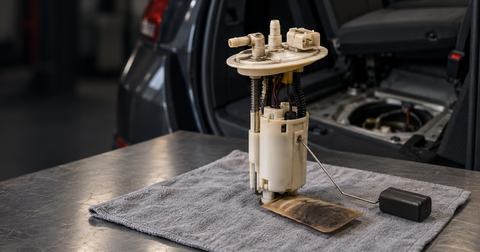
The solenoid and its battery cable
Can you start or drive a car with a bad starter?
Don't count on a failing starter to start the car again, and don't keep trying if you see smoke or smell burning. Starters have been recalled for fire, and one of those recalls tells owners to park outside and away from structures until the repair is done.
If the car won't crank, keep each try short and rest between tries. A jump start helps a weak battery but not a failed starter. A failing starter can quit at any time, so plan on it not starting next time and get the circuit tested.
What should a shop test before replacing a starter?
Ask which test pointed at the starter before the shop replaces it. A shop test should rule out the battery and its terminals too, because they cause a slow or dim start.
A new starter doesn't fix a weak battery or a loose cable. Our VIN decoder lists the recalls for your model year, and NHTSA's recall lookup confirms whether one is open on your car.
What a starter costs depends on the car and the shop. Ask for the part and the labor quoted separately, so you can compare quotes.

A test light on the solenoid terminal
From the carmakers
Are there recalls or free fixes for a bad starter?
Yes, for some cars, through recalls and a few bulletins. A worn starter is normal wear, not a defect. A few cars have a recall or a free fix.
Recalls are free repairs. A bulletin can show the real cause of a no-crank but pays only where its card says so, so read the card for your car before you ask for a free repair.
Recall 25V-644
After repeated attempts, the starter motor may overheat from an electrical overload.
Recall 24V-107
Water may enter the starter solenoid and cause an electrical short, which can result in an engine compartment fire while parked or driving.
Recall 20V-467
An incorrect attachment nut may have been used to attach the battery positive (B+) power supply cable to the starter motor…
Service campaign SC313
The starter solenoid positive (+) terminal nut in the subject vehicles may not have been properly tightened to specifications during assembly.
Service bulletin T-SB-0019-24
Some 2022 – 2024 model year Tundra vehicles may exhibit a condition where the vehicle has difficulty starting in temperatures below -4°F (-20°C).
Service bulletin SA-014-25
Some vehicles may experience an engine no start/no crank with either of the following DTC's stored: P0615:12 - Starter relay circuit malfunction…
Conclusion
What to do next about a bad starter
If the lights stay bright and you hear one click or silence, check the clamps and try a jump, then ask the shop which test points at the starter. If the lights dim or the clicks come fast, test the battery first, and if you see smoke or smell burning, stop cranking and turn the ignition off.
Oil & Miles checks each step here against the carmakers' manuals and bulletins and NHTSA's records.
What to say to the shop
When a quote names the starter before any test, ask:
- Which test pointed at the starter?
- Were every battery and starter connection checked first?
“My car [clicks once or stays silent] when I turn the key. Can you check every battery and starter connection, and tell me which test points at the starter before you replace it?”
A good answer: the connections checked first, then the test that points at the starter.
Common questions
Asked most often
Will a jump start work if the starter is bad?
A jump start helps a weak battery but not a failed starter, so a car that still won't crank after a good jump points at the starter.
What can be mistaken for a bad starter?
A weak battery, loose or corroded battery clamps, a blown fuse, a bad relay, a switch that doesn't signal the car is ready to start, or a flat key fob battery. Check the lights and the clamps first.
Will a bad starter store a trouble code?
It can, but the code names the circuit, not the starter. A code like P0615 (starter relay circuit) can come with a no-crank caused by water at a connector.
How do you know if a starter needs to be replaced?
Only a test is sure, because a weak battery and a loose cable make the same sounds. If the clamps are clean and a good jump doesn't help, ask the shop which test pointed at the starter.
What people ask next

Sources
- 2018 Toyota Camry Owner's Manual (US), pages 524 and 525 and page 199, for the three no-start cases, the key battery and fuse, and the 30-second cranking limit. Toyota, read November 7, 2026
- 2024 Kia Soul Owner's Manual (US, SK3), "Driving your vehicle", "Starting the engine", for the cranking limit of 10 seconds followed by a rest of 5 to 10 seconds. Kia, read November 7, 2026
- NHTSA recalls 24V-576 and 25V-644 (BMW), 24V-107 (Hyundai) and 20V-467 (Ford), for the starter overload and its later starter replacement, the solenoid short and the wrong cable nut. NHTSA, read November 7, 2026
- Service bulletins SC313 (Kia), T-SB-0019-24 (Toyota) and SA-014-25 (Mazda), for the terminal nut, the solenoid switch and the relay connector. Carmakers via NHTSA, read November 7, 2026
- NHTSA recall and complaints files: 34 passenger-vehicle recalls with a starter component, 25 of them describing fire, overheating or a short, and 1,557 of 1,614,203 complaints naming a starter. One complaint can name several parts, and complaints are owners' words, not confirmed causes. NHTSA, read November 7, 2026
- 2022 Chevrolet Equinox Owner's Manual (US), page 204, for the Stop/Start system. Chevrolet, read November 7, 2026
- A battery maker's voltage guide and two shop guides (OPTIMA Batteries, AutoZone and McLaren Scottsdale), for the resting voltage of a full battery and for oil soaking a starter. Read November 7, 2026
- Three repair-shop and parts-store guides on telling a starter from a battery (Firestone Complete Auto Care, AutoZone and Tires Plus), for the sounds and the jump test. Read November 7, 2026
Each step comes from the owner's manuals and the carmakers' and NHTSA's own documents.
AI illustration by Oil & Miles
This article is general information, not advice about your specific vehicle. See the disclaimer.