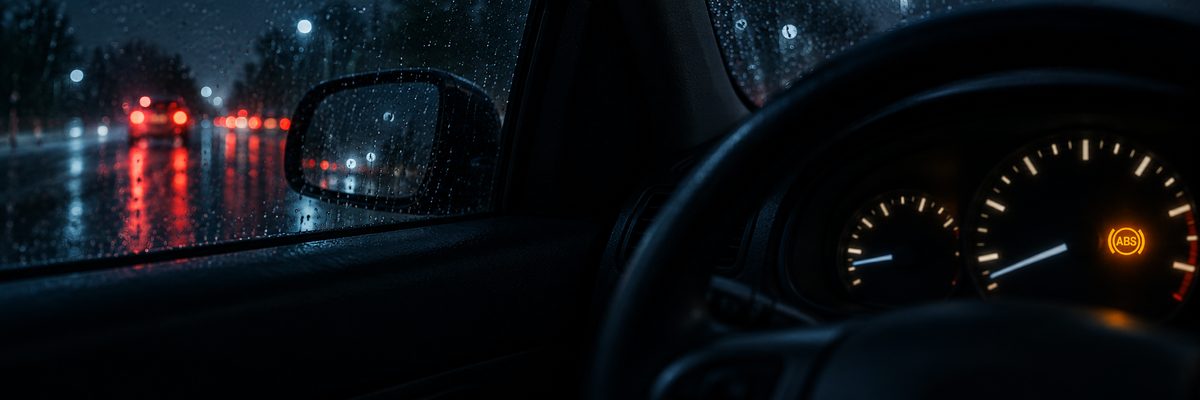

An ABS light is about the part of the brakes that stops the wheels locking, not the part that stops the car. That one distinction decides most of what follows, from whether you can drive to what a shop should test first.
So the first questions are which other lights are on with it and how the brake pedal feels. Those two tell you whether to drive on or stop.
What does the ABS light mean?
It means the anti-lock braking system, or ABS, found a fault and turned itself off. ABS keeps the wheels from locking in a hard stop, which helps you keep steering, and the light says that help is off.
Here's what the light does on most cars. A federal brake standard sets how it works, so the meaning barely changes from one car to the next:
- It checks itself at start-up. Most cars light the ABS warning briefly when you start the car, and your owner's manual says whether yours does. One that then goes out has passed its start-up check, and one that never lights is a fault too.
- It stays on while the fault lasts. Once lit for a fault, it must stay on whenever the ignition is on, until the problem is gone.
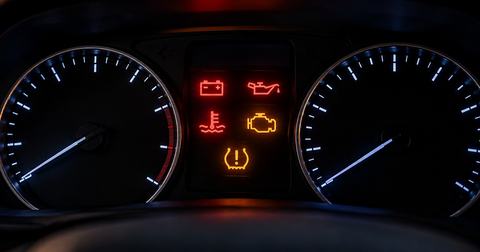
- It's yellow when it stands alone. A separate anti-lock light reads ABS or Antilock in yellow. Some cars report an ABS fault on the red BRAKE light instead.
When ABS does work in a hard stop, the pedal pulses and you may hear it. That's normal, so hold the pedal down firmly rather than pumping it.
Worth knowing
A dark warning lamp isn't proof the anti-lock works. Recalls have covered cars where an anti-lock fault lit only the red BRAKE light, or no light at all.
Is it safe to drive with the ABS light on?
With that light alone and brakes that feel normal, yes, carefully, and get it checked soon. The regular brakes still work, but the wheels can lock in a hard stop.
Without anti-lock, a car must still stop safely in the federal test, only over a longer distance. So leave more room and brake earlier, above all in rain, snow or ice.
At your next stop, restart the car. If the light stays on once you're moving, book a dealer or a shop with an ABS scanner, the tool that reads the anti-lock system's own codes.
The other lights and the pedal tell you when it's more than anti-lock. Stop as soon as it's safe if any of these shows with it:
- The red BRAKE light. The two together point at the regular brakes, and some manuals say the car can turn unstable when braking.
- A soft or sinking pedal. That's the regular brakes, not the anti-lock system, so have the car towed rather than driven.
- A hard pedal, a pull or an odd noise. Stop, and have the car towed rather than driven.
Why are the ABS and brake lights on together?
Because the fault may reach the regular brakes, not just the anti-lock system. The red BRAKE light covers low fluid, the parking brake and a loss of pressure in part of the brake system.
Owner's manuals treat the pair as a problem with the regular brakes, and some say the car can turn unstable under sudden braking. When both lights are on, check these 3 things:
- Check the parking brake. Make sure it's fully released, since one left on keeps the red light lit.
- Check the fluid level. Below the MIN line points to worn pads or a leak, and topping it off hides the reason.
- Both lights still on? Have the car towed rather than driven.
On some cars the red light is the only warning an ABS fault gets, because the rule lets a carmaker share one red lamp. So a red light alone doesn't rule out the anti-lock system.
The red light on its own has its own causes, and our brake warning light guide covers them. A parking brake message is in our parking brake malfunction guide.
What causes the ABS light to come on?
The ABS module turns the light on when it loses a signal it trusts. The code stored in the module shows where to look, and here are the causes the carmakers' service bulletins name:
A wheel speed sensor and its tone ring usually sit at a wheel, so the code often names the corner to check. The rest are in the module, the fluid or the wiring.
1. A wheel speed sensor or its wiring
On most cars each wheel has a sensor that reads how fast it turns, and the module compares all four. When one signal drops out or reads wrong, the module can't tell whether a wheel is locking, so it switches ABS off.
A rubbing or broken sensor wire is a known fault, and carmakers have fixed it with repair kits or new sensors. Ask which wheel the code names before anyone replaces more than one sensor, and here's how to test a wheel speed sensor yourself.

Corroded pins in a sensor plug
2. A dirty or damaged tone ring
The sensor reads a toothed or magnetic ring that turns with the wheel. Metal dust, debris or a bent ring gives it a false signal, even when the sensor is fine.
Bulletins have technicians clean metal flakes off the ring and the sensor tip before replacing parts, so ask for that check. On some cars the ring sits on the wheel hub, which our wheel bearing replacement cost page covers.
3. The ABS module or its software
The module is the anti-lock control unit, with its own pump and valves. Software faults and failed units both turn it off, and some carmakers fix it with a software update rather than a new module.
Recalls have updated ABS module software free on some pickups, and they're cards in the documents section. Ask whether an update exists for your car before anyone quotes a new module.
4. Low brake fluid
On cars and light trucks, low fluid is a red BRAKE light condition. On some heavy-duty pickups the ABS warning comes on with low fluid too, from a weeping brake hose next to the sensor wiring.
Low fluid points to worn pads or a leak, so look at the reservoir rather than only topping it off. Our guide to brake fluid leaks shows where to look.
5. A brake light switch or relay
The module also watches the switch that turns on your brake lights. If your brake lights don't work, or stay on, mention it when the light is checked.
One carmaker fixes the light on some pickups with a new stop lamp switch, a new relay and a module update. So a brake light fault and this warning can be one repair.
6. A chafed wiring harness
A harness, the bundle of wires running to the sensors, can rub through and short, with the anti-lock and stability warnings on. In one carmaker's bulletin the short blew a fuse, so a fuse that blows again points back at the wiring.
So if a new fuse fixes the light only for a while, ask the shop to look along the harness for a worn spot. That comes before replacing a sensor.

Use this image
Free to republish under CC BY 4.0: credit Oil & Miles and link to this page. The snippet does both.
<a href="https://oilandmiles.com/articles/abs-light"><img src="https://oilandmiles.com/assets/img/diagrams/abs-light-signal.svg" alt="Where the ABS light gets its signal: a wheel speed sensor reads a toothed tone ring on each wheel and reports to the ABS module, which lights the yellow ABS lamp and the stability control lamp together when a sensor fails; a separate brake fluid reservoir lights the red BRAKE lamp" width="1600" height="1192"></a> <p>Diagram: <a href="https://oilandmiles.com/articles/abs-light">Oil & Miles</a>, CC BY 4.0</p>Why are the ABS and traction control lights on together?
Because both systems use the same wheel speed sensors and the same brakes, so one fault can take out both. Stability control brakes each wheel on its own, through the brakes the ABS also controls.
How the traction light behaves tells you what's going on. Here's what the traction light means next to the anti-lock light:
- Traction light flashing. The system is working, not broken. It flashes while it stops a wheel spinning or catches a slide.
- Traction light on and steady. Traction or stability control is off or not working, so check nobody switched it off. Our traction control light guide covers it, and on a Honda or Acura the lamp reads VSA.
- Anti-lock light on as well. Look for one fault in something both use, such as a wheel speed sensor. Treat the two lights as one repair until a scan says otherwise.
Tires can do it too, because the module compares how fast each wheel turns. A smaller spare or one odd tire spins faster, so after a flat or new tires, check the sidewall sizes first.
Why does the ABS light come on and go off?
Because the fault comes and goes: the module loses a signal, then gets it back. A light that goes off means the module stopped seeing the fault, not that it was fixed.
Carmaker documents name three patterns behind it. Here's what can make it come and go:
- A damaged wire. Chafed harnesses and sensor wiring set faults that come and go, so ask for the wiring at that wheel to be checked.
- Hard braking on ice. Continuous braking on an icy road can light it. Pull over and restart: if it goes off, it may have been the ice, but have the stored code read at your next service.
- Several lights at random. A communication fault between the car's computers, or a loose ground wire, can light many warnings at once. A weak battery can set it off too, and one carmaker says a low battery, worst in the cold, can make it worse.
If you can, have the module scanned while the light is on, when the fault is live. A shop reading a stored code after the light went out may find less to go on.
How do you fix the ABS light?
Find the fault the module stored, then fix that part, because resetting the light without a repair only hides it. Work through the 4 steps below to fix it, in order:
- Note which lights are on. ABS alone, with traction control or with the red BRAKE light changes what comes next.
- Check the parking brake and the fluid. A parking brake that is still on, or fluid below MIN, points at the regular brakes first.
- Restart the car. Stop, turn the engine off and start it again. If the light stays on once you're moving, it needs a scan.
- Have the ABS module scanned. Many basic code readers read engine codes only, so check that the scanner lists ABS. The code shows where to look.
If the light went out before the scan, ask for the stored code anyway. If no code is stored, ask what was checked.
What the fix costs depends on the part the scan names, from a wheel speed sensor to the module. Our ABS sensor replacement cost page prices the sensor job by car.
What to say to the shop
When a quote names a part before any scan, ask:
- Which code is stored, and which wheel does it name?
- Is there a recall or a software update for my VIN?
- Were the wiring and the ring checked before the sensor?
“My anti-lock light is on [alone, or with these other lights]. Can you read the ABS module’s code, check my VIN for recalls and updates, and check the wiring before you replace a part?”
A good answer: the stored code and the wheel it names, then a VIN check before any part.
Will an ABS light fail inspection?
In some states, yes: Maine and Rhode Island reject a car whose anti-lock warning stays on. New Hampshire did too, but it suspended its inspection program until further notice on February 13, 2026.
Elsewhere it varies, and a state may pass it, fail it only with another fault, or not check it at all. Maine and Rhode Island fail a car for it, and Pennsylvania and Virginia only in some cases.
| Verdict | States | What the rule says |
|---|---|---|
| Fails | Maine, Rhode Island, New Hampshire (inspections suspended since February 2026) | Reject if the warning stays on, on a car built with ABS |
| Sometimes | Pennsylvania, Virginia | Pennsylvania fails it only with a driving problem or lost braking, and Virginia only on older combined booster and ABS units |
| Passes | New York, Massachusetts, West Virginia, Hawaii, Missouri | The rule says in words that the warning isn't a reason to fail |
| Not checked | Vermont, North Carolina, Delaware | The passenger-car rules don't mention it |
Each state's own rule is the source.
Maine also rejects an anti-lock warning that doesn't light at all during the start-up check, and New Hampshire did before it suspended inspections. A dead bulb fails there too.
The red BRAKE light is a different story. Massachusetts passes the anti-lock warning, and Virginia and Vermont don't fail it on its own, but all three reject a red brake warning that stays on, so fix that one before the inspection.
Outside the US
In the UK, an ABS warning that shows a fault, or doesn't work at all, fails the MOT as a Major defect under section 1.6 of the GOV.UK MOT inspection manual. UK owners check recalls on GOV.UK by registration number, and Canadian owners search Transport Canada's recall database by make, model and year.

Use this image
Free to republish under CC BY 4.0: credit Oil & Miles and link to this page. The snippet does both.
<a href="https://oilandmiles.com/articles/abs-light"><img src="https://oilandmiles.com/assets/img/diagrams/abs-light-checklist.jpg" alt="ABS light checklist: with the red BRAKE light or a soft pedal, stop and have it towed, while the ABS light alone leaves the regular brakes working, so leave more room; a light at start-up that goes out is the self-check, a flashing traction light means it is working and ABS with traction is one fault; check the parking brake and fluid, restart, and have the ABS module scanned; ask which wheel the code names, whether the wiring and ring were checked and whether a recall or update covers your VIN." width="1200" height="1562"></a> <p>Infographic: <a href="https://oilandmiles.com/articles/abs-light">Oil & Miles</a>, CC BY 4.0</p>From the carmakers
What do carmakers say about the ABS light and free fixes?
The carmakers' own documents show what the light means, the faults found behind it, and the recalls that fix some of them free. A recall pays only on the cars whose VIN it lists, so run yours on NHTSA's recall lookup or our VIN check before you pay.
Recall 24V-896
The hydraulic control unit (HCU) may fail, which can cause the anti-lock brake (ABS), electronic stability control (ESC), and traction control systems to fail.
Recall 24V-653
Due to a software malfunction, the anti-lock brake system (ABS) control module may disable the electronic stability control system.
Recall 19V-889
…if this specific error occurs, the vehicle's diagnostics will not illuminate the instrument cluster ESC and ABS malfunction warning lights.
Recall 19V-761
If a wheel-speed sensor fails, while the vehicle is traveling between 41 and 60 mph in four-wheel or automatic mode…
Recall 15V-678
In the event of an ABS malfunction, the Brake System warning light will illuminate, but the ABS warning light will not illuminate.
Recall 13V-483
…may experience random illumination of multiple instrument cluster warning lights, loss of cluster illumination and loss of anti-lock brake system…
Owner's manual 2020 Equinox, pp117–118
If the regular brake system warning light is not on, the vehicle still has brakes, but not antilock brakes.
Federal safety standard FMVSS 135, S7.8.3
…in the event of any single functional failure in any such system, the service brake system shall continue to operate and shall stop the vehicle…
Conclusion
What to do next about an ABS light
If the light is on alone and the brakes feel normal, drive carefully and have the ABS module scanned soon. If the red BRAKE light comes on with it or the pedal sinks, stop and have the car towed.
Oil & Miles checks each step here against the federal rule and the carmakers' own documents before the usual list of causes.
Common questions
Asked most often
Does the ABS light mean a bad sensor?
Not by itself, because the sensor's wiring, the ring it reads and the module's software can set the same light. The stored code shows where to look.
How much does it cost to fix the ABS light?
It depends on the part the scan names. A wheel speed sensor is the cheap end and the module the expensive one, and our ABS sensor cost guide prices the sensor by car.
Does disconnecting the battery reset the light?
It can switch the light off for a while, but resetting it without a repair only hides the fault. The module turns it back on once it sees the fault again.
Can I fix it myself?
You can check the fluid, the parking brake and whether the light clears on a restart. Finding the failed part takes a scanner that lists ABS, not only engine codes.
What people ask next
Sources
- FMVSS 135, light vehicle brake systems (49 CFR 571.135), for the anti-lock light's color, start-up check and stay-on rule, and the 279-foot stop with anti-lock failed. Code of Federal Regulations, read October 24, 2026
- FMVSS 126, electronic stability control (49 CFR 571.126), for stability control braking each wheel on its own. Code of Federal Regulations, read September 27, 2026
- Owner's manuals: 2020 Chevrolet Equinox (pages 117 and 118), 2020 Nissan Altima, 2020 Kia Soul, 2023 Hyundai Sonata, 2021 Toyota Avalon, and 2018 Honda CR-V and Accord, for what the light means for the brakes, the traction light, mismatched tires and ice. GM, Nissan, Kia, Hyundai, Toyota and Honda, read September 27 and 28 and October 24, 2026
- NHTSA recalls 24V-896, 24V-653, 19V-889, 19V-761, 15V-678 and 13V-483, from NHTSA's recall records. NHTSA, read October 24, 2026
- Service bulletins: Ford 20-2302, SSM 49433 and 25-2380, GM 16039, PIT5707 and PIT4946A, Stellantis S2523000051 and S2523000060, FCA 05-005-17 and Nissan NTB22-084, for the causes, and GM PIT6476 (January and June 2026) for the low battery. Carmakers via NHTSA, read September 27 and October 28, 2026
- State inspection rules: each of the 13 states' own inspection manual or regulation, for what fails an inspection, and New Hampshire's Vehicle Inspection Program Public Guidance of February 13, 2026, read October 28, 2026, for the suspended program. State agencies and the Code of Federal Regulations, read September 28, 2026
- California's OBD-II regulation, 13 CCR 1968.2, for the emissions scope of a basic code reader. California Air Resources Board, read September 27, 2026
- MOT inspection manual, section 1.6 (anti-lock braking system), for the UK MOT result on an ABS warning. GOV.UK, read November 4, 2026
- Check if a vehicle has been recalled and Transport Canada, defects and recalls of vehicles, for recall checks in the UK and Canada. GOV.UK and Transport Canada, read November 4, 2026
How this was compiled
The sections follow what a driver needs to know about this warning, from what it means to what to ask a shop. The recalls come from NHTSA's recall records, and the bulletins from NHTSA's archive of carmaker service documents, read in full where we quote them.
What we didn't do
We didn't test or scan a car, read a Jeep owner's manual or cover trailer ABS lights, and no figure here ranks the causes. Our inspection rules come from the 13 states in the table only.
AI illustration by Oil & Miles
This article is general information, not advice about your specific vehicle. See the disclaimer.