
- Engine stalled?
- Brake firmly and steadily, and don't pump the pedal. Driving
- Hiss or idle dip?
- Press the pedal at idle and listen, watching the revs. Home test
- Quote for a booster?
- Ask the shop to measure the vacuum supply first. Home test
- Before you pay
- Check your VIN, since some booster faults are recall repairs. Recalls
The home test for a bad brake booster works only on a booster that runs on vacuum. An electric booster, on hybrids, EVs and some newer trucks, needs a shop with a scan tool, and a hydro-boost truck needs its power steering side checked.
What are bad brake booster symptoms?
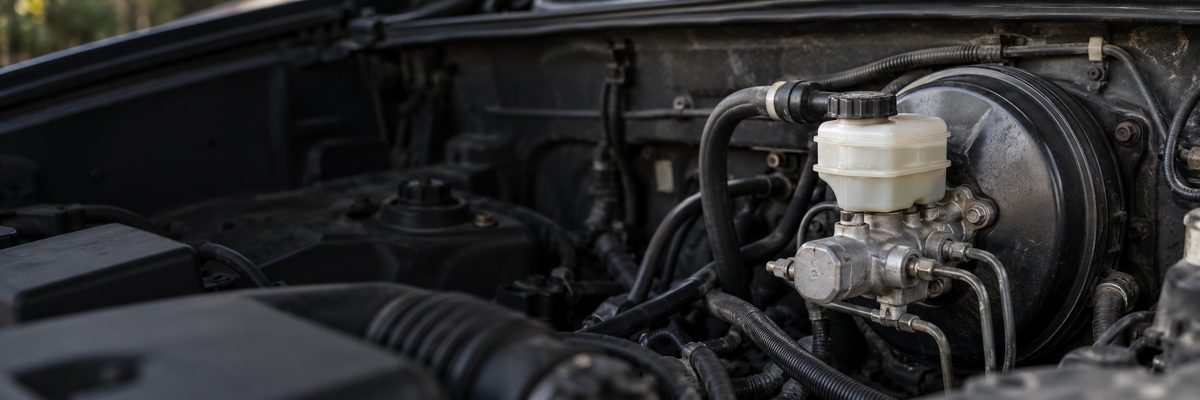
The main sign of a bad brake booster is a hard brake pedal that needs far more force to stop the car. The booster uses suction from the engine, called vacuum, to push the pedal with you, and when it loses that vacuum your leg does all the work.
Each sign below says what you'll notice, why it happens and what to check. Here are the six signs of a bad brake booster to watch for:
1. A hard brake pedal
You'll press harder than usual to slow down, and the car can feel like it doesn't want to stop. That's the assist missing, and it can fade slowly or go all at once.
We'd ask for the vacuum supply to be checked first, meaning the hose, the check valve and, on engines that have one, the vacuum pump. Those can harden the pedal just like a bad booster.

A hard brake pedal
2. A pedal that goes hard after a few presses
You'll notice the first stop feels normal, then the pedal stiffens if you brake again soon, or it's hard first thing in the morning. The booster stores a little vacuum for a few stops, and a leaking hose or check valve, the one-way valve that holds that vacuum in, lets it escape.
A check valve or hose is one of the cheaper fixes in this list. Ask the shop to test the hose and the check valve before anyone quotes a new booster.
3. A hiss when you press the pedal
You'll hear a hiss or a whistle from under the dash or the hood each time you brake. Air is being drawn in through a torn diaphragm, the rubber wall inside the booster, a cracked hose or a loose fitting.
A small tear can start with just the hiss and an odd pedal feel, then the pedal gets heavier as the tear grows. So book a check as soon as a new hiss comes with every press, while the brakes still feel close to normal.
4. An idle that dips or stalls when you brake
You'll see the revs drop, or feel the engine stumble or even stall, as you press the pedal. A big leak in the booster lets extra air into the engine, which upsets the fuel mix at idle.
It can also turn on the check engine light, so mention any stored code to the shop. Our guide to a vacuum leak shows how shops track one down.
5. Longer stops
You'll notice the car needs more room to stop, even when you push hard. With less help on the pedal, the brakes squeeze less for the same push, so the car stops later.
Longer stops are the sign that matters most for safety. The section on driving below says when to stop and call a tow.
6. A warning light or message
You'll see a red brake light, an ABS or stability light, or a message about brake assist, depending on the car. Some cars watch the booster's vacuum with a sensor, and on some Chrysler-built cars the ABS pump runs to help, so the pedal may pulse at each stop.
The light alone doesn't say which part failed, so have the codes read. Our guides to the brake warning light and the Service Brake Assist message explain those warnings.
Can you drive with a bad brake booster?
Not once the pedal turns hard or sinks, and then have it towed. The brakes still work without it, because your foot still pushes the master cylinder that sends fluid to the brakes, but stopping takes far more force.
If the engine stalls while you drive, press the brake with steady, firm pressure, don't pump it, and expect the steering to turn heavy. The little assist that's left gets used up with each press, and then the pedal turns hard.
If the pedal is very hard, the car is slow to stop, or the pedal sinks to the floor, don't drive on: have it towed. A sudden change is more urgent than a slow one, because it can get worse between one stop and the next.
If you have to move the car a few yards to somewhere safe, go slowly and brake early. We don't suggest driving it to the shop, because you can't tell from the seat which part failed.
How do you test a brake booster at home?
These tests work only on boosters that run on vacuum, not on an electric booster or hydro-boost. Park outside with the parking brake on, in Park on an automatic or in neutral on a manual with the clutch pressed to start, and to test a brake booster, work through the 3 steps below, in order:
- Empty the reserve. With the engine off, press the pedal several times until it stays firm. That uses up the vacuum the booster stores, so a firm pedal here is normal.
- Start the engine with your foot on the pedal. Keep light pressure on it as the engine starts. A working booster pulls the pedal down a little as the vacuum returns, and a pedal that stays hard points to the booster or its vacuum supply.
- Check that it holds. Let the engine idle for a minute, switch it off, wait a few minutes, then press the pedal. The first couple of presses should still feel assisted, and a hard first press is a reason to have the booster and its check valve checked.
While the engine idles, press the pedal again and listen near it and under the hood, and watch the revs. A hiss or a dip in the idle points to a leak.
Don't loosen any hose or touch the brake lines for these tests. They're a quick check from the driver's seat, not a full diagnosis.
A pedal that drops at start-up shows the booster gets some vacuum, but not that every part is healthy. A hard pedal doesn't prove the booster is bad either, so a good shop measures the vacuum supply before it replaces anything.
What to say to the shop
When a shop says you need a new brake booster, ask:
- Did you check the hose and the check valve?
- Did you measure the vacuum, and test the vacuum pump if my car has one?
- Is there brake fluid in the booster or its hose?
“Before you replace the booster, can you check the hose and check valve, measure the vacuum, and look for brake fluid inside it?”
Is it the brake booster or something else?
Often it's something else, because a bad hose, valve or vacuum pump feels exactly like a bad booster, so rule those out first. These are the parts that feel like a bad brake booster:
- A cracked, loose or disconnected hose, or a bad check valve. The small parts that carry vacuum to the booster. A split or loose hose lets the assist fade, and a pedal that went hard right after engine work points here first.
- A weak vacuum pump. Diesels and some turbo and smaller newer engines don't make enough vacuum on their own, so a pump does it. When the pump wears, the pedal goes hard even with a good booster. On 2014–2018 GM pickups and 2015–2018 GM full-size SUVs, a GM special coverage replaces a pump that loses vacuum, with its belt, for 10 years or 150,000 miles from when the truck was first put in service, so check the VIN, since older trucks may have run out.
- Hydro-boost. Some trucks use pressure from the power steering pump instead of vacuum, so a power steering fault can harden the pedal too.
- An electric booster. Hybrids, EVs and some newer trucks use one, and a fault tends to show as a warning and a sudden loss of assist. A scan finds it, not a vacuum test.

A cracked vacuum hose
A pedal that sinks toward the floor, or keeps sinking while you hold it, usually isn't the booster. It points to the brake fluid side, such as air in the fluid, a leak or a worn master cylinder, and it's a reason to stop driving now.
One clue links the two: brake fluid inside the booster or its vacuum hose means the master cylinder is leaking into it. That fluid can ruin the booster's diaphragm, so the shop should check both parts, and our brake fluid leak guide covers the leak itself.
What makes a brake booster fail?
A brake booster tends to fail at its rubber diaphragm, which tears with age or when something gets inside that shouldn't. These are the usual reasons a brake booster fails:
- A torn diaphragm. Age and wear can tear it, and a hiss can be the first sign.
- Water and rust. Water that gets into some boosters can corrode them, or freeze in winter and limit braking.
- Brake fluid from the master cylinder. A leak at the back of the master cylinder lets fluid seep into the booster.
Several of these are recall repairs, listed in the documents section below, so check your VIN before you pay with our free VIN checker or NHTSA's recall lookup. A recall covers only the cars whose VIN is on it.
Worth knowing
A new booster fitted without fixing what soaked the old one can fail the same way. Brake fluid inside the old booster means the master cylinder leaked into it, so ask whether the quote covers both.
What the repair costs depends on what failed: a hose or check valve is a small job, while a new booster means unbolting the master cylinder too. A clunk on the first press is a different booster fault, and our guide to a knocking noise when braking covers it.

Use this image
Free to republish under CC BY 4.0: credit Oil & Miles and link to this page. The snippet does both.
<a href="https://oilandmiles.com/articles/bad-brake-booster-symptoms"><img src="https://oilandmiles.com/assets/img/diagrams/bad-brake-booster-symptoms-checklist.jpg" alt="Bad brake booster symptoms checklist: empty the reserve, start the engine with your foot on the pedal, check that it holds, listen for a hiss. Tow it with a very hard pedal, a pedal that sinks, a car slow to stop or brake fluid in the booster. Check your VIN for vacuum pump and booster recalls. Ask the shop to check the hose and check valve, measure the vacuum, look for fluid in the booster and read the codes." width="1200" height="1516"></a> <p>Infographic: <a href="https://oilandmiles.com/articles/bad-brake-booster-symptoms">Oil & Miles</a>, CC BY 4.0</p>From the carmakers
What do carmakers say about bad brake boosters and free fixes?
These documents say which part of the booster or its vacuum supply fails, how it feels from the driver's seat and what the dealer does about it. Most of them are recalls that fix the booster or its vacuum supply at no charge.
A recall repair is done free at a dealer, but only on cars whose VIN is on that recall. Run your 17-digit VIN on NHTSA's recall lookup before you pay. It shows only open safety recalls, not repaired ones or a carmaker's coverage programs, so if nothing shows, ask a dealer to check your car's recall and service program history.
The cards cover the recalls and the two programs we read for this page, free fixes first. Each card says who pays for the fix:
Recall 23V-410
The brake booster diaphragm may become misaligned and cause an internal vacuum leak, which can result in a loss of power brake assist.
Recall 21V-890
The vane cap inside the vacuum pump may break, causing the pump to fail, which could result in a sudden loss of braking assist.
Recall 19V-645
As the vacuum level drops, the brake assist decreases, increasing braking effort, extending the distance required to stop the vehicle…
Recall 20V-603
The output of the mechanical vacuum pump can decrease over time, decreasing the amount of vacuum/power brake assist.
Recall 13V-360
In the affected vehicles, the pump may not activate, resulting in an intermittent reduction or loss of brake assist.
Recall 14V-154
The water inside could freeze and limit the braking ability of the vehicle, increasing the risk of a crash.
Recall 15V-800
In affected vehicles, engine oil from the vacuum pump may seep into the brake booster, damaging a component within the brake booster.
Recall 22V-315
Moisture may accumulate and cause corrosion in the brake booster housing unit, which can result in reduced brake performance or brake failure.
Recall 25V-236
A brake fluid leak can cause reduced brake function and extend the distance required to stop, increasing the risk of a crash.
Recall 25V-823
An unexpected loss of power brake assist while driving can extend stopping distance and increase the risk of a crash.
Recall 25V-488
The Electronic Brake Booster (EBB) module may malfunction while driving or when the driver is utilizing an Advanced Driver Assistance System (ADAS) feature, resulting in a loss of power brake assist.
Special coverage N182202780
…engine mounted mechanical vacuum pump output may decrease over time decreasing the amount of vacuum/power brake assist.
Customer satisfaction program 13N02
The driver may hear a hissing noise while depressing the pedal and may also experience a "spongy" pedal feel…
Conclusion
What to do next about a bad brake booster
If the pedal is very hard or sinks, stop somewhere safe and have the car towed rather than driving to a shop. If a test points to the booster, have the hose, check valve and any vacuum pump checked first, then run your VIN for a recall.
Oil & Miles checks each step here against the carmakers' manuals, recalls and service documents and NHTSA's records.
Common questions
Asked most often
What are the signs of a bad brake booster?
A hard brake pedal that needs far more force, longer stops, a hiss when you brake, and an idle that dips or stalls as you press the pedal. A pedal that goes hard after a few presses points to the check valve or hose.
Will a bad brake booster cause a soft pedal?
Not as a rule: a bad brake booster tends to make the pedal harder, though a small tear can feel a little spongy at first. A pedal that sinks toward the floor points to air in the fluid, a leak or a worn master cylinder, which is a reason to stop driving.
What does a bad brake booster sound like?
A hiss or a whistle from under the dash or the hood when you press the pedal. It's air leaking in through a torn diaphragm, a cracked hose or a loose fitting.
Can a bad brake booster cause a rough idle?
Yes. A big leak in the booster lets extra air into the engine, so the idle can dip, stumble or stall as you press the pedal.
How much does it cost to fix a brake booster?
It depends on what failed: a hose or check valve is a small repair, while a new booster means unbolting the master cylinder too. A recall may cover it.
What people ask next
Sources
- Owner's manuals: GM (2012 Cruze, 2010 Malibu, 2014 Silverado), Chrysler and Jeep (2014 Grand Cherokee and others), Honda (2018 Accord) and Toyota (2010 Prius), for what happens when the assist is lost and the warning light. Read October 21, 2026
- NHTSA recalls 23V410000, 21V890000, 19V645000, 20V603000, 14V154000, 15V800000, 22V315000, 13V360000 and 25V488000, and the Ford F-150 master cylinder recalls, for the booster, vacuum pump and electric booster faults. NHTSA recall records, read October 21 and 23, 2026
- Ford customer satisfaction program 13N02, supplement 3, February 2024, for the torn diaphragm, the hiss and the coverage. NHTSA archive, read October 21, 2026
- GM special coverage N182202780, for the vacuum pump on GM trucks and SUVs, and Ford recall 25V-823, for the electronic brake booster. NHTSA, read October 28, 2026
- Independent shops in the Midwest: Rick's Auto Service (Mishawaka, Indiana), Sparks Tire & Auto (St. Charles, Missouri) and Stadium Auto Service (Ann Arbor, Michigan), on the hard pedal, the hiss and the stall. Read October 21, 2026
- Independent shops on the East Coast: Gower's Brake & Alignment (Raleigh, North Carolina) and Yates Automotive (Alexandria, Virginia), on the vacuum supply, the check valve, the vacuum pump and when to tow. Read October 21, 2026
- Parts and trade guides: AutoZone, CarParts.com, Innova and Brake & Front End, on how the booster works, the home tests and fluid in the booster. Read October 21, 2026
How this was compiled
The symptoms, the safety advice and the free repairs come from carmakers' owner's manuals, recall reports and service documents. Independent shops' articles are used only where two or more agreed, for how a shop tells the booster from its vacuum supply.
What we didn't do
We didn't test a car or measure a booster's vacuum ourselves. We found no carmaker figure for a normal vacuum reading that fits every engine, so we give none.
This article is general information, not advice about your specific vehicle. See the disclaimer.