
Short answer
Passive: ohms and AC volts. Active: power, then signal
Unplug a passive sensor and measure its resistance, then watch a small AC (alternating current) voltage rise as you turn the wheel. An active sensor can't be judged by ohms, so check for voltage at its harness plug, where the car's wiring connects, with the key on, then for a switching signal on a scan tool or scope.
Knowing how to test a wheel speed sensor can save you from buying a sensor the car didn't need when the ABS light comes on. The sensor sits behind each wheel and tells the anti-lock brakes (ABS) computer how fast that wheel turns.
The catch is that two different kinds of sensor hide behind the same two-wire plug. A multimeter test that proves one kind good or bad tells you nothing about the other, and you can't tell them apart by looking.
So the order matters: find out which kind your car has, then run the test that fits it, and only then look at the part. Below is each test, what the readings mean, and what to check when the sensor turns out fine.
Where are you starting from?
Got a scan tool that reads ABS? Start with the wheel speeds.
What tools do you need?
Two tools cover almost every test here, and a third only helps. Safety comes first: resistance is measured with the ignition off, and any test that turns a wheel needs the car on stands:
- A digital multimeterEnough for a passive sensor, and for checking power at an active sensor's plug.
- A scan tool that reads the ABS systemShows the codes and the four live wheel speeds. A basic reader for the check engine light may not see ABS faults, so check what yours reads.
- Jack standsFor any test that spins a wheel, the car goes up on stands with the wheel off the ground, never on a jack alone.
- A lab scope, if you have oneThe kind of meter that draws the signal as a line. It shows an active sensor best, but a scan tool gets you most of the way.
Is your wheel speed sensor passive or active?
A passive sensor is a magnet wrapped in a coil of wire. It makes its own small AC voltage as the teeth of a steel ring pass by.
An active sensor is powered by the ABS computer and switches its signal as a ring goes by. That ring is toothed, or magnetic and hidden in the wheel bearing's seal.
Counting wires won't settle it: a trade magazine for tire and brake shops says both kinds have two wires, sit in the same place, and set trouble codes that don't say which one you have. Hella, a sensor maker, adds that the type can't always be told from appearance.
Two checks point to the type:
- The service information for your carIt may name the sensor type, though the trade magazine notes that it often doesn't.
- Voltage at the harness plug, key onClose to battery voltage points to an active sensor; the brake trade magazine measured about 10.6 volts on one. Some passive systems carry a small bias voltage too, so a low reading isn't proof on its own.

Use this image
Free to republish under CC BY 4.0: credit Oil & Miles and link to this page. The snippet does both.
<a href="https://oilandmiles.com/articles/how-to-test-a-wheel-speed-sensor"><img src="https://oilandmiles.com/assets/img/diagrams/wheel-speed-sensor-test.svg" alt="A multimeter's two probes on an unplugged wheel speed sensor connector, shown twice: a passive sensor over a toothed steel ring, tested at the sensor with ohms and AC volts, and an active sensor over a magnetic encoder ring, tested at the harness side with the key on." width="1000" height="750"></a> <p>Diagram: <a href="https://oilandmiles.com/articles/how-to-test-a-wheel-speed-sensor">Oil & Miles</a>, CC BY 4.0</p>How do you test a passive wheel speed sensor with a multimeter?
Measure its resistance unplugged, then its AC voltage while the wheel turns. Both readings have to pass, because a sensor can show the right ohms and still send too weak a signal.
1. Measure the resistance
With the ignition off, unplug the sensor and set the meter to ohms. Put the probes on the sensor's two terminals, not the harness side, so you're measuring the sensor and not the ABS computer behind it.
Compare the reading with your carmaker's figure, and then with the same sensor on the other side of the car. Published ranges differ between makers, so the opposite wheel is the fairest yardstick when you don't have the exact number.
Here's what three sources give as a normal reading:
Resistance figures from three sources
- Standard Motor Products, a parts makerTypically between 1,000 and 2,500 ohms for a passive sensor, with the exact figure in the carmaker's procedure.
- A trade magazine for brake shopsBetween 1,000 and 2,500 ohms as the normal range for passive sensors.
- Bendix, for one heavy-truck sensor1,575 to 2,100 ohms at 68°F. The same part drifts from about 1,100 ohms at −40°F to 3,400 ohms at 428°F, so Bendix says not to test at extreme temperatures.
2. Spin the wheel and read AC volts
Set the meter to AC volts, keep the probes on the sensor's terminals, and turn the wheel by hand. The reading should rise as you turn faster, since the sensor makes more voltage the quicker the teeth pass.
The same trade magazine expects about half a volt to one volt from a wheel spun by hand. Bendix sets its heavy-truck minimum at 0.25 volts with the wheel turning at least half a revolution per second, so a steady turn matters more than a hard spin.
3. Wiggle the wire while you watch
With the meter still connected, flex the sensor's cable along its run and at the plug. A reading that jumps or drops out points at a broken wire inside the insulation, not at the sensor.
GM warned its technicians about exactly that on some of its cars: an ohm check of the sensor's harness may not find a wire that's broken inside intact-looking insulation. The light came on most easily while turning, which is when the wire flexes.
How do you test an active wheel speed sensor?
Check that the ABS computer is sending it power, then check that it sends back a signal that switches as the wheel turns. Don't use the ohms setting: Hella says an active sensor's internal resistance can't be measured.
The brake trade magazine explains why a meter gets it wrong. One active design measured at its wire ends reads around 5 to 6 megaohms, a number that says nothing about whether it works.
1. Check for power at the harness
Unplug the sensor, turn the ignition on without starting the engine, and measure DC (direct current) volts on the harness side between the power terminal and a good ground. Mitsubishi's procedure for one of its models expects system voltage there, and the brake trade magazine found about 10.6 volts on the car it tested.
No voltage means the fault is upstream, in the wire or the ABS computer, and a new sensor won't fix it. Use the meter, not a test light, which the trade magazine says won't show that voltage because the circuit treats the lamp as the sensor.
2. Check the signal as the wheel turns
An active sensor signals by switching a small current between two levels. That's easiest to see on a scope or as a live wheel speed on a scan tool, which is why both are the tools for this step.
The two carmaker procedures we read put numbers on that current:
Active sensor signal figures, one carmaker each
- GM, bulletin 17-NA-047Sensors reading a magnetic ring switch between 7 milliamps (low) and 14 milliamps (high) of DC current.
- Mitsubishi, TSB-23-35-001For the Eclipse Cross, 5 to 9 milliamps or 11 to 17 milliamps, measured through a special test harness, with system voltage at the power terminal.
Those figures belong to those carmakers' cars, so treat them as examples of what a good signal looks like, not as a spec for yours. Measuring milliamps also means putting the meter in the circuit, which goes beyond a driveway test.
How do you test a wheel speed sensor with a scan tool?
Read the ABS codes first, because they narrow the fault to the wheel speed sensor circuits. On GM's cars, for example, one bulletin lists codes C0035 to C0050 for those faults.
Then watch the four live wheel speeds while someone drives, or while you turn the raised wheels. The wheel whose number lags, jumps or drops to zero is your suspect, and the other three give you a working comparison for free.
Don't worry if a stopped car shows 3 to 5 mph on one wheel. The brake trade magazine calls that normal, and it's the steady trace at speed that counts.
After a repair, some systems need the car driven before the fix is confirmed. Mitsubishi's procedure, for one, has the car driven at 12 mph or faster to confirm the fix.
What do the readings mean?
One reading doesn't settle it on its own, because the same result means different things on a passive and an active sensor. Read each one against the type you found first.
Each reading points at a next step, and a few point away from the sensor altogether:
| What you see | What it means | Next step |
|---|---|---|
| Passive: ohms match the carmaker or the opposite wheel | The coil is intact | Check AC volts while spinning |
| Passive: no reading at all (open) | The coil or its wire is broken | Wiggle test, then replace the sensor |
| Passive: ohms fine, no AC volts when spun | No signal reaches the terminals | Check the ring and the gap |
| Active: no voltage at the harness, key on | No power is reaching the sensor | Trace the wire back to the ABS computer |
| Active: power fine, wheel speed missing on the scan tool | The sensor or its ring isn't signaling | Inspect the ring, then the sensor |
| Everything passes, light stays on | An intermittent wire or ring fault | Watch live data on a drive |
What if the sensor tests fine but the ABS light stays on?
Then look at the ring the sensor reads and the wire it reports through. A good sensor sends a bad signal when either one is at fault.
We'd check these three, in this order:
- The wire and the plugA break inside the insulation, a corroded pin or a chafed section can drop the signal. On systems that feed the sensor a small steady voltage (a bias voltage), the trade magazine says the fault is often in the harness and connectors, not the sensor.
- The ringGM's bulletin traces its magnetic-ring faults to debris stuck on the ring. Stellantis tells its technicians not to use magnets, metal brushes or screwdrivers on that ring when cleaning it.
- The bearingA worn wheel bearing lets the ring wobble, so the gap to the sensor keeps changing. Our bad wheel bearing guide covers the noise and play that go with it.
If the wire, the ring and the bearing all check out and the light keeps coming back, the fault is probably intermittent. Watch the live wheel speeds on a drive, because a dropout shows up on the scan tool the moment it happens.
Can you test a wheel speed sensor by swapping it or with a magnet?
Both are shortcuts that can cost you a second part. Volkswagen told its dealers to stop swapping sensors from side to side during diagnosis, because the swapping ground down the magnetic ring on the bearing.
A magnet held to the sensor sounds like a neat trick, but Stellantis tells its technicians not to use magnets on the magnetic rings some active sensors read. The multimeter, the scan tool and the scope give you an answer without risking the ring.
Use this image
Free to republish under CC BY 4.0: credit Oil & Miles and link to this page. The snippet does both.
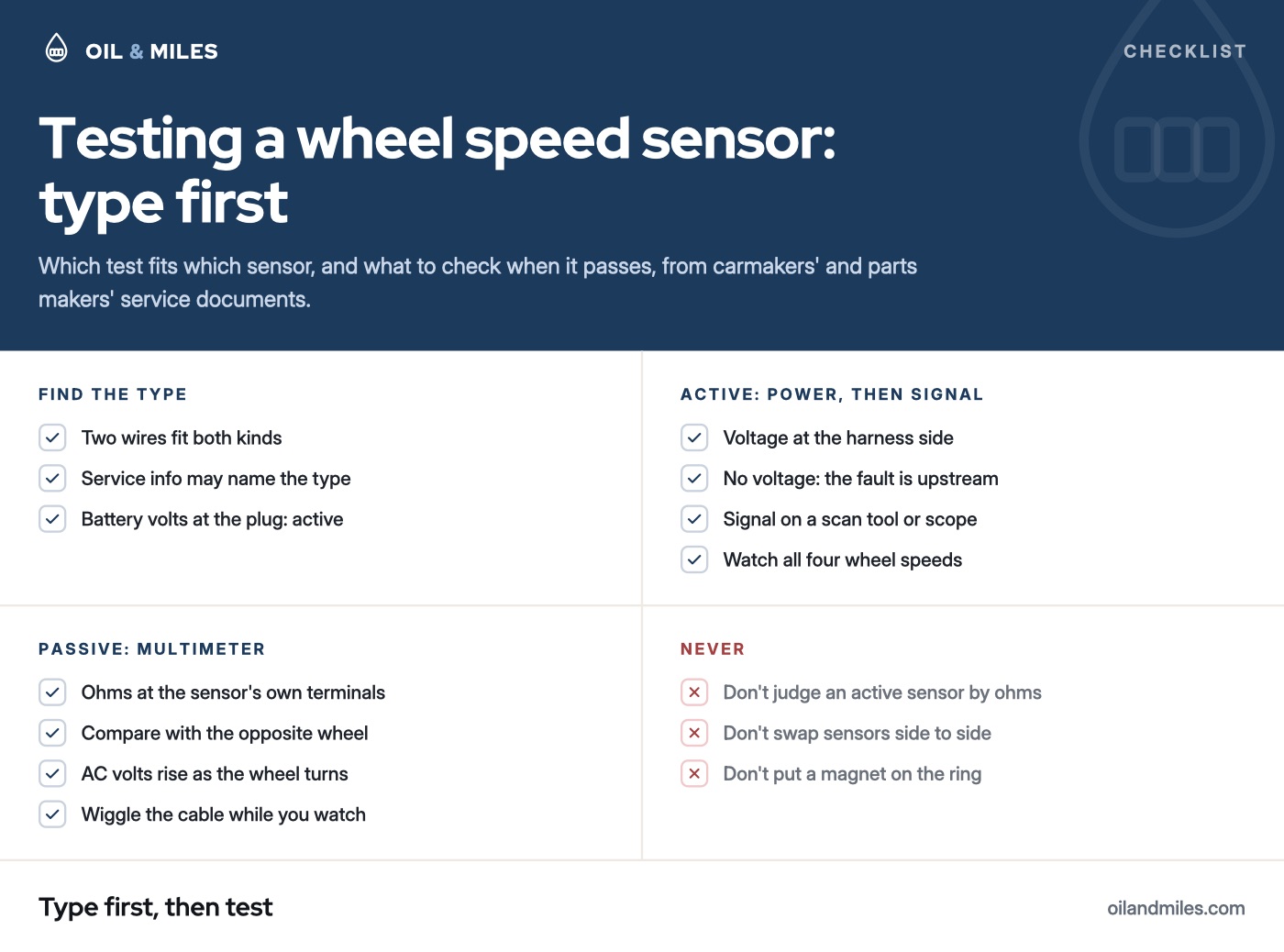
<a href="https://oilandmiles.com/articles/how-to-test-a-wheel-speed-sensor"><img src="https://oilandmiles.com/assets/img/diagrams/how-to-test-a-wheel-speed-sensor-checklist.jpg" alt="Wheel speed sensor test checklist: two wires fit both kinds, the service information may name the type, and close to battery voltage at the plug with the key on points to active; for a passive sensor measure ohms at its own terminals, compare with the opposite wheel, watch AC volts rise as the wheel turns and wiggle the cable; for an active sensor check voltage at the harness side, then the signal on a scan tool or scope, and watch the four wheel speeds; don't judge an active sensor by ohms, don't swap sensors side to side and don't put a magnet on the ring." width="1200" height="890"></a> <p>Infographic: <a href="https://oilandmiles.com/articles/how-to-test-a-wheel-speed-sensor">Oil & Miles</a>, CC BY 4.0</p>From the documents
What GM, Mitsubishi and Volkswagen tell technicians
Three carmaker documents cover the test from three sides: a good signal, the order to test in, and what not to do.
Each was written for its maker's own cars, so the numbers are examples. The method carries over to any car.
GM Bulletin 17-NA-047
values switch between 7mA (Low) and 14mA (High) DC current.General Motors, February 2017
Mitsubishi TSB-23-35-001
Disconnect the wheel speed sensor connector, and measure at the wiring harness side.Mitsubishi Motors, January 2023
Volkswagen Tech Tip TT 44-14-02
Discontinue the practice of swapping sensors from side to side during workshop diagnosis.Volkswagen of America, July 2014
We read all three as one message: match the test to the sensor type, and prove the fault before you swap a part.
Conclusion
Know the type before you buy the part
A sensor bought after the wrong test is money spent twice. Here's what to take from this page about how to test a wheel speed sensor:
- Find the type first.Both kinds use two wires. Check the service information, or look for close to battery voltage at the harness with the key on.
- Passive means ohms, then AC volts.Compare the ohms with the carmaker's figure or the opposite wheel. The AC reading should climb as the wheel turns faster.
- Active means power, then signal.An ohm reading can't judge it. Look for voltage at the harness, then a switching signal on a scan tool or scope.
- A scan tool names the wheel.The ABS code and the live wheel speeds point at the suspect. The three good wheels are your comparison.
- A good sensor can still read badly.Check the wire, the ring and the bearing before buying a second part. Don't swap sensors side to side or put a magnet on the ring.
So spend five minutes on the type before you spend money on the part. Oil & Miles reads the carmakers' service documents before it tells you what to test.
Common questions
Asked most often
How many ohms should a wheel speed sensor read?
A passive sensor typically reads somewhere between 1,000 and 2,500 ohms, but the carmaker's figure for your car is the one to use, and the opposite wheel is a good check. An active sensor has no meaningful ohm reading, so don't test it that way.
Can you test an ABS sensor with a multimeter?
Yes for a passive sensor, by measuring ohms unplugged and AC volts while the wheel turns. For an active sensor a multimeter can only confirm power at the harness plug; the signal itself needs a scan tool or a scope.
How do you test a wheel speed sensor without a scanner?
On a passive sensor, a multimeter does the whole job: ohms, then AC volts while you turn the wheel. On an active sensor you can check for voltage at the harness with the key on, but proving the signal usually takes a scan tool or a scope.
Can a parts store test an ABS sensor?
The free testing one large parts chain lists covers batteries, alternators and starters, not wheel speed sensors. Its code reader does read the ABS light, which tells you which wheel to test, and the tests on this page do the rest.
Can a bad wheel bearing make a sensor fail its test?
It can make a good sensor read badly, because a worn bearing lets the ring wobble and the gap change. If the sensor passes on the bench but the signal drops on the car, check the bearing.
What people ask next

Sources
- GM bulletin 17-NA-047, February 2017, for the 7 and 14 milliamp signal, the sensor codes and debris on the magnetic ring. NHTSA bulletin archive, read October 1, 2026
- GM bulletin PIC5992, for the broken wire an ohm check can miss. NHTSA bulletin archive, read September 29, 2026
- Mitsubishi TSB-23-35-001, January 2023, for the active-sensor test order, system voltage at the harness, the signal current and the 12 mph drive. NHTSA bulletin archive, read October 1, 2026
- Stellantis bulletin S2523000091, December 2025, for not using magnets, metal brushes or screwdrivers on the encoder ring. NHTSA bulletin archive, read October 1, 2026
- Volkswagen tech tip TT 44-14-02, July 2014, for swapping sensors side to side. NHTSA bulletin archive, read September 29, 2026
- Bendix Service Data SD-13-4860, for the resistance range, its change with temperature and the AC volts test. Bendix, via NHTSA, read October 1, 2026
- Check and change ABS and wheel speed sensors, for telling the types apart and why an active sensor can't be measured in ohms. Hella Tech World, read September 28, 2026
- A Closer Look: ABS Sensors, March 6, 2023 (sponsored), for the passive resistance range. Standard Motor Products, read September 29, 2026
- Wheel Speed Sensor Diagnostics for Meters and Scopes, April 2013, for the two-wire problem, the passive ohms and AC volts, the standstill reading and bias voltage. Tire Review, read October 1, 2026
- Testing Active Wheel Speed Sensors, February 2018, for the megaohm reading and the test light. Brake & Front End, read October 1, 2026
- Free Auto Parts Testing Services, for what a parts chain's free testing covers. AutoZone, read October 1, 2026
How this was compiled
The test steps and figures come from carmakers' and parts makers' service documents, read at source, and two trade magazines written for repair shops.
Where the sources give different numbers, as they do for passive resistance, we show each one with its source rather than pick one.
What we didn't do
We haven't tested the sensors on your car, and we didn't find a carmaker resistance figure that covers passive sensors across makes.
We found no document that confirms a magnet test or a parts-store sensor test, so neither is recommended here.
This article is general information, not advice about your specific vehicle. See the disclaimer.