
Key takeaways
- Safety: If the pedal goes soft or sinks, the wheel wobbles, or the knock started right after brake or wheel work, stop and have the car towed.
- A knock you also hear when accelerating points to the suspension or a hub rather than the brakes.
- Ask for the caliper and bracket bolts to be checked for torque with the wheel off.
- Run the VIN before paying, because carmakers have recalled cars for loose caliper and hub bolts.
When you brake, the car's weight pitches forward onto the brakes. Any part with slack in it moves under that load, and that movement is what makes a knocking noise when braking.
Is it safe to drive with a knocking noise when braking?
If the knock started right after brake or wheel work, stop and have the car towed back, since a caliper or wheel left loose can come off. Subaru's recall letter for loose caliper bolts tells owners who hear a clunk from the front wheel when braking to pull over and not drive the car.
Otherwise, if the car still brakes normally, drive it gently and straight to a shop, because one of the causes is a brake part coming loose. Carmakers have recalled cars whose caliper or hub bolts, which hold the brakes and wheels on, weren't tight enough.
We'd stop driving and have it checked if the knock comes with a pull, a soft pedal or a wobble, or with grinding, which means metal is touching metal. Three of those signs say more about what's wrong:
- A soft pedal. Fluid may be escaping through a brake fluid leak, which can also light the red brake warning light. One recall found that loose caliper bolts can damage a brake hose, which can leak.
- The car pulls to one side. One wheel is braking differently from the other. Pull over and have it towed.
- A wobble, or a knock that gets louder. A wheel, hub or suspension part may be moving, and after a tire job the lug nuts can work loose. Our steering wheel shake guide covers the shake on its own.
Listen for unusual sounds when you stop, and watch for pulling, extra pedal travel or a hard pedal. Noting what you heard and felt, and when, helps the shop find the part faster.
Clunking after a brake job or tire change
Don't drive on a clunking or knocking noise that starts right after a brake or tire job. Have the car towed back, and have the shop check the bolts and hardware before blaming the new pads.
New brakes can clunk or thump when something from the old job wasn't renewed or tightened. Ask the shop three things:
- Were the clips and hardware replaced? Weak clips let the pads move in their bracket. A decent pad set includes new shims, thin plates that quiet the pads, and often the clips, as our pad and rotor cost guide notes.
- Were the caliper bolts torqued, or replaced where they're one-time-use? Each car has its own torque setting.
- Were the lug nuts retightened? Ford manuals say to retighten them within 100 miles after any wheel removal, such as a tire rotation, and Nissan's say 600 miles.
Is a single clunk when braking normal?
One clunk on your first move after starting the car can be normal. The ABS, the system that stops the wheels locking, tests its pump and valves as you first move off, so you may hear a clunk or feel the pedal move.
It can sound like a short clunk, bang or buzz from the front, sometimes with a motor or clicking noise and a brief pulse in the pedal, as you first pull away at low speed, forward or in reverse. Several carmakers tell dealers this first-move clunk is normal and not to repair it.
The self-test runs once per drive, so a clunk on every stop isn't the self-test and needs a look. In a hard stop the ABS itself can make noise as it works, and that's normal too.
A thin, high-pitched squeal is a different signal: on many pads it's a built-in wear warning, so it points at worn pads rather than something loose. A few carmakers rule other noises harmless too, so ask before paying to fix one.
What causes a knocking noise when braking?
The usual causes are a loose caliper bolt, the one to rule out first, and pads moving in their bracket. Worn suspension bushings or struts, rust on the rotors, the brake booster, the steering shaft, an electric parking brake and a hybrid's brake software make up the rest.
A knocking sound when braking comes from something with slack in it, pushed by the braking load. When the knock comes and where you feel it point to one of eight causes, each with the question to ask the shop.

Use this image
Free to republish under CC BY 4.0: credit Oil & Miles and link to this page. The snippet does both.
<a href="https://oilandmiles.com/articles/knocking-noise-when-braking"><img src="https://oilandmiles.com/assets/img/diagrams/knocking-noise-when-braking-where.svg" alt="Where a knocking noise when braking comes from: a front wheel corner with the pads and their clips, the caliper bolts, the suspension bushings and ball joint, and the rotor surface, plus a separate brake pedal and booster; braking pushes the car's weight forward so any part with slack knocks" width="1200" height="694"></a> <p>Diagram: <a href="https://oilandmiles.com/articles/knocking-noise-when-braking">Oil & Miles</a>, CC BY 4.0</p>1. A loose caliper or bracket bolt
A loose or missing caliper or bracket bolt gives a grind, a thump, a click or a clunk from one wheel, often soon after a brake job. It's the most serious cause here, because a loose caliper can shift or come away, and loose hub bolts in the same recalls put a wheel at risk.
Some carmakers make these bolts for one use only, so a reused bolt can be the problem. Don't just tighten them yourself, because each car has its own setting.
So ask for the bolts to be checked with the wheel off before anything else. After any brake job, ask whether they were tightened to the maker's setting, called torque, and replaced where the maker says they're one-time-use.

Caliper bolts checked for torque
2. The pads moving in their bracket
Brake pads shifting in their bracket give a knock or click from a wheel at low speed, on rough roads or on the first press after moving off. Thin spring clips hold the pads, and when the clips weaken or the grease dries out, a pad can move and hit the bracket.
The caliper, the part that squeezes the pads, slides on two pins that can knock the same way. Worn or missing clips and dry slide pins are what a shop looks for first when it chases a brake knock.
Ask for new clips and grease, and the slide pins checked, whenever the pads are changed. Brake heat can take the spring out of old clips, so all of them should be replaced, not just the broken ones.
One clunk per stop, or one only on the first stop after reversing, points to the pads shifting once under the load. A Nissan bulletin traces a single front clunk to the pads moving with the rotor, and Honda's guide ties a noise that a light touch of the brakes stops to loose hardware.
3. Worn suspension bushings or ball joints
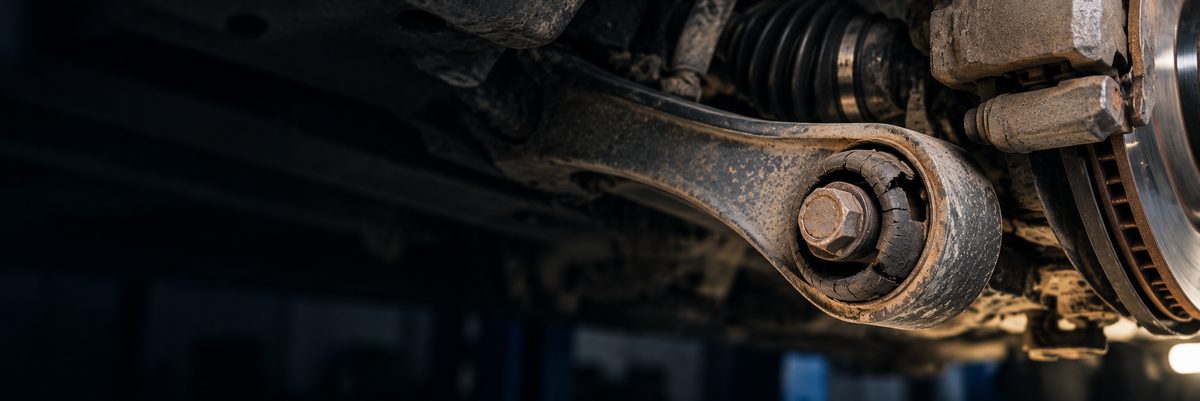
Worn suspension bushings or ball joints give a thud you feel through the car as well as hear, over bumps and when you accelerate too. Bushings are the rubber mounts the suspension arms pivot on, and ball joints are the joints the wheel steers on.
As you brake, the car's weight pushes the wheel back, and worn rubber or a loose joint lets it move. So a knock that also comes when you accelerate points to the suspension or a hub rather than the brakes.
Ask for the suspension to be checked with the wheels off the ground, not just the brakes. On some cars the bushings are replaced in pairs, one on each side.
Ask for these three nearby parts to be checked too:
- Sway bar links. The thin rods that tie the anti-roll bar to the suspension. They clunk over bumps and in turns too, and on some trucks a loose link nut is the whole fault.
- Struts. The spring and shock absorber in one unit. Honda's noise guide has its technicians check them for damaged bushings, loose fasteners and leaks.
- Engine mounts. The rubber blocks that hold the engine in the car. A collapsed or torn mount gives a steady clunk, so ask for them checked if the brakes and bushings are tight.
4. Rust or deposits on the rotors
Rust or deposits on the rotors give a thumping noise when braking, or a pulse, especially after the car has sat for days. The rotors are the discs the pads grip, and rust or old pad material leaves them uneven.
A stone caught between a rotor and its thin metal shield, or a bent shield touching the rotor, can tick or clunk too. A shop spots it as soon as the wheel comes off.
If the thump stays, the rotor itself may need resurfacing or replacing, and our guide to warped brake rotors explains the three faults behind it. Ask whether resurfacing will do before paying for new rotors.
A thump that keeps coming as the wheels turn points here too. Rear drum brakes can make a noise that turns with the wheel as well, so tell the shop whether it comes from the front or the back.

Rust, deposits and a stone at the shield
5. The pedal or brake booster
A clunk the moment you first press the pedal, from under the hood or the dash rather than the wheels, points to the brake booster. The booster is the round canister that adds force to your foot, and its rod and pins can knock when they have slack.
So tell the shop the noise follows the pedal, not the wheels, even if braking feels fine. Other brake booster problems show up as a dash message instead of a noise.
6. The steering shaft or coupling
A clunk you feel in the steering wheel as you brake points to the steering shaft, the link between the wheel and the steering rack. Its two halves slide on ridges that can stick and then slip, so it can clunk on rough roads too.
Ask for the steering shaft to be checked if the knock is in your hands more than your feet. The fix is in the steering, so new pads won't stop it.
7. An electric parking brake after parking
A single clunk as you pull away after a long park, and not on every stop, points to an electric parking brake. It holds the rear pads against the rotors while the car sits, and they can stick, then break free.
If the clunk only ever comes on the first move after a long park, mention the parking brake. One carmaker's fix was stiffer rear pads.
8. A hybrid grabbing at low speed
A sudden grab near a stop under light braking, sometimes with a clunk or thud, points to a hybrid's brake software. Hybrids slow the car partly with the electric motor and partly with the regular brakes, and the software can get the mix wrong.
On some hybrids the fix is a software update, not brake parts, so ask a dealer whether one applies. On other hybrids, have the brakes checked too, since a grab can also come from the brake parts.
Why does the knocking stop when I brake?
A knock that stops when you brake most likely means the loose part is in the brake hardware, and pressing the pedal holds it still. This kind of rattle comes from play in the brake parts over bumps.
On rough roads or lane dots, road vibration shakes a caliper or pad that has room to move, and it rattles against its mount. Clamp the pads on the rotor, with the pedal or on some cars the parking brake, and the loose part is held still.
That's why the documented fix is brake parts, such as new caliper brackets and pins. So if the knock fades when you brake, say so to the shop, because it tells them to start with the brake parts.
Why is there a knocking sound when braking at low speed?
Pads shifting in their bracket and worn suspension bushings both knock or clunk at low speed, as you slow to a stop. On a hybrid it can also be the brake software, and a clunk only on your first move after starting is more likely the normal ABS self-test.
How do you find and fix the knock?
Note when the knock comes, then have a shop check the bolts, the pads and the suspension, in that order. Each cause has its moment, so note these from your normal driving, without trying to make it happen again:
- First move after starting only. The ABS self-test, normal. Or an electric parking brake letting go after a long park.
- On rough roads, or braking at low speed. Pads or a caliper moving in the bracket.
- When accelerating too. Look past the brakes to the suspension and hubs. A rear hub can clunk that way too. Our wheel bearing guide explains why a knock points away from the bearing itself.
- Felt in the steering wheel. The steering shaft or a suspension part.
- As you press or release the pedal. The booster, or on some hybrids the brake actuator that builds brake pressure.
A shop starts by trying to hear the knock for itself, braking gently and harder, over bumps and in reverse. Then it takes the wheels off, checks the bolts, pads and shields, and rocks each wheel by hand for play. If it's grinding, squealing or a shake instead, start from our symptom finder.
The fix is making the part that moves secure again. Work through these 4 steps in order:
- Rule out a loose caliper first. Ask for the caliper and bracket bolts to be checked for torque before anything else.
- Check the pads in the bracket. Weak clips and dry grease get new hardware, and the slide pins are checked and greased.
- Check the suspension if the brakes are tight. Bushings and ball joints move under braking, and the shop should check them with the wheels off the ground.
- Run the VIN. Enter the 17-character number from the windshield at NHTSA's recall lookup to see any open recall, or our free VIN checker for your model year's recalls, and ask a dealer whether a bulletin applies.
If the bolts, clips and suspension are tight, ask whether the noise is a known, normal one on your car, as the normal clunks above show. Ask for that answer in writing, so the next shop doesn't start over.
What to say to the shop
“My brakes knock when I stop. Before any parts, can you check the caliper and bracket bolts for torque, the pad clips and slide pins, and whether my VIN has a recall or bulletin?”
If the knock won't show at the shop, record it on your phone and ask to ride along on the test drive. Note the speed, the direction and the weather, because some clunks show only on the first stops while backing up in cool, damp air.
Our complaints lookup shows what owners of your model report. A recall repair is free, and a bulletin repair is free while the car is under warranty, and some carmakers pay part or all of it after that, so ask the dealer before you pay.
How much does it cost to fix a knocking noise when braking?
A recall or warranty fix costs nothing, so run the VIN first, since carmakers have recalled cars for loose caliper and hub bolts. Past that, the bill follows the part that moved, and the likeliest causes, a loose caliper bolt or worn pad clips, are small jobs.
If the pads or rotors need replacing too, a pad and rotor job on a 2025 Subaru Crosstrek 2.0 costs about $391–$488, parts and labor, at an independent shop. A strut mount or a whole strut costs more, so ask the shop to write the hours it charges on the quote.
At the counter, ask which part moved, the hours and the rate, and whether a recall or bulletin covers your VIN. For other cars, our pad and rotor cost guide and our repair estimate give a price before you approve the job.

Use this image
Free to republish under CC BY 4.0: credit Oil & Miles and link to this page. The snippet does both.
<a href="https://oilandmiles.com/articles/knocking-noise-when-braking"><img src="https://oilandmiles.com/assets/img/diagrams/knocking-noise-when-braking-checklist.jpg" alt="Knocking noise when braking checklist: note when it knocks, on a quiet road with a phone recording, and say if it shows in the steering wheel or fades as you brake; stop if the car pulls, the pedal goes soft, it grinds or the wheel wobbles; check your VIN for a loose-bolt recall and ask whether a hybrid software update applies; ask the shop for the caliper bolts torqued, new clips and grease, and the suspension and steering shaft checked; don't pay to fix the first-move ABS clunk." width="1200" height="1616"></a> <p>Infographic: <a href="https://oilandmiles.com/articles/knocking-noise-when-braking">Oil & Miles</a>, CC BY 4.0</p>From the carmakers
Is there a recall for a knocking noise when braking?
Yes, for some cars: carmakers have recalled cars whose caliper or hub bolts weren't tight enough, and a recall repair is free. Other knocks are covered by a warranty bulletin, and every quote below is in the document's own words.
Recall 24V-911
Some of the bolts that secure the front brake caliper and the wheel hub bearing may be loose…
Recall 16V-576
…hearing a rattle or clunking sound from the front wheel area, especially when the brakes are applied…
Recall 15V-012
The under-torqued fasteners may result in a brake caliper separating from the wheel assembly…
Service bulletin L-SB-0007-26
…may exhibit a knocking from one or both rear brakes due to delamination of the rear disc brake pad material from the base plate…
Service bulletin 05-006-21
Rear Caliper Adapter Bolts Are Loose Or Missing…FCA US, November 2021
Conclusion
What to do next about a knocking noise when braking
If it knocks at the wheels, have the caliper bolts checked first, then ask for new pad clips with any pad job. If it pulls, shakes or the pedal sinks, stop driving, because it's more than a noise, and do the same for a knock that starts right after brake work.
Oil & Miles checks each step here against the carmakers' manuals and bulletins and NHTSA's records.
Common questions
Asked most often
Can a clunk when stopping come from the transmission?
On some trucks, yes: a clunk when stopping or launching can come from the transmission or the rear driveshaft. On some pickups, a bump just after a stop can be fuel moving in the tank, which is normal.
What does a loose caliper sound like?
A loose caliper can grind or thump from the front brakes, or click and clunk from the rear, depending on the car. Either way, have the bolts checked before you drive far, and right after brake work don't drive on it at all.
Why does my car make a thud when I release the brake pedal?
It can be the booster or, on some hybrids, the brake actuator under the hood. On some hybrids the fix was a new actuator.
Why does my car make noise when braking but the brakes are fine?
It may be the ABS self-test on your first move, which is normal, or a noise the carmaker has ruled harmless. If it happens every stop, have it checked anyway.
What people ask next

Sources
- Service bulletins: about 35 from 16 carmakers, numbered in the text or here: GM PI0833, Mazda 04-005/18 and 04-003/18, Ford SSM 52444, Nissan NTB00-033e, Ford ASI-32260, Audi PSS 46, Lexus L-SB-0013-22 and L-SB-0032-23, GM PIC6290, 09-04-17-002E, 09-04-21-003D and PIT5161A. Carmakers via NHTSA, read September 28 and October 21, 2026
- Parts makers: Wagner on brake noise and Moog on a failing control arm, for brake hardware and the control arm clunk. Wagner and Moog, read September 28, 2026
- NHTSA recalls 15V-012, 16V-576 and 24V-911, from NHTSA's recall records, the Subaru and Toyota Part 573 reports and Subaru's owner letter. NHTSA, read September 28, 2026, the Part 573 reports October 21, 2026
- Owner's manuals: 2020 Nissan Altima page 417, 2021 Toyota Avalon page 315, 2020 Chevrolet Equinox pages 206 and 289 and 2023 Hyundai Sonata pages 344 and 500 (PDF page numbers), and 2011 Ford Edge page 300 for the lug nuts. Nissan, Toyota, GM and Hyundai, read September 28, 2026
- Honda Job Aid 04885, Noise Repair Techniques (September 2016), GM bulletin 11-00-89-005X and Nissan's June 2022 CVT warranty extension, for struts and mounts, brake hardware that clicks on a change of direction, and repairs carmakers pay outside the warranty. Carmakers via NHTSA, read October 29, 2026
- Ram service bulletin 02-001-25 (February 2025), for the front-end clunk over bumps and in turns from a loose stabilizer link nut on the 2019–2024 Ram 1500. Stellantis via NHTSA, read October 29, 2026
- Ford owner's manuals, 2010–2026, and Nissan owner's manuals, for when to retighten the lug nuts. Ford and Nissan, read October 29, 2026
- Independent shops: Auto Star Repair & Sales (Graham, Washington), Round Rock Auto Center (Round Rock, Texas) and Chloe's Auto Repair & Tire (Georgia and Texas), on pad hardware, slide pins, loose bolts, shields, debris and how a shop finds the knock. Read October 21, 2026
- NHTSA complaint records, 2010–2025 models, file dated August 25, 2026. NHTSA, read September 28, 2026
The bulletins come from NHTSA's archive of carmaker service documents.
AI illustration by Oil & Miles
This article is general information, not advice about your specific vehicle. See the disclaimer.