
Key takeaways
- Safety: If a transmission temperature warning comes on, pull over where it's safe and let the engine idle in Park or Neutral until the warning goes out. Driving on can boil the fluid over and start a fire.
- A shudder at a steady 30–50 mph points to the torque converter, and slipping across gears points to the transmission.
- The wrong or burnt fluid can cause the same shudder, so check the fluid before you blame the part.
- A code names a system and not the part, so ask the shop about a bulletin for your car.
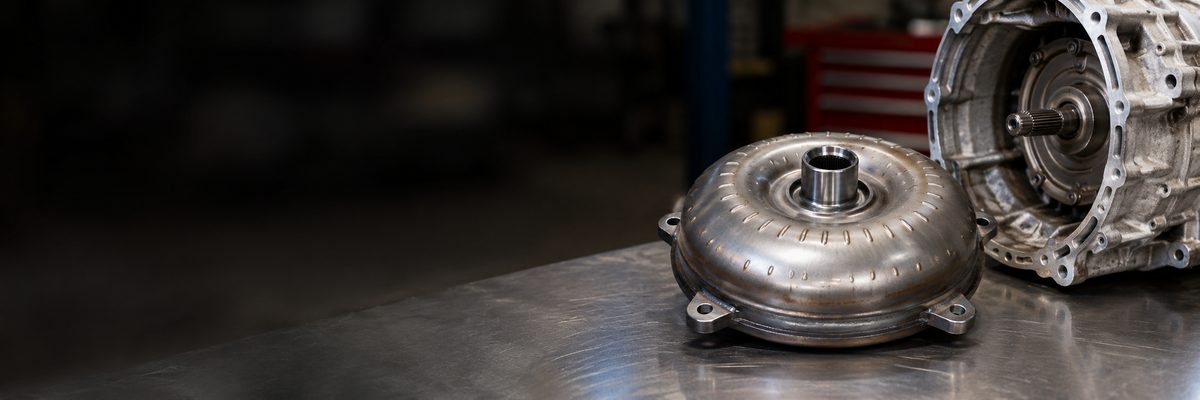
A bad torque converter can show as a shudder at a steady 30–50 mph, like driving over a rumble strip. It can also make the car slip, stall as you stop, run hot or whine in gear, though a dual-clutch transmission has no torque converter and CVT problems are a different case.
What are the symptoms of a bad torque converter?
A bad torque converter shows as a shudder at steady speed, slipping, stalling at a stop, hot fluid or a whine in gear. Each of them has more than one possible cause.
| Sign | What it points to first |
|---|---|
| Shudder at steady speed A rumble between about 30 and 50 mph on a light throttle. | The lock-up clutch (it locks the converter at cruising speed) grabbing and slipping. |
| Slipping The engine revs rise and the car doesn't speed up. | Slip in the converter or in the transmission. |
| Stall at a stop The engine shakes or dies as you slow down or sit at a light. | A lock-up clutch that doesn't let go. |
| Weak takeoff The car feels sluggish pulling away. | Worn parts or poor fluid flow inside the converter. |
| Hot, burnt fluid The fluid is dark brown or black and smells like burnt toast. | Heat from friction inside the converter. |
| Whine or rattle in gear The noise fades in neutral or park. | Worn bearings inside the converter. A noise alone doesn't prove the part. |
None of these signs names the converter on its own. A worn transmission, the wrong fluid and a misfire can feel the same.
Is it safe to drive with a bad torque converter?
It depends on the signs: heat and slipping need action. A failing converter can overheat the transmission and send debris through it.
If a transmission temperature warning comes on, pull over where it's safe and let the engine idle in Park or Neutral until the warning goes out. Driving on can boil the fluid over and start a fire. A converter that breaks can lose drive. If the car loses drive or stalls while moving, steer to a safe spot, stop and call for help.
When do the symptoms show up?
At a steady 30–50 mph on a light throttle, when you slow to a stop and under hard acceleration. Some behavior on a cold car or one that sat for days is normal.
| Condition | What it means |
|---|---|
| The first miles on a cold car The lock-up clutch hasn't engaged yet. | Normal. The clutch waits until warm, on a 2017 Chrysler Pacifica usually the first 1–3 miles. |
| The first seconds after days parked Drive or Reverse engages slowly. | Normal. The fluid drains back and refills within five seconds. |
| Steady speed on a light throttle A shudder at 30–50 mph. | A sign, though on some trucks a light shudder is normal. |
| Slowing to a stop The engine shakes or dies. | A sign. The lock-up clutch should let go as you slow down. |
| Hard acceleration The revs climb and the car lags. | A sign, and the transmission can cause it too. |
A shudder that returns on every trip at the same speed is worth a diagnosis, and so is any stall. A single odd moment on a cold start isn't.
Is it the torque converter or the transmission?
A shudder in one speed range points to the converter, and slipping or harsh shifts across several gears point to the transmission. Both parts can cause the same signs, so treat this as a first guess.
| What you notice | What it points to |
|---|---|
| A shudder only at 30–50 mph Smooth in other speed ranges. | The converter. |
| The engine stalls as you stop The car drives normally otherwise. | The converter. |
| Slipping between gears The car falls out of gear or revs without pulling. | The transmission, or a converter that has damaged it. |
| Harsh clunks on shifts Bangs when the gear changes. | The transmission. |
| A delay going into Drive or Reverse It takes a few seconds to engage. | The transmission, from low pressure or worn clutches. |
A failing converter can send debris through the transmission, so a converter fault can end as a transmission fault. If the car slips across several gears, treat it as a transmission problem first.

A steady highway speed
What should you check first?
Check the fluid and read the codes before you blame the converter. A shop can then test the cheaper causes first, before anyone pulls the transmission to get at the converter.
- Check the fluid level and color. Dark, burnt-smelling fluid points to heat, and low fluid shows its own signs. Learn to check the level and read the color, and if there's no dipstick, check without one.
- Confirm the fluid is the right one. The wrong fluid alone can cause a shudder.
- Read the codes and note any warning light. A code names a system, not a confirmed bad part.
- Ask the shop about a bulletin for your car. Some makers list a shudder repair, so ask the dealer whether one covers your car.
Don't let a shop replace the converter before a test confirms it, because the transmission has to come out to do it. A converter test is a shop job and not a driveway check.

Clean fluid and burnt fluid
What to say to the shop
When a quote blames the torque converter, ask:
- Which code is stored, and which system does it name?
- Is there a bulletin for my car?
“My car [shudders or slips]. Can you read the stored code and check for a bulletin for my car before you replace the torque converter?”
A good answer: the stored code and the system it names, then a bulletin check before any part.
What do the trouble codes say?
A code from P0740 to P0744 points at the converter clutch, but a shop still has to confirm the part. P0740 is a circuit malfunction, P0741 performance or stuck off, P0742 stuck on, P0743 electrical and P0744 intermittent.
A code for the output speed sensor, such as P0720, points to a different part. P0700 is the general transmission control code, and it doesn't name the converter.
What makes a torque converter fail?
Torque converters fail from the wrong fluid, heat, a cracked lock-up piston or a stuck clutch solenoid. Worn bearings can also do it.
- Wrong fluid. The wrong fluid alone can cause shudder.
- Heat. Low or burnt fluid and towing past the rated limit raise the temperature.
- A cracked lock-up piston. A crack lets pressure bleed off, so the clutch can't hold.
- A stuck clutch solenoid. It can set code P0741 or cause a stall at a stop, and on some cars a software update fixes it.
- Worn bearings. A whine in gear can come from the bearings inside the converter.
Check the solenoid and the fluid before you blame the converter, since both can cause the same signs. A bad converter is replaced, not repaired.
From the carmakers
Are there recalls or free fixes for torque converters?
Yes, on specific cars: recalls for converters that break, and bulletins for shudder that is a repair on some cars and a normal trait on others. The VIN decoder lists the recalls for your model year.
Some cars have a recall or a bulletin for the converter. A bulletin isn't a stop-driving instruction, and a recall is a free fix.
Recall 12V-006
The torque converter output shaft may fail.
Recall 17V-427
…the torque converter weld studs may have been inadequately welded.
Recall 18V-901
The pump impeller blades within the torque converter may detach, especially when driven under high load, potentially causing a vehicle stall.
Owner letter ONL6T806032025
…the torque converter lock-up clutch cannot provide adequate holding force due to pressure bleeding down through a crack in the lock-up piston.
Service bulletin SSM 54939
…a shudder condition, most noticeable at speeds below 60 mph.
Service bulletin T-SB-0023-15 Rev
…a brief shudder intermittently while driving under light loads between approximately 25 and 50 mph.
Service bulletin 24-NA-179
…a shudder, surge or chuggle type concern.
Conclusion
What to do next about a bad torque converter
If the car slips across gears, runs hot or stalls at a stop, have the transmission looked at soon. If it only shudders at a steady speed, start with the fluid and a bulletin check.
Oil & Miles checks each step here against the carmakers' books and NHTSA's records.
Common questions
Asked most often
Can a bad torque converter be fixed?
No. A bad converter is replaced, not repaired. The transmission has to come out, so confirm the cause first.
Can a fluid change fix a bad torque converter?
Not one that has failed, but it can cure a shudder that feels like one. Worn-out fluid can cause the judder, and a software update and a fluid flush fixed it on some 2012 and 2013 Honda Odyssey Touring models, while a one-time exchange to GM's newer fluid fixes it on some 8-speed automatics, and other fluids or additives won't.
What can be mistaken for torque converter shudder?
An engine misfire can feel like converter shudder, so check a worn spark plug too. The wrong fluid and a normal trait on some trucks can feel the same.
Does every automatic have a torque converter?
No. Dual-clutch transmissions have none. A CVT is a different design, though some CVTs do use a converter.
What people ask next
Sources
- 2016 Ram 1500 Owner's Manual (US), Starting and Operating, for how the converter clutch engages and the cold-start and parked behavior. Ram, read November 7, 2026
- 2017 Chrysler Pacifica Owner's Manual (US), Starting and Operating and Servicing and Maintenance, for the warm-up note, the overheating response and the fluid caution. Chrysler, read November 7, 2026
- 2014 Jeep Grand Cherokee Owner's Manual (US), Maintaining Your Vehicle, for the fluid caution. Jeep, read November 7, 2026
- 2016 Hyundai Tucson Owner's Manual (US), for the dual-clutch transmission without a torque converter. Hyundai, read November 7, 2026
- NHTSA technical service bulletins and owner letter: Honda ONL6T806032025, Ford SSM 54939, Toyota T-SB-0023-15 Rev and GM 24-NA-179, for the shudder repairs and the normal-trait note. NHTSA, read November 7, 2026
- Honda service bulletin 17-052 (Version 2) and GM bulletin 18-NA-355 (April 2020), for the shudder that a fluid change fixes. NHTSA, read November 10, 2026
- Delaware DMV list of on-board diagnostic trouble codes, page 10, for the converter clutch code names. Delaware DMV, read November 7, 2026
- NHTSA recall file: 12V-006, 17V-427 and 18V-901, for the converter recalls. NHTSA, read November 7, 2026
- GM bulletins PIP5009G and 13120, and two transmission parts sellers, for the clutch solenoid cause. NHTSA, read November 7, 2026
- Three repair-shop guides on torque converter symptoms (AutoZone, AAMCO Minnesota and RepairPal), for the signs, the converter-or-transmission comparison and the causes. Read November 7, 2026
The converter behavior and the fluid caution come from owners' manuals, and the shudder repairs come from NHTSA's bulletin records.
AI illustration by Oil & Miles
This article is general information, not advice about your specific vehicle. See the disclaimer.