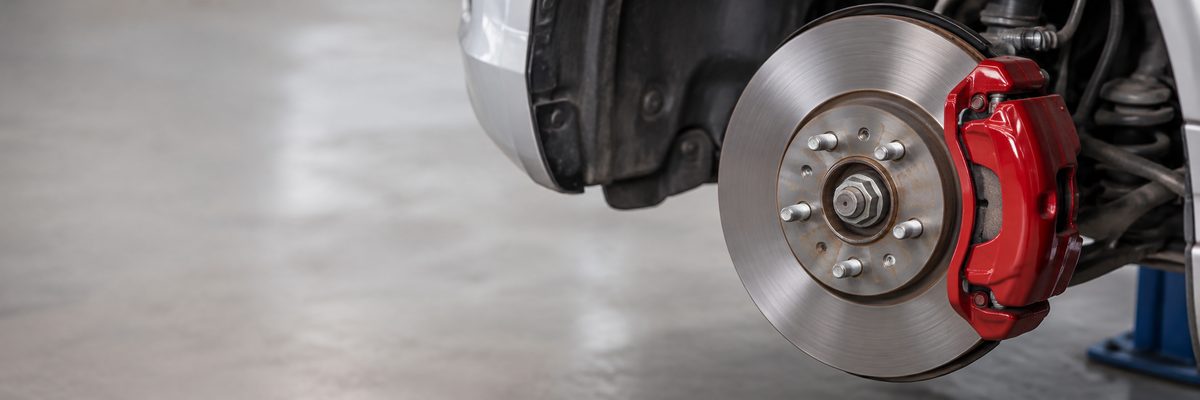

A brake squeak is a vibration. The pad and rotor rub, and when something makes them shake against each other, the brake sings like a glass rim under a wet finger.
Why are my brakes squeaking?
What causes brakes to squeak is often small: dirt and dust between the pad and rotor, a worn pad's warning tab, or dry metal where the pad sits. A squeal can also come from damp rotors and light stops, which carmakers call normal.
A short squeak on its own isn't a danger sign, because most come from dust, damp or dry metal. A screech that never stops, or other signs with the noise, are the ones to act on.
A squeak and a squeal are the same high note, a vibration between the pad and the rotor. Grinding is a different, low metal-to-metal sound, and it's one of the danger signs below.
Every pad sheds dust as it wears, and some of that dust ends up as brake noise. On the cars I see, the most common cause is plain brake dirt, and a cleaning is often the whole fix.
Check the causes in this order, from the cheapest to rule out:
- Dirt and brake dust. Dust packs between the pad and rotor, and a cleaning can fix it once the pads are measured.
- Worn pads. A metal tab on the pad touches the rotor and screeches when the pad is thin.
- Pad type. Low-quality pads can be very noisy, and semi-metallic pads are noisier and dustier than ceramic ones.
- Dry contact points. The grease where the pad sits in its bracket and on the slide pins wears away, and the metal rubs.
Is it safe to drive with squeaky brakes?
In most cases yes, if the car stops the way it did before, because most squeaks are dust, damp or dry metal, not a brake that's failing. Drive gently and have the brakes looked at soon.
A squeak alone isn't the danger sign. These are, and each one means a shop now or a tow:
- A soft or sinking pedal. If the pedal goes down further than normal or the car takes longer to stop, the brakes aren't working properly, so don't drive, and have the car towed.
- The red brake light, with the parking brake off. The fluid may be low, and with a leak the brakes won't work well. Our brake fluid leak guide shows where it goes. Kia says that if the light stays on or the brakes don't work properly, don't drive, and have the car towed. Our brake warning light guide covers the light on its own.
- A screech that never stops. It points to pads worn to their warning tabs. Mazda warns that driving on worn pads is dangerous and the brakes could fail.
- Grinding. Metal-to-metal grinding means the pads may be worn out, so have them checked now.
- A heavy pull or a shaking wheel. A pull to one side or a steady shudder in the steering wheel while braking needs a shop as soon as possible.
A knock or a clunk is a different noise, with its own causes, in our knocking noise when braking guide. A pulsing pedal points to the rotors, covered in warped brake rotors.
Is the squeak your brake pad wear indicator?
If it's a high, thin screech, it may be. The wear indicator is a small metal tab on the pad that touches the rotor once the pad is thin, so brakes screeching is often a built-in warning, not a fault.
Kia and Hyundai say the sound can come and go or come every time you press the pedal. Both say to replace the pads as a front or rear pair.
Ignore the sound and the brakes lose stopping power, so don't keep driving on worn pads. Brake pads squeaking from the tab won't stop until the pads are replaced.

The pad's wear indicator tab
What does the timing of a brake squeak tell you?
When it squeaks is the best clue to why. A squeak when braking that fades after a few stops is rarely a fault, while one that never stops points to the pads.
Is a morning or after-rain squeak normal?
Moisture settles on the rotors overnight or in the rain, and the first few stops clear it. In high humidity a squeak or squeal on its own isn't a fault, and on the Trailblazer and the Encore GX, GM traced a squeal to the first stops after a night parked or on cold brakes.
Some 2021–2022 F-150s with an electric parking brake can squeal from the rear after sitting 8 hours or more, and Ford's fix is new rear discs, pads, pin bolts and clips. If yours does it, ask the dealer whether that bulletin applies.
Low-speed and reverse squeaks are normal
Light pressure at low speed is when a pad is most likely to sing, so brakes that squeak when stopping slowly are common. Occasional noise on light to moderate stops is normal, and on the 2025–2026 Corvette the squeal under light braking below 10 mph goes after one to six stops.
Some squeals also show up when backing up, often on the first stops of the day. On the Trailblazer and the Encore GX, the same front squeal sometimes comes while in reverse.
Squeaking without braking means worn pads
A high-pitched screech that stays on while driving, even with your foot off the pedal, points to the wear tab. The sound comes whether or not the pedal is pressed, and the brakes should be checked as soon as possible.
A grinding or groaning noise rather than a squeal can be a stone caught between the rotor and its dust shield. It doesn't affect braking, but get it out as soon as you can.
Why do new brakes squeak?
New brakes squeaking can come down to a dry fit, not a bad pad. On the Corvette, GM has the paste applied every time the pads are removed or replaced, because dry metal where the pad ends sit can sing.
On the Chevrolet SS, whose performance brakes squeal by design, GM had dealers fit revised shims and cover the pad ends with copper paste, with a plain instruction not to replace the pads. A noise from new pads is worth a call back to the shop that fitted them before you pay for new ones.
New pads also need bedding in, a set of moderate stops, with no hard ones, that wears them into the rotor. Infiniti's routine is ten moderate stops from about 30 mph, each followed by a minute of cruising to cool the brakes, and GM's manual has owners skip hard stops for the first 200 miles.
Why are my brakes squeaking but the pads are good?
Then it's dust, dry metal or the rotor surface. Brake dust packed around the pad, or rotors left damp by rain or a night parked, can squeak with plenty of pad left.
Dry contact points are the other common one. On the Corvette, GM found that the grease at the pad's contact points wears away with use, car washes and the weather, so the metal rubs, and a clean and fresh grease is the repair there, not new pads.
Some squeaks aren't the brakes at all. GM traced a squeak on some 2025 Equinox and Terrain models to the brake pedal sensor under the dash, fixed with grease at its pin.
Shops explain that hybrids and EVs slow mostly on regenerative braking, so the pads sweep the rotors less and surface rust can build up and squeal. On the Model Y, Tesla's service steps suggest a burnish of about six moderate stops from 50–55 mph down to 10 mph, 30 seconds apart, which can clear that squeal.

A rotor with a smooth, shiny face
How do you fix squeaky brakes?
Start with a safe check at home, then match the fix to the cause. To stop brakes from squeaking, work through these steps in order:
- Check without tools first. If it squeaked only on damp mornings and faded, nothing needs fixing. Otherwise note whether your foot was on the pedal, and check the brake fluid against the reservoir marks, since the level drops with pad wear or a leak.
- Measure the pads. If they're down to the wear tab, replace them as a pair on the same axle. Semi-metallic pads are the noisier kind, so ask whether a ceramic pad suits your car, and whether to resurface or replace the rotors.
- Have the brakes cleaned. Ask the shop to clean the dust from the pads, rotors and bracket with brake cleaner. EPA's brake-dust guidance says not to use compressed air, which blows the dust into the air, or a dry rag or a brush.
- Grease the contact points. The pad ends, where they sit in the bracket, get fresh brake grease. Grease or any lubricant must never touch the pad face or the rotor.
Cleaning and greasing mean taking the wheel off and moving the caliper. If you haven't done brake work before, leave it to a shop, since the caliper has to go back on tight.
What to say to the shop
“My brakes squeak. Before new pads, can you measure them, clean the brakes and grease the contact points, and check whether a bulletin covers my VIN?”
How much does it cost to fix squeaky brakes?
Cleaning and fresh grease need no new parts, and new pads and rotors cost the most. A front pad and rotor job on a 2025 Subaru Crosstrek 2.0 runs about $391–$488, parts and labor, at an independent shop, and our brake pad and rotor cost guide prices more cars.
From the carmakers
Is there a carmaker bulletin for squeaky brakes on your car?
On some cars, yes, though some brake squeal is normal in the carmakers' own words. Every quote in the cards below is from the document itself.
The best known is GM's for the 2020–2024 Buick Encore GX and the 2021–2024 Chevrolet Trailblazer, built before April 2, 2024. Dealers fit a new front pad kit for a squeal on light stops.
A bulletin isn't a free repair by itself. GM's Corvette fix, for one, is maintenance the owner pays for, so ask the dealer in writing whether a bulletin applies to your VIN and who pays.
Owner's manual 2020 Altima, brake pad wear indicators
Occasional brake noise during light to moderate stops is normal and does not affect the function or performance of the brake system.
Owner's manual 2025 CX-5, brake pad wear indicator
In high humidity weather conditions, brake noises, such as brake squeak or brake squeal can be heard. It does not indicate a malfunction.
Service bulletin 24-NA-072
…a squeal noise heard from the front of the vehicle during light brake pedal application.
Service bulletin 17-NA-245
DO NOT replace brake pads for this condition.
Service bulletin 24-NA-221
This maintenance item is not covered under warranty and is the financial responsibility of the customer.
What the data says
The 2021 Chevrolet Trailblazer had the most federal complaints that mention a squeal, at 9. The 2022 Trailblazer and the 2018 Camry had 6 and 6, and the 2019 RAV4 and 2017 CR-V 5 each.
From NHTSA complaints on these five cars, read November 5, 2026. They're owner reports, not a failure rate.
Conclusion
What to do next about squeaky brakes
Note when it squeaks and rule out the danger signs, then have the pads measured and the brakes cleaned and greased before you pay for new pads. If the pedal goes soft or the red brake light stays on, don't drive, and have the car towed.
Oil & Miles checks each step here against the carmakers' manuals and bulletins and NHTSA's records.
Common questions
Asked most often
Is it normal for brakes to squeak?
Sometimes, yes: occasional noise on light to moderate stops is normal, and so is a squeal in humid weather. A high-pitched screech that stays on isn't normal, because it points to the wear tab.
What does it mean when your brakes squeak?
Most often dust and dirt, damp rotors or dry metal where the pad sits. A high-pitched screech that stays on points to pads worn to their warning tabs.
Can you spray something on squeaky brakes?
No lubricant or anti-squeal spray goes on the pad face or the rotor. Brake cleaner removes the dust, and grease goes only on the pad ends, as GM's bulletin keeps its paste off the friction material.
What people ask next
Sources
- 2020 Nissan Altima Owner's Manual (US), pages 8-20, 9-2 and 2-10, for the wear indicator, normal brake noise, the pedal and the brake light. Nissan, read November 5, 2026
- 2025 Mazda CX-5 Owner's Manual (US), section 5, for humid-weather squeal and worn pads. Mazda, read November 5, 2026
- 2023 Kia Sportage Owner's Manual (US), for the wear indicator, brake dust and the brake warning light. Kia, read November 5, 2026
- 2023 Hyundai Sonata Owner's Manual (US), page 6-31, for the wear indicator and replacing pads as axle sets. Hyundai, read November 5, 2026
- GM service bulletins 24-NA-072 (November 2024), 17-NA-245 (July 2017), 24-NA-221 (November 2025) and 25-NA-030 (February 2025), for the Encore GX and Trailblazer, Chevrolet SS, Corvette and Equinox and Terrain. General Motors via NHTSA, read November 5, 2026
- 2021 Toyota Avalon Owner's Manual (US), page 432, 2020 Ford Explorer Owner's Manual (US), page 209, and 2020 Chevrolet Silverado Owner Manual, pages 204, 351 and 354, for a pull, a shudder, grinding, a fluid leak and breaking in new pads. Toyota, Ford and GM, read November 5, 2026
- Infiniti bulletin ITB00-024K (March 2023) and Audi bulletin 2017130/11 (April 2013), for bedding new pads and keeping grease off the pads and rotors. Infiniti and Audi via NHTSA, read November 5, 2026
- Wagner on brake pad types, for low-quality, semi-metallic and ceramic pads. Wagner, read November 5, 2026
- Ford SSM 51590 (May 2023) and Tesla's Model Y and Model 3 service pages, for the electric parking brake, the burnish for rust squeal and a stone in the dust shield. Ford and Tesla, read November 5, 2026
- R1 Concepts and Glenn Dale Auto & Tire, on rotor rust on hybrids and EVs that brake mostly on regen. A parts maker and a repair shop, read November 5, 2026
- EPA-747-F-04-004, Current Best Practices for Preventing Asbestos Exposure Among Brake and Clutch Repair Workers (March 2007), for cleaning brake dust. US Environmental Protection Agency, read November 5, 2026
- NHTSA complaint records, complaints that name the brakes and mention a squeal, squeak or screech. NHTSA, read November 5, 2026
AI illustration by Oil & Miles
How this was compiled
The manual lines come from each carmaker's US owner's manual, and the bulletins from NHTSA's archive of carmaker service documents. The complaint counts are NHTSA complaints whose component names the brakes and whose text says squeal, squeak or screech. Owner, shop and parts-maker reports for causes no carmaker documents were swept on November 5, 2026, and only causes with a carmaker document made the page.
What we didn't do
We didn't run a test of our own for this page. We didn't rank the causes by complaint counts, because owners rarely know the cause when they report a noise.
This article is general information, not advice about your specific vehicle. See the disclaimer.