Cars/Honda/CR-V/2018/Specs

2018 Honda CR-V Oil Capacity · Oil Type · Tire Pressure · Fuses

The 2018 Honda CR-V takes 0W-20 oil: 4.7 US qt (4.4 L) in the 2.4 L and 3.7 US qt (3.5 L) in the 1.5 L turbo with a new filter. Tires run 32 psi front and 30 rear on 17 inch wheels (33 and 30 on 18 inch), and the lug nuts take 80 lb-ft.

Owner's Manual 31TLA6100, 2017 edition Covers 2.4 L and 1.5 L turbo, CVT, 2WD and AWD, U.S. Checked October 29, 2026

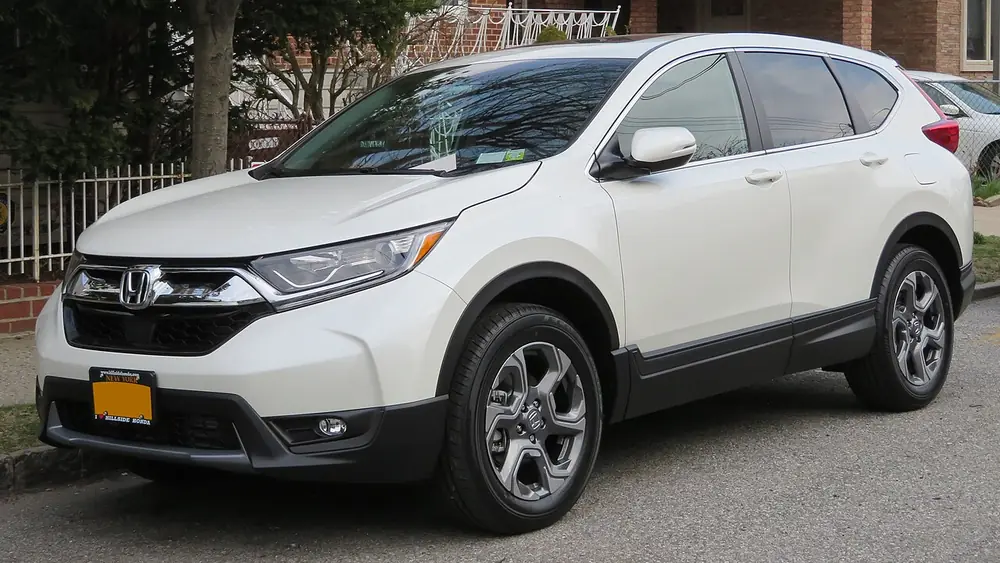
A white fifth-generation Honda CR-V seen from the front
Photo: Kevauto, CC BY-SA 4.0
2018 Honda CR-V key figures by engine
Engine Engine oil Tire pressure CVT fluid Fuel economy
2.4 LLX, 17 in 4.7 qt0W-20, with filter 32/30 psifront/rear HCF-23.9 qt 2WD, 4.5 AWD28 mpgcombined 2WD, 27 AWD
1.5 L turboEX, EX-L, Touring, 18 in 3.7 qt0W-20, with filter 33/30 psifront/rear HCF-23.9 qt 2WD, 4.5 AWD30 mpgcombined 2WD, 29 AWD
Jump to
  1. Engine oil
  2. Engine and trims
  3. Transmission fluid
  4. Light bulbs
  5. Tires and wheels
  6. Warning lights
  7. Coolant and brake fluid
  8. Electrical
  9. Maintenance
  10. Fuel and fuel economy
  11. Towing and emergencies

Engine oil

0W-20, 4.7 qt (2.4 L), 3.7 qt (1.5 L turbo)
Oil grade 0W-20Both engines
2.4 L, with filter 4.7US qt 4.4 L
1.5 L turbo, with filter 3.7US qt 3.5 L
0W-20
Short answer

The 2018 Honda CR-V takes 0W-20 oil in both engines: 4.7 US qt (4.4 L) in the 2.4 L and 3.7 US qt (3.5 L) in the 1.5 L turbo with a new filter.

Oil type and other oils

Honda's owner's manual says the 2018 Honda CR-V uses Genuine Honda Motor Oil 0W-20 or a premium-grade 0W-20 detergent oil with the API Certification Seal, in both engines.

  • The manual lists 0W-20 only: its viscosity chart has one 0W-20 bar across every outside temperature, with no 5W-20 or 5W-30 option.
  • Synthetic oil is fine if it carries the API seal and is 0W-20.
  • The 2018 Honda CR-V needs no oil additives. Honda says they can hurt engine performance and durability.
  • The oil filter is Honda part 15400-PLM-A02 on every 2018 Honda CR-V trim, so both engines take the same filter.

Oil capacity

The 2018 Honda CR-V 2.4 L takes 4.7 US qt (4.4 L) of oil with a new filter, and the 1.5 L turbo takes 3.7 US qt (3.5 L).

2018 Honda CR-V engine oil capacity by engine
Oil 2.4 L (US qt / L) 1.5 L turbo (US qt / L)
Grade 0W-200W-20
Oil change, no filter 4.4 US qt (4.2 L) 3.4 US qt (3.2 L)
Oil change with new filter 4.7 US qt (4.4 L) 3.7 US qt (3.5 L)

Oil life

The 2018 Honda CR-V has no fixed oil-change mileage: the Maintenance Minder shows the oil life left, and a reminder comes on at every start once it drops below 15%. The screen says Maintenance Due Soon at 15% oil life and Maintenance Due Now at 5% to 1%.

How to reset the oil life

Reset the Minder after each oil change, or the next interval will be wrong. There are two versions, by instrument cluster:

How to reset with the TRIP knob: 4 steps
  1. Turn the ignition ON with the car stopped.
  2. Press the TRIP knob until the Maintenance Minder shows.
  3. Hold the knob 10 seconds or more, until the display blinks.
  4. Turn the knob to the item you serviced, then hold it 5 seconds or more.
How to reset with the driver information interface: 4 steps
  1. Turn the power mode ON.
  2. Go to the Maintenance Minder screen and press ENTER.
  3. Hold ENTER about 10 seconds to enter reset mode.
  4. Choose the item, or All Due Items, and press ENTER.

More on what the percentage means: Oil change light. When yours is due: Oil change interval calculator.

Source: 2018 Honda CR-V Owner's Manual, pp. 559, 563, 565, 568, 572, 653 · Honda Parts Now parts catalog (read October 29, 2026)

Which engine does your 2018 Honda CR-V have?

LX has the 2.4 L. EX, EX-L and Touring have the 1.5 L turbo
2.4 L, LX184hp
1.5 L turbo, EX and up 190hp
Drive 2WDor AWD

Honda's spec sheet for the 2018 Honda CR-V puts the 2.4 L engine in the LX and the 1.5 L turbo in the EX, EX-L and Touring, and every trim comes with 2WD or AWD. The table below gives the 2018 Honda CR-V engine, power and wheels for each trim, and the VIN character that tells them apart.

Trim Engine Power Wheels and tires VIN 8th character
LX2.4 L184 hp, 180 lb-ft 17 in, 235/65R17 104H2 or 3
EX1.5 L turbo 190 hp, 179 lb-ft 18 in, 235/60R18 103H5
EX-L1.5 L turbo 190 hp, 179 lb-ft 18 in, 235/60R18 103H8
Touring 1.5 L turbo 190 hp, 179 lb-ft 18 in, 235/60R18 103H9

The 6th VIN character usually gives the drive, 1 for 2WD and 2 for AWD. Some LX VINs show 5 or 6 there instead, with 3 as the 8th character. Oil, coolant and A/C capacities differ by engine, so check your car with the VIN decoder before you buy parts.

Source: Honda 2018 CR-V Specifications and Features sheet (Honda News, October 17, 2017) · NHTSA vPIC VIN decoder (read October 29, 2026)

Transmission fluid (CVT)

Honda HCF-2, 3.9 qt 2WD, 4.5 qt AWD
Fluid HCF-2
2WD3.9US qt
AWD4.5US qt

Honda's owner's manual says the 2018 Honda CR-V CVT takes Honda HCF-2 only, in both the 2.4 L and the 1.5 L turbo: 3.9 US qt (3.7 L) in a 2WD model and 4.5 US qt (4.3 L) in an AWD model.

When to change the CVT fluid

The Maintenance Minder calls for a CVT fluid change with sub-item 3. If you tow or drive mountain roads at low speed, change it every 25,000 miles.

Source: 2018 Honda CR-V Owner's Manual, pp. 561, 653

Headlight and other bulbs

Low beam H11, high beam HB3, fog H8, or LED
Low beam H11
High beam HB3
Fog lights H8

Honda's owner's manual lists an H11 (55 W) low-beam headlight bulb and an HB3 (60 W) high beam for the 2018 Honda CR-V, and cars with LED headlights have no bulb to change there. The table below lists the 2018 Honda CR-V bulbs for every light. Where the manual gives only the watts, the type reads "not named".

Light Bulb Watts
Low beam H11 or LED55 W (bulb)
High beam HB3 or LED60 W (bulb)
Fog lights H835 W
Back-up lights Type not named 16 W
Map and ceiling lights Bulb or LED8 W (bulb)
Cargo area lights Type not named 5 W
Vanity mirror lights Type not named 1.8 W

Most other outside lights on the 2018 Honda CR-V are LED, so there is no bulb to replace in them.

Source: 2018 Honda CR-V Owner's Manual, p. 652

Tires and wheels

32/30 psi on 17 in, 33/30 psi on 18 in, lug nuts 80 lb-ft
17 inch wheels 32/30psi
18 inch wheels 33/30psi
Lug nut torque 80lb-ft

Honda's owner's manual sets the 2018 Honda CR-V tire pressure at 32 psi front and 30 psi rear on 17 inch wheels and 33 psi front and 30 psi rear on 18 inch wheels, set cold. The table below gives the 2018 Honda CR-V tire pressure in kPa too, with the tire and wheel sizes. The label on the driver's doorjamb shows the pressure for your own car.

Spec 17 inch wheels 18 inch wheels
Front pressure 32 psi (220 kPa) 33 psi (230 kPa)
Rear pressure 30 psi (210 kPa) 30 psi (210 kPa)
Tire size 235/65R17 104H235/60R18 103H
Wheel size 17 x 7 1/2J18 x 7 1/2J
Lug nut torque 80 lb-ft (108 N·m) 80 lb-ft (108 N·m)

The compact spare is a T155/90D17 112M on a 17 x 4T wheel, set to 60 psi (420 kPa). Keep under 50 mph (80 km/h) on it, and fit a full-size tire as soon as you can.

TPMS reset (calibration)

The 2018 Honda CR-V TPMS has to be calibrated every time you adjust a tire pressure or rotate or replace a tire.

How to calibrate the TPMS: 4 steps
  1. Set all four tires to the cold pressure above.
  2. Stop the car, shift to P and turn the ignition ON.
  3. With a TPMS button: hold it until the low tire pressure indicator blinks twice. With the driver information interface: choose Vehicle Settings, then TPMS Calibration, and confirm.
  4. Drive about 30 minutes at 30-65 mph (48-105 km/h) in total. The calibration finishes by itself. It cannot run with the compact spare on.

Tire rotation

The 2018 Honda CR-V has no fixed rotation mileage: rotate the tires when the Maintenance Minder shows sub-item 1. Honda says rotating on that schedule spreads wear more evenly and makes the tires last longer. Tires with a directional tread go front to back only, never side to side, with the rotation mark facing forward. Calibrate the TPMS after every rotation.

Jack points and changing a flat tire

If a tire goes flat while driving, hold the wheel firmly, brake gradually and stop in a safe place. Place the jack under the jacking point closest to the tire you are changing, with the jacking point tab sitting in the notch of the jack. Use only the jack that came with the car, on firm, level ground, with the engine off and nobody inside. Never get under the car while only the jack holds it.

How to prepare to change the tire: 6 steps
  1. Park on firm, level, non-slip ground, set the parking brake and shift to P.
  2. Turn on the hazard lights and turn the ignition to LOCK.
  3. Open the cargo floor lid and take out the tool bag, the jack and the compact spare.
  4. Block the wheel diagonal to the flat tire, in front and behind.
  5. Put the spare under the car, wheel side up, near the flat tire.
  6. Loosen each wheel nut about one turn.
How to lift the car: 3 steps
  1. Place the jack under the jacking point closest to the flat tire.
  2. Turn the end bracket clockwise until the top of the jack meets the jacking point.
  3. Raise the car with the jack handle bar and the wheel nut wrench until the tire is off the ground.
How to put on the spare: 4 steps
  1. Remove the wheel nuts and the flat tire.
  2. Wipe the wheel mounting surfaces clean and mount the spare.
  3. Run the nuts down until they touch the wheel, then lower the car and remove the jack.
  4. Tighten the nuts in the order shown in the manual, two or three rounds, to 80 lb-ft (108 N·m). Never add force with your foot or a pipe.

Source: 2018 Honda CR-V Owner's Manual, pp. 518, 519, 520, 561, 604, 619, 620, 621, 622, 623, 643, 653

Warning lights

Seven lights that mean stop, and what to do

On the 2018 Honda CR-V, Honda's owner's manual says to stop in a safe place right away for the red brake light, the low oil pressure light, a blinking check engine light, overheating, the "something wrong" message, low tire pressure and a blinking transmission temperature or AWD light. The table below lists the 2018 Honda CR-V warning lights that mean stop, with what the manual says to do for each.

Light What to do
Brake system (red with amber) Stop in a safe place right away and contact a dealer. If the pedal has no resistance, stop at once.
Low oil pressure Stop in a safe place right away. Park on level ground, turn the engine off for about 3 minutes and check the oil level. If the light stays on 10 seconds after a restart, turn the engine off and contact a dealer.
Check engine light, blinking A misfire. Park away from anything flammable, turn the engine off for at least 10 minutes, then see a dealer.
Overheating Park in a safe place right away, turn the accessories off and the hazard lights on. If you see steam, turn the engine off and wait. With no steam, keep the engine running and open the hood.
"Something wrong" message Stop in a safe place right away and have the car checked.
Low tire pressure Stop in a safe place, check the pressures and inflate the tires.
Transmission temperature or AWD light, blinking Stop in a safe place and shift to P. Let it idle until the light goes off, and see a dealer if it keeps blinking.

The charging system light is not a stop light. Turn off the climate control, rear defogger and other electrical loads, and contact a dealer right away. If you stop, leave the engine running, because a restart can drain the battery. Every other symbol is explained on our dashboard symbols page.

Source: 2018 Honda CR-V Owner's Manual, pp. 80, 83, 89, 93, 95, 106, 633, 637, 638, 639

Coolant, brake fluid and A/C

Coolant Type 2, brake fluid DOT 3, rear differential, A/C
Coolant Type 2
Brake fluid DOT 3
A/C refrigerant R-1234yf

Honda's owner's manual lists Honda Type 2 coolant, 50/50 with distilled water, and Honda Heavy Duty Brake Fluid DOT 3 for the 2018 Honda CR-V. AWD models take Honda DPSF-II in the rear differential. The table below gives the 2018 Honda CR-V fluid capacities by engine. The manual lists no power steering fluid.

Fluid Type 2.4 L1.5 L turbo
Coolant Honda Type 21.65 US gal (6.24 L) 1.64 US gal (6.20 L)
Rear differential, AWDHonda DPSF-II1.32 US qt (1.247 L) 1.32 US qt (1.247 L)
Brake fluid DOT 3Same for both engines
Washer fluid, U.S. Not named 2.6 US qt (2.5 L) 2.6 US qt (2.5 L)
A/C refrigerant R-1234yf 14.6-16.4 oz (415-465 g) 15.3-17.1 oz (435-485 g)
A/C compressor oil Not named RB100EV-01RL85HM (POE)

The coolant figures include what stays in the reserve tank. R-1234yf is flammable, and the manual says only trained and certified technicians should service the A/C. Change the brake fluid every 3 years if the Maintenance Minder has not asked for it sooner. See also coolant flush cost, brake fluid flush cost and CVT problems.

Source: 2018 Honda CR-V Owner's Manual, pp. 561, 610, 652, 653

Electrical

Fuse boxes, battery 51R, key fob CR2032
Fuse boxes 2
Battery, U.S. 51R
Key fob CR2032

Honda's owner's manual shows two fuse boxes in the 2018 Honda CR-V: one in the engine compartment near the brake fluid reservoir, and one under the dashboard with its fuse map on the steering column lower cover. Turn the ignition to LOCK before you check a fuse, and match the number on your own box cover or label, since fuse numbers differ between models. The tables below list the 2018 Honda CR-V fuses people look for most.

Engine compartment fuse box

Circuit Fuse no. Rating
Horn 2410 A
Hazard lights 1410 A
Stop lights 910 A
Back-up lights 1810 A
Washer 615 A
Audio 1915 A
Injector 1020 A
Ignition coil 1515 A
A/C compressor, upper shutter grille 2310 A

Interior fuse box, under the dashboard

Circuit Fuse no. Rating
Fuel pump 815 A
Starter 2010 A
Meter 710 A
A/C910 A
ABS/VSA3410 A
SRS3510 A
Accessory power socket, front 2920 A
Accessory power socket, center console 1020 A
Accessory power socket, cargo area h 20 A

Replace a blown fuse only with a spare of the same amp rating. Honda's manual says a higher rating greatly raises the chance of damaging the electrical system.

Fuse finder

The fuse finder shows every fuse in both 2018 Honda CR-V fuse boxes from Honda's owner's manual, in its number order. Tap a number to see its circuit and rating, or search for a part such as horn or power window. The tiles follow the manual's list, not the layout of the box, so match the number on your own cover or label.

Tap a number

The circuit, its rating and the models it applies to show here.

Large fuses 1a to 4d in the engine box are grouped under cover numbers 1 to 4 in the manual. A rating in brackets, such as (30 A), is printed that way in the manual and usually marks a circuit not fitted to every model.

Battery

The owner's manual prints no battery group size and says a replacement must have the same specifications. Battery finders list group 51R for the U.S. 2018 Honda CR-V with either engine, so check the label on your old battery before you buy. When a battery is due: how long a car battery lasts.

Key fob battery

The 2018 Honda CR-V smart entry remote takes a CR2032 battery, and the remote with a screw cover takes a CR1620.

Source: 2018 Honda CR-V Owner's Manual, pp. 607, 608, 609, 644, 645, 646, 647 · Interstate and EverStart battery finders (read October 29, 2026)

Maintenance

Minder codes, spark plugs, filters, wipers 26, 17 and 12 in
Schedule Minder
Wiper blades 26/17/12in
Brake fluid 3years max

Honda's owner's manual gives the 2018 Honda CR-V no mileage-based schedule. The Maintenance Minder shows the jobs that are due as codes on the instrument panel display, next to the oil life percentage. They appear by themselves once oil life drops to 15%, and you can see them anytime by turning the ignition ON and pressing the TRIP knob until the oil life shows.

How the codes look (our drawing, not the real screen). B 1 2 means an oil and filter change, a tire rotation and new air filters, all due at the next service.

The letter, A or B, is the main job, and the numbers 1 to 7 are extra jobs. The table below explains each 2018 Honda CR-V Maintenance Minder code. Canadian models use their own codes.

Code What to do
AReplace the engine oil. If no message shows within 12 months of the reset, change the oil every year.
BReplace the engine oil and filter. Inspect the brakes, steering and suspension parts, driveshaft boots, brake lines, fluid levels, exhaust and fuel lines.
1Rotate the tires.
2Replace the engine air filter and the dust and pollen (cabin) filter. Inspect the drive belt.
3Replace the CVT fluid.
4Replace the spark plugs. Inspect the valve clearance.
5Replace the engine coolant.
6Replace the rear differential fluid (AWD).
7Replace the brake fluid, at least every 3 years.

The manual also lists an idle speed check every 160,000 miles, and a valve adjustment only if the valves are noisy.

Spark plugs

The 2018 Honda CR-V spark plugs are replaced on Maintenance Minder code 4, together with a valve clearance check. The two engines use different plugs, and the manual prints no gap or torque, so fit the exact part listed below.

Engine Spark plug
2.4 LNGK DILKAR7H11GS, NGK DILKAR7G11GS or DENSO DXE22HQR-D11S
1.5 L turbo NGK ILZKAR8J8SY

Engine and cabin air filters

Both filters are replaced on Minder code 2, and every 15,000 miles in dusty air (engine filter) or sooty city air (cabin filter). The manual does not show where they sit. The part numbers below come from Honda parts stores.

Filter 2.4 L1.5 L turbo
Engine air filter Honda 17220-5PH-A00Honda 17220-5AA-A00
Cabin air filter Honda 80291-TF3-E01Honda 80291-TF3-E01

Wiper blade sizes

The owner's manual lists no wiper sizes. The WiperBladesUSA, Otto Blades and AutoZone blade finders and Honda's own part length agree on the 2018 Honda CR-V wiper blade sizes below.

Blade Length
Driver 26 in
Passenger 17 in
Rear 12 in

Source: 2018 Honda CR-V Owner's Manual, pp. 559, 560, 565, 566, 610, 652 · Honda parts stores, WiperBladesUSA, Otto Blades and AutoZone wiper finders (read October 29, 2026)

Fuel and fuel economy

Unleaded 87 octane, 14 gal tank, EPA fuel economy
Fuel Unleaded
Octane 87or higher
Tank 14US gal

Honda's owner's manual says the 2018 Honda CR-V takes unleaded gasoline, 87 octane or higher, and holds 14 US gal (53 L). It is built for fuel with up to 15% ethanol, never fuel with methanol, and Honda recommends TOP TIER detergent gasoline without manganese (MMT) additives. The table below gives the 2018 Honda CR-V fuel economy from the EPA for each engine and drive.

Engine and drive City Highway Combined
2.4 L, 2WD26 mpg 32 mpg 28 mpg
2.4 L, AWD25 mpg 31 mpg 27 mpg
1.5 L turbo, 2WD28 mpg 34 mpg 30 mpg
1.5 L turbo, AWD27 mpg 33 mpg 29 mpg

Lower octane fuel can cause a loud, steady metallic knock that damages the engine. If problems start after a fill-up, try another station or brand.

How to refuel

The 2018 Honda CR-V has no fuel cap. The fuel door is on the left rear side, so stop with the pump on that side.

How to refuel the car: 5 steps
  1. Stop with the pump on the left rear side and turn the engine off.
  2. Pull the fuel door release under the lower left corner of the dashboard.
  3. Put the nozzle in slowly and fully, resting on the bottom of the filler, and hold it level.
  4. Fill until the nozzle clicks off, then wait about 5 seconds before you take it out. Do not top off.
  5. Close the fuel door by hand.

Use only a gas station nozzle, since a siphon hose can damage the filler. If the nozzle keeps clicking off before the tank is full, try another pump, then see a dealer.

Low fuel light and range

The low fuel light comes on with about 2.1 US gal (8.0 L) left, so refuel soon. If it blinks, the fuel gauge has a problem and needs a check. Running the tank dry can make the engine misfire and damage the catalytic converter. The range display estimates the miles left from the fuel economy of past trips, so treat it as a guide.

If you run out of fuel

How to add fuel from a can: 5 steps
  1. Turn the engine off and make sure the can holds gasoline.
  2. Press the edge of the fuel door until it pops open.
  3. Fit the funnel from the tool kit in the cargo area. Do not use any other funnel or nozzle.
  4. Pour the fuel in slowly.
  5. Wipe the funnel clean, put it away and close the fuel door by hand.

How to get better fuel economy

Honda's manual lists the basics: service the car when the Maintenance Minder asks, use the recommended oil viscosity, keep the tires at the doorjamb pressure, carry no extra weight and clear snow or mud from under the car. To measure your own fuel economy, divide the miles driven by the gallons used at a fill-up.

Source: 2018 Honda CR-V Owner's Manual, pp. 85, 118, 119, 120, 549, 550, 551, 552, 650, 652 · EPA fueleconomy.gov, 2018 Honda CR-V (read October 29, 2026)
Towing and emergencies

Tows 1,500 lb, 850 lb maximum load, jump start
Towing 1,500lb
Maximum load 850lb
Gross weight rating 4,695lb

Honda's owner's manual says the 2018 Honda CR-V can tow 1,500 lb (680 kg), counting the trailer, its cargo and everything in or on it, with the tongue load kept at about 10% of the trailer weight. The tables below give the 2018 Honda CR-V weight ratings from the manual and the dimensions from Honda's spec sheet.

Rating Value
Maximum load, people, cargo and tongue load 850 lb (385 kg)
Gross vehicle weight rating 4,695 lb (2,130 kg)
Front axle rating 2,425 lb (1,100 kg)
Rear axle rating, 2WD2,292 lb (1,040 kg)
Rear axle rating, AWD2,369 lb (1,075 kg)

The manual prints no payload figure, only the 850 lb maximum load, so none is worked out here.

Weights and dimensions

Measurement 2WDAWD
Curb weight, LX3,307 lb 3,421 lb
Curb weight, EX3,358 lb 3,473 lb
Curb weight, EX-L3,377 lb 3,492 lb
Curb weight, Touring 3,397 lb 3,512 lb
Height 66.1 in 66.5 in
Ground clearance, unladen 7.8 in 8.2 in
Length 180.6 in
Width 73.0 in
Wheelbase 104.7 in
Cargo volume, rear seat up / down 39.2 / 75.8 cu ft (Touring 37.6 seat up)
Seats 5

Towing your CR-V

Honda's owner's manual says to call a professional towing service. A flat bed is the best way for every model, and a wheel lift with the front tires raised is fine on 2WD models only, so an AWD CR-V goes on a flat bed. The manual warns that towing it behind a motorhome or another vehicle can damage the transmission. Never tow by the bumpers or with just a rope or chain, and if the parking brake won't release, use a flat bed.

Jump start

To jump start the 2018 Honda CR-V, connect the positive cable first, and clamp the last negative end to the engine hanger, never to your battery. A battery can explode, so keep sparks, flames and smoking away.

How to jump start the 2018 Honda CR-V: 6 steps
  1. Turn off the audio and lights, turn off the engine and open the hood.
  2. Connect the first cable to your battery's + terminal, then to the booster battery's + terminal. Use a 12-volt booster only, and set a charger used as a booster below 15 volts.
  3. Connect the second cable to the booster battery's - terminal, then to the engine hanger on your engine.
  4. If the booster is another car, start it and raise its rpm slightly.
  5. Start your engine. If it turns over slowly, check that the clamps have good metal-to-metal contact.
  6. Once your engine runs, remove the cables in this order: the engine hanger clamp, the booster's - terminal, your + terminal, then the booster's + terminal.

Source: 2018 Honda CR-V Owner's Manual, pp. 451, 453, 457, 629, 630, 631, 648, 652 · Honda 2018 CR-V Specifications and Features sheet (Honda News, October 17, 2017)

Known problems tied to these specs

Two known problems touch these specs on the 2018 Honda CR-V: fuel in the oil on the 1.5 L turbo, and a head gasket warranty program that is still open.

Program open

Cylinder head gasket

2017 to 2022 CR-V, 1.5 L turbo

Honda Service Bulletin 26-016 (Version 3, September 25, 2026) extends the head gasket warranty on the 1.5 L turbo to 10 years from purchase or 150,000 miles, whichever comes first. It covers coolant loss, overheating or misfire from coolant leaking into the cylinders, and misfire codes may be stored but aren't needed for the repair. Salvage and branded titles are covered too. Honda's August 2026 dealer message adds 6 months from the owner notice for cars already past the age limit. Ask a Honda dealer to check your VIN.

Head gasket replacement cost

10years or 150,000 miles

Fuel in the oil (oil dilution)

Program ended

On the 1.5 L turbo, fuel could collect in the engine oil, worst in cold climates. Honda answered with software updates and a warranty extension. Honda CR-V oil dilution

Source: Honda Service Bulletin 26-016, Version 3, September 25, 2026 (NHTSA A26-016)

Oil & Miles

2018 Honda CR-V spec card

Engine oil, with filter
0W-20 · 4.7 US qt (2.4 L) · 3.7 US qt (1.5 L turbo)
Oil filter
15400-PLM-A02 · both engines
Tire pressure, cold (front/rear)
32/30 psi (17 in) · 33/30 psi (18 in)
Lug nuts
80 lb-ft · 108 N·m
CVT fluid
Honda HCF-2 · 3.9 US qt (2WD) · 4.5 US qt (AWD)
Coolant
Honda Type 2 · 50/50
Brake fluid
DOT 3
Fuel
87 octane · 14 US gal
Low beam bulb
H11 · 55 W
Wiper blades (driver, passenger, rear)
26 · 17 · 12 in
Battery, U.S.
Group 51R
Key fob battery
CR2032 (smart entry) · CR1620 (screw cover)

Sources: 2018 Honda CR-V Owner's Manual, pp. 608, 609, 623, 652, 653 · oil filter and wiper sizes from parts catalogs · battery group from battery finders oilandmiles.com

Costs and tools for the 2018 Honda CR-V

Cost guides

Questions people ask

Can I use 5W-30 instead of 0W-20 in a 2018 Honda CR-V?

The owner's manual lists 0W-20 only. Its viscosity chart has one 0W-20 bar across every outside temperature, with no 5W-20 or 5W-30 option.

How many quarts of oil does a 2018 Honda CR-V take?

The 2.4 L takes 4.7 US qt (4.4 L) and the 1.5 L turbo 3.7 US qt (3.5 L) with a new filter.

Is synthetic oil OK in a 2018 CR-V?

Yes, if it carries the API Certification Seal and is 0W-20.

How do I reset the tire pressure light on a 2018 CR-V?

Set all four tires to the cold pressure, then run TPMS calibration with the TPMS button or the driver information interface, and drive about 30 minutes at 30 to 65 mph.

What battery does a 2018 Honda CR-V key fob use?

A CR2032 in the smart entry remote, and a CR1620 in the remote with a screw cover.

Where is the fuse box on a 2018 Honda CR-V?

One is in the engine compartment near the brake fluid reservoir, and one is under the dashboard.

Source: 2018 Honda CR-V Owner's Manual, pp. 518, 519, 572, 608, 609, 644, 645, 653