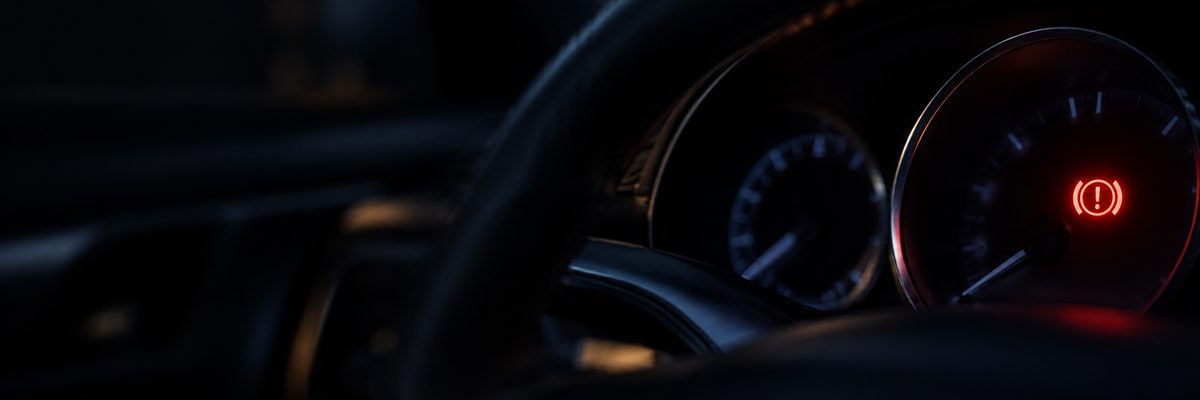

One red brake lamp covers several faults, so the lamp alone can't tell you which one set it off. The pedal feel and the fluid level often can.
What should you do if the brake warning light comes on while driving?
If the pedal feels wrong, or the light stays on with the parking brake off, don't drive on: have the car towed. A brake that's leaking or has lost a circuit won't get better on the way to the shop.
If it comes on at speed, turn on your hazard lights, slow down gently and leave the road as soon as it's safe. On some newer trucks with electric brake assist, the pedal may feel harder or lower and the truck may limit its own speed.
Is it safe to drive with the brake warning light on?
It isn't safe to drive with the brake warning light on until you know why, unless it was only the parking brake and the light went off. Your car has two brake circuits, so one can still stop it if the other fails, but it takes much longer.
The brake pedal is your best clue: once you're stopped somewhere safe, press it gently. Soft, sinking or much harder to push than usual means don't drive, and even a firm pedal doesn't make the car safe while the light stays on.
What does the brake warning light mean?
It means the parking brake is on, the brake fluid is low, or the brakes have a fault, and one red lamp covers all of them. The federal brake rule lists these reasons for the light:
- The parking brake is on. The one cause you can clear yourself.
- The fluid is low. Below the safe level the carmaker set for the reservoir.
- Part of the system lost pressure. A big loss of fluid or pressure, such as a burst brake line.
- An electrical fault in the ABS. On cars that show it on the red lamp instead of a separate yellow ABS light.
- Worn brake pads. Only on cars whose maker chose a dash warning for pad wear.
- An electric brake fault. On cars with electrically worked brakes, a fault or a low charge in that system.
A lamp covering two or more of these must be red and read BRAKE, or the car splits them onto lamps reading Brake Fluid, Park or Brake Wear. The rule also requires a bulb check, on most cars at start-up, so a light that never comes on needs a look.

Use this image
Free to republish under CC BY 4.0: credit Oil & Miles and link to this page. The snippet does both.
<a href="https://oilandmiles.com/articles/brake-warning-light"><img src="https://oilandmiles.com/assets/img/diagrams/brake-warning-light-signals.svg" alt="Where the brake warning light gets its signals: the parking brake switch, the brake fluid level float, a pressure loss in one of the two brake circuits and, on some cars, the ABS module all feed one red lamp that reads BRAKE" width="1600" height="900"></a> <p>Diagram: <a href="https://oilandmiles.com/articles/brake-warning-light">Oil & Miles</a>, CC BY 4.0</p>What is the symbol for the brake warning light?
It's red, and it reads BRAKE or shows an exclamation mark inside a circle, with a curved bracket on each side, as our dashboard warning lights guide shows. These look-alikes mean something else:
- ABS in a circle, yellow. The anti-lock system, not the regular brakes. See our ABS light guide.
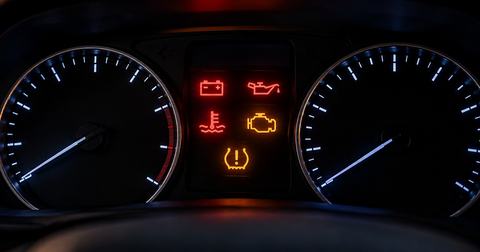
- A yellow parking brake light. On some cars, a fault in the electric parking brake, not low fluid.
- An amber BRAKE SYSTEM light. On some cars, a problem in a braking system other than the regular brakes.
- Brake Fluid, Park or Brake Wear in words. Cars that split the conditions onto their own lamps.
Why is my brake warning light on?
The brake warning light is on because one of those conditions happened, or the car thinks it did. The parking brake and worn pads are the common, less urgent ones, while a leak or a lost circuit is the dangerous one.
Below are the four usual causes, each with what you'll notice and what to ask. Start with the parking brake and the fluid level, because you can check both yourself.
1. The parking brake isn't fully off
You'll notice the light goes off once the lever, pedal or switch is fully released. The parking brake has its own switch on the lamp, so a brake left slightly on, or a worn or misadjusted switch, keeps it lit.
If the brake is fully off and the light stays on, don't assume it's the switch, because the brakes may not be working properly. Ask for the fluid and the switch to be checked together.
2. Worn pads, by low fluid or a wear sensor
You'll find the fluid near the MIN mark, with nothing wet anywhere. As pads wear thinner, the pistons that push them sit further out, and fluid from the reservoir fills the gap, so the level drops.
That's normal wear, not a fault, but a leak can light the lamp the same way, so never assume it's the pads until a leak is ruled out. Ask for the pads to be measured and the brakes checked for leaks before anyone quotes other parts, and our guide shows what new pads and rotors cost.
On cars with a small wire in the pads that warns when they're thin, you'll see the light or a separate Brake Wear light. Many cars have none and use a squeal or a visual check instead, so a dark lamp doesn't prove the pads are fine.
Once a shop confirms it's the pads, book new pads soon, because the sensor warns only when they're already thin. Have the rotors looked at in the same visit, since thin pads wear them too.

Fluid at the MIN line
3. A leak, sometimes one you can't see
You'll notice the level keeps dropping, sometimes with a wet spot at a wheel or a pedal that feels different. Fluid is escaping from a hose, a caliper or the master cylinder, the part your pedal pushes, and the brakes can't work well until it's fixed.
On some pickups and big SUVs the fluid leaks into the brake booster behind the pedal, so there's no puddle at all. Check each wheel and behind the reservoir, and our brake fluid leak guide shows where else to look.

A wet hose at the caliper
4. A false reading from a sensor, wiring, software or a weak battery
You'll see the light on with the fluid between MIN and MAX and the parking brake off. A faulty level sensor, a bad wiring connection or a software glitch can tell the dash the fluid is low when it isn't.
Carmakers have fixed this on some newer SUVs and sedans with a new reservoir sensor, a cleaned ground or a software update. Ask for a scan and a check of the grounds first.
A weak battery can do the same, often after a slow start or on a cold morning, with a brake message, a harder pedal or a speed limit. Low voltage can make the brake computer report a fault that isn't there, and on some trucks it's the first thing dealers are told to check.
Ask for the battery and its cable clamps to be tested before any brake part. Our guide to a bad battery or alternator shows how to tell which one it is.
Why is my brake warning light flashing or coming on and off?
A brake warning light flashes because your carmaker chose it to, and it can mean low fluid, a parking brake left on, or an electric parking brake fault. What a flashing brake light means depends on your car, and these are the usual ones:
- In sharp corners. On some cars it flickers as the fluid moves in a low reservoir. Have the level checked.
- With the parking brake on and the car in gear. Some cars flash it, with a chime once you move, to warn you're driving off with the brake set. Release it fully.
- On an electric parking brake. A light that flashes after you release it, or while you drive, can mean a fault in that brake. See a dealer.
Your manual's warning-light page says what a flash means on your car. Until you've read it, treat a flash like a steady light.
What does "check brake system" mean?
It's a text message on the driver display, not the lamp itself, and it can tell you more, because some messages name the part. The brake system messages depend on the carmaker, and these are the common ones:
- Brake Fluid Low. The level is below the safe mark.
- Service Parking Brake, Service Brake Assist or an amber Brake System Problem. A fault in the electric parking brake, in the system that adds force to your pedal, or in another braking system such as brake hold. Our Service Brake Assist page covers the pedal assist.
- Service Brake System or Brake System Failure. A fault the car found, set on some trucks by low voltage, or brake assist off, which a free recall fixed on some pickups.
Treat a message the way you'd treat the lamp: check the parking brake and the fluid, then have the codes read. If it came with a soft or hard pedal, stop.
How do you fix or reset the brake warning light?
You fix the brake warning light by fixing what turned it on, because the light stays lit as long as the cause is there. There's no reset button, and a light that comes back after it's cleared means the problem never went away.
Before anyone replaces a part, you can make 5 safe first checks yourself, so work through the 5 steps below, in order:
- Release the parking brake fully. On an electric one, use the switch the way your manual shows.
- Check the fluid on level ground. It should sit between the MIN and MAX marks on the reservoir.
- Find out why it's low before adding any. Some manuals say not to top off the brake fluid, because adding fluid doesn't fix a leak. If yours says to add some, use only the type printed on the cap, from a sealed bottle.
- Look for a leak. Check inside each wheel, under the car, and behind the reservoir where the master cylinder meets the booster.
- If the level is fine, get it scanned. Ask for the brake and ABS codes to be read, plus a check of the grounds and a battery test.
If the light stays on after these, a shop has to find the cause. Before you pay for any repair, check your VIN with our free VIN checker or NHTSA's recall lookup, because several leaks and brake faults are free recall repairs.
What to say to the shop
“Before you replace a part for the brake light, can you measure the pads, show me the leak, read the codes and check my VIN for recalls?”
What the repair costs depends on the cause. Our guides price a brake fluid leak repair and brake pads and rotors, parts and labor.
Outside the US
In the UK, a lit brake fluid warning is only a Minor defect at the MOT, while an electronic parking brake or ABS warning that shows a fault is Major (GOV.UK MOT inspection manual, sections 1.1.10, 1.1.6 and 1.6). UK owners check recalls on GOV.UK by registration number, and Canadian owners search Transport Canada's recall database by make, model and year.

Use this image
Free to republish under CC BY 4.0: credit Oil & Miles and link to this page. The snippet does both.
<a href="https://oilandmiles.com/articles/brake-warning-light"><img src="https://oilandmiles.com/assets/img/diagrams/brake-warning-light-checklist.jpg" alt="Brake warning light checklist: release the parking brake, check the fluid on level ground, find out why it's low before adding any, look for a leak at each wheel; stop and have it towed with a soft or sinking pedal, the light on with the parking brake off, or BRAKE and ABS on together; check your VIN, because some leaks run into the booster with no puddle; ask the shop to measure the pads, read the codes, check the grounds and test the battery, and don't top off to make it go away." width="1200" height="1566"></a> <p>Infographic: <a href="https://oilandmiles.com/articles/brake-warning-light">Oil & Miles</a>, CC BY 4.0</p>From the carmakers
Is there a recall or free fix for the brake warning light?
The federal rule and the carmakers' documents say what the brakes must still do, why the light comes on and when to stop. Ford and GM recalls fix the leaks and faults behind the light at no charge.
A recall repair is done free at a dealer, but only on cars whose VIN is on that recall. Run your 17-digit VIN on NHTSA's recall lookup, or ask a dealer, before you pay for a brake part.
Recall 25V-236
A brake fluid leak can cause reduced brake function and extend the distance required to stop, increasing the risk of a crash.
Recall 22V-150
The brake master cylinder may allow brake fluid to leak from the front wheel circuit into the brake booster.
Recall 20V-332
The brake master cylinder may leak brake fluid into the brake booster.
Recall 16V-345
The master cylinder rear cup seal may roll, resulting in brake fluid leakage from the primary reservoir into the brake booster.
Recall 20V-469
The front brake hoses may rupture prematurely.
Recall 25V-544
The rear brake jounce hose may rupture and leak brake fluid.
Recall 20V-055
This software has an error, and as a result, the vehicle's electronic brake assist may be disabled.
Recall 23V-727
Without a low brake fluid warning light, the vehicle may be driven with low brake fluid, reducing braking performance…
Recall 25V-689
The brake fluid level sensor may not activate the visual warning indicator when the brake fluid is low.
Bulletin 08-241-23
A brake warning lamp on in Instrument Panel Cluster (IPC) and a firmer brake pedal.
Federal rule FMVSS 135
The remaining portions of the service brake system shall continue to operate and shall stop the vehicle.
Conclusion
What to do next about a brake warning light
If the light stays on with the parking brake off, or the pedal feels soft, sinks or is much harder to push, don't drive, and have the car towed. If the fluid is low, find out whether it's worn pads or a leak before you add any.
Oil & Miles checks each step here against the federal brake rule, the carmakers' manuals and bulletins, and NHTSA's records.
Common questions
Asked most often
Can a low battery cause the brake warning light?
Yes, on some cars. Low voltage can set a brake message on some trucks, or briefly light the parking brake warning after an automatic restart, so have the battery tested first.
What does the brake system warning light mean on a Honda?
The red light, reading BRAKE in the US, means the parking brake is on, the fluid is low, or the brake system has a problem. The amber BRAKE SYSTEM light covers other braking systems, like the electric parking brake, and means have it checked.
How much does it cost to fix the brake warning light?
It depends on the cause: nothing for the parking brake, new pads for wear, or a leak repair. Our brake fluid leak and brake pad and rotor cost guides price each one.
What people ask next
Sources
- FMVSS 135, light vehicle brake systems (49 CFR 571.135), for what must light the lamp, its color and words, the bulb check, flashing, and the 551-foot stop with one circuit failed. Code of Federal Regulations, read September 27, 2026
- General Motors owner's manuals, such as the 2022 Chevrolet Equinox (page 273), for not topping off the brake fluid. General Motors, read October 29, 2026
- FMVSS 101, controls and displays (49 CFR 571.101), for the red color of the brake system warning. Code of Federal Regulations, read September 9, 2026
- Owner's manuals, GM, Nissan and Hyundai: 2017 Malibu, 2018 Equinox, 2020 Silverado, 2020 Altima and 2023 Sonata, for what the light covers, the messages and when to stop. Read September 27, 2026
- Owner's manuals, Toyota, Jeep, Ford and Honda: 2021 Avalon, 2019 Camry, 2015 Wrangler, 2014 F-150, 2018 CR-V and Accord, and 2016 Civic, for the pedal check, flashing, the amber light and Toyota's stop advice. Read September 27 and 28, 2026
- NHTSA recalls 16V345000, 20V332000, 22V150000, 25V236000, 20V469000, 20V055000, 23V727000, 25V689000 and 25V544000, from NHTSA's recall records and the carmakers' Part 573 reports, for the leaks, the brake assist fault and the low fluid light that may not come on. NHTSA, read September 27, October 21 and October 23, 2026
- Service bulletins: Nissan NTB12-011a (campaign PC125), Ford SSM 54431, GM PIC6156, PIT5634 and PIT6467C, and Jeep 08-241-23, for pad wear, false readings and low voltage. Carmakers via NHTSA, read September 27, 2026
- Independent shops in Florida and Texas: Flex Auto (Orlando), Great Bear Automotive (Weston) and Auto Service Experts (San Antonio), on why worn pads lower the fluid, the pedal check and what a shop checks. Read October 21, 2026
- Independent shops in California and New Jersey: Grand Garage (Escondido), Toole's Garage (San Carlos) and Geller's Automotive (Byram), on the parking brake switch, a soft pedal and when to tow. Read October 21, 2026
- MOT inspection manual, sections 1.1.6, 1.1.10 and 1.6 (parking brake, brake fluid, anti-lock braking), for the UK MOT grade of each brake warning. GOV.UK, read November 4, 2026
- Check if a vehicle has been recalled and Transport Canada, defects and recalls of vehicles, for recall checks in the UK and Canada. GOV.UK and Transport Canada, read November 4, 2026
AI illustration by Oil & Miles
How this was compiled
The causes and what to do come from the federal brake rule, carmakers' owner's manuals, service bulletins and recall reports. Independent shops' articles are used only where two or more agreed, for how pads lower the fluid and what a shop checks.
What we didn't do
We didn't test a car or scan one ourselves, and we didn't cover air brakes or trailer brakes. We didn't read a Subaru or Kia owner's manual for this light.
We found no carmaker figure for how many miles pads have left once a wear light comes on, so we give none. The cost guides price the repairs, so this page doesn't.
This article is general information, not advice about your specific vehicle. See the disclaimer.