
Key takeaways
- Safety: A brake grind that stays on means have the brakes checked now, and have the car towed if the red brake light is on.
- A few grinds on the first stops after the car sat overnight or got wet can be rust and clear within a few stops.
- A grind that stays on can mean pads worn past their warning squeal.
- Pads that look fine can still grind, because the inner pad can wear faster or a stone or bent dust shield can rub the rotor.
- A grind while you drive but not while you brake points away from the brakes, to a wheel bearing for example.
Brakes making a grinding noise are either metal meeting metal, or rust or grit between the pad and the rotor. When it grinds and whether it stays on tell you if the car can wait for a shop or shouldn't move.
Is it safe to drive with grinding brakes?
It depends on whether the grinding stays. A few grinds on the first stops after rain or an overnight sit can be rust that clears within a few stops.
A brake grind that stays on means have the brakes checked now, and have the car towed if the red brake light is on. If the brake pedal feels spongy or soft, or goes down further than normal, have the brakes checked immediately. Pads worn to the metal are dangerous to drive on, and worn pads can make the brakes fail.
Worn brakes need checking as soon as possible, so don't keep driving on a grind that stays on. If money is tight, ask the shop to measure the pads and the rotors first. Pads alone can be enough when the rotors pass, and waiting can turn a pad job into a pad and rotor job.
What causes a grinding noise when braking?
The first cause to rule out is pads worn down to the metal. If the pad has a built-in tab, it squeals when the pad gets thin, and grinding can mean that warning was missed.
The squeal can come and go, and it may stop when the pedal is pressed firmly. On some cars it's a high-pitched screech that stays on whether or not the pedal is pressed.
Three more causes make the same noise:
- A stone or grit. Something small caught between the pad and the rotor rubs until it falls out or is pulled out.
- Scored rotors. Grooves cut into the rotor rub against the pad, even a new one.
- A stuck caliper or slide pin. A caliper that doesn't let go keeps a pad rubbing on one wheel.
A knock or a clunk with the grind is a different fault, so describe it to the shop. A squeal on its own is a different fault too.

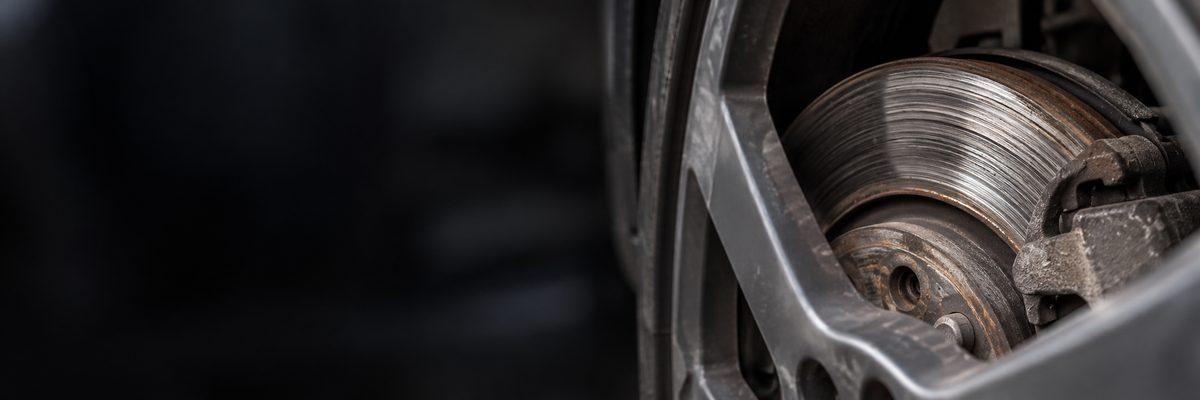
A pad worn to metal
Is the grinding even coming from the brakes?
A grind while you drive, not while you brake, is a different fault. A bad wheel bearing hums, then growls, then grinds. Grinding, play in the wheel or jerky steering means stop and have the car towed.
A heat shield touching the driveshaft can grind while you brake at low speed, and a wheel hub that doesn't sit flat can make the front end grind or shake in a way that feels like the brakes. A shop can check both, and on some cars the fix for the hub is a new one.
Why do brakes grind in the morning or after rain?
A grind on the first stops can be surface rust. Rust forms on the rotors overnight or when they get wet, and the first few stops wear it off.
Some front pads grind or groan on the first few stops after the car sat overnight, and it may feel like ABS is active when it isn't. The fix is new front pads and a burnish, a set of stops that beds the new pads in.
If the grinding clears within a few stops, rust can be the cause. If it comes back every morning, ask the dealer whether a pad bulletin covers your car.
Why are my brakes grinding when stopping at low speed or on a hard stop?
At low speed with light pedal pressure a pad can rub, so a grind can show up there first. An occasional squeal on light to moderate stops is normal, but a grind that stays on isn't.
On a hard stop the anti-lock brakes can make a motor sound and pulse the pedal, and that's normal. A noise that carries on after the braking ends isn't ABS.
Why do electric cars and hybrids grind?
Electric cars and hybrids can grind from surface rust. They slow down mostly by regenerative braking, so the pads touch the rotors less and the rust has little to rub off.
A burnish of about six moderate stops from 50–55 mph to 10 mph, 30 seconds apart, might clear a squeal from surface rust. If the grind stays on after that, have the brakes checked now.
Why do my brakes grind when the pads look fine?
The pad you can see may not be the one that's worn. The inner pad, on the far side of the rotor from the wheel, can wear faster than the outer pad, so a shop should measure both.
A stone caught behind a bent or rusted dust shield can rub the rotor with plenty of pad left. A sticking caliper or worn slide hardware can wear one pad faster than the other too. On some cars the rear discs rust and the rear pads can't wipe it off, and the result is a grind when braking. Ask the shop to measure the pads on both sides and the rotor thickness, because a rotor can look fine from the wheel side.

A rotor with grooves
What to say to the shop
When a quote names pads or rotors, ask:
- What are the pad measurements on both sides?
- What is the rotor measurement?
“My brakes grind when I brake. Can you measure the pads on both sides and the rotor before you replace anything?”
A good answer: the pad and rotor numbers on both sides, before any part is ordered.
Why are my new brakes grinding?
A grind after a brake job can point to a part that was disturbed rather than a bad pad. A dust shield bent during the job, pad clips or shims left out, or pads that were never bedded in can all cause it.
New pads need bedding in, a set of moderate stops with no hard ones. A bedding routine is ten moderate stops from about 30 mph, each followed by a minute of cruising to cool the brakes.
Call the shop that did the work before you pay for new parts. A noise that starts right after a brake job is theirs to check.
How much does it cost to fix grinding brakes?
Pads alone cost the least, and pads with rotors cost more. A front pad and rotor job on a 2025 Subaru Crosstrek 2.0 runs about $391–$488, parts and labor, at an independent shop.
A stuck caliper adds to that bill, and our brake pad and rotor cost guide prices more cars. There's no safe temporary fix, so the cheapest repair is the one done before the rotors are scored.
From the carmakers
Is there a recall or bulletin for brake grinding?
A few cars have a bulletin for the grind. A bulletin isn't a recall, and a bulletin isn't a free repair by itself. Our free VIN decoder lists your model year's recalls, and the dealer can tell you in writing whether a bulletin applies to your VIN and who pays.
Service bulletin 21-NA-142
…describe it as a grind/groan sound.
Service bulletin 25-NA-128
…a grind, groan and/or rubbing type noise coming from the front of the vehicle.
Service bulletin 19-NA-116
…hearing grinding or scraping noise coming from the brakes.
Service bulletin 04-001-24b
…hearing a grinding noise and/or vibration occur when applying the brake.
Service bulletin 04-003-22a
…may exhibit a grinding noise from the rear brakes when braking.
Service bulletin 04-001-26
…the front inner brake pads wear out faster than the outside.
Service bulletin 04-003-25a
…premature wear of the front inner brake pads.
Service bulletin 24-2078
…a grinding or rubbing noise while braking at or below 10 mph.
Service bulletin SSM 51948
…a squeal and/or grinding noise and/or vibration from the front brakes.
Conclusion
What to do next about grinding brakes
Note when it grinds, and have the pads and rotors measured before you pay for anything. A brake grind that stays on means have the brakes checked now, and have the car towed if the red brake light is on.
Oil & Miles checks each step here against the carmakers' manuals and bulletins and NHTSA's records.
Common questions
Asked most often
Is there a temporary fix for grinding brakes?
No. There's no safe temporary fix, so have the brakes checked now.
Does ABS make a grinding sound?
On a hard stop the anti-lock brakes can make a motor sound and pulse the pedal, and that's normal. A noise that carries on after the braking ends isn't ABS.
How far can you drive on grinding brakes?
Don't. A grind that stays on means have the brakes checked now, because worn brakes need checking as soon as possible.
What people ask next
Sources
- 2025 Chevrolet Equinox Owner's Manual (US), printed pages 247 and 178, for the wear indicator sound, noise on the first stops and Brake Assist noise. General Motors, read November 5, 2026
- 2020 Nissan Altima Owner's Manual (US), pages 8-20, 9-2 and 2-10, for the wear indicator, normal brake noise, the pedal and the brake light. Nissan, read November 5, 2026
- 2025 Mazda CX-5 Owner's Manual (US), section 5, for worn disc pads. Mazda, read November 5, 2026
- 2012 Toyota Camry Owner's Manual (US) and 2018 Honda Accord Owner's Manual (US), printed page 205 and PDF page 581, for the sounds the anti-lock brakes make. Toyota and Honda, read November 5, 2026
- Infiniti bulletin ITB00-024K (March 2023), for bedding in new pads. Infiniti via NHTSA, read November 5, 2026
- Tesla Model Y and Model 3 service pages, for rust on the discs from little friction-brake use and a stone in the dust shield. Tesla, read November 5, 2026
- GM bulletins 21-NA-142, 25-NA-128 and 19-NA-116, Mazda bulletins 04-001-24b, 04-003-22a, 04-001-26 and 04-003-25a, and Ford bulletins 24-2078 and SSM 51948, for the cars in the cards. General Motors, Mazda and Ford via NHTSA, read November 5, 2026
- Our pad and rotor replacement cost page, for the front-axle figure on the 2025 Subaru Crosstrek 2.0, its parts and Subaru's hours, with that page's own sources. Oil & Miles
- NHTSA recalls by VIN, for the brake recalls on the cars here and the VIN lookup. NHTSA, read November 5, 2026
The manual lines come from each carmaker's US owner's manual, and the bulletins from NHTSA's archive of carmaker service documents.
AI illustration by Oil & Miles
This article is general information, not advice about your specific vehicle. See the disclaimer.