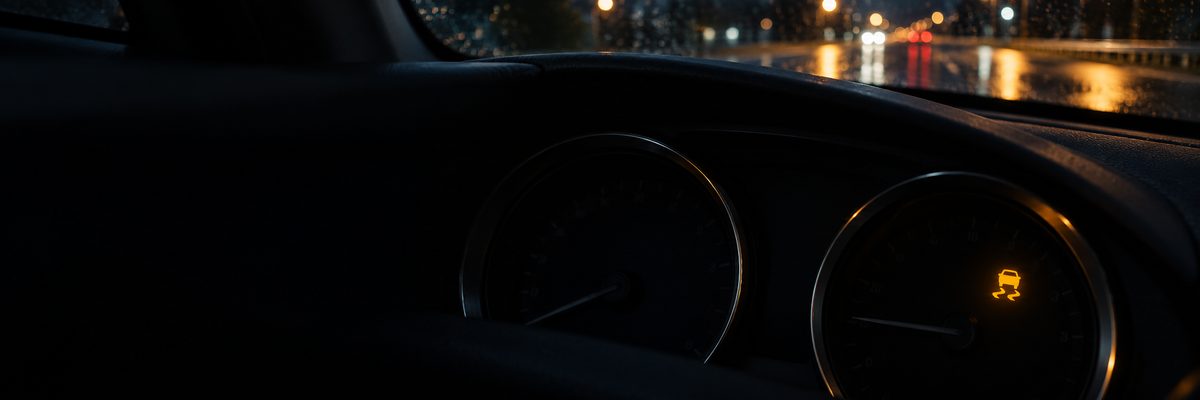

The traction control light is the yellow lamp that shows a swerving car with two wavy skid lines, or the letters TC or TCS, for traction control, or ESC, for electronic stability control. Federal rules let that one lamp report on two systems.
Traction control stops the drive wheels spinning, and stability control stops the car sliding sideways. A fault in either one can light the lamp.
What does the traction control light mean?
Flashing means it's working right now, holding back a wheel that has started to spin. A steady light means it's switched off or has found a fault.
The lamp also lights for a moment when you start the car, as a bulb check, and then goes out. If it stays on after that, or comes on while you drive, the system is telling you something.
Why is the traction control light flashing?
Because it's working: a wheel is slipping, and the system is braking it or cutting power to get grip back. Ease off the accelerator and drive to suit the road.
Flashing with a loss of power is the same thing on a slippery road, since cutting power is how the system works. If it flashes under hard acceleration after new tires, a mismatched set can be fooling it, and if the car also stumbles or jerks, see why a car jerks when accelerating.
What does traction control do?
It stops the drive wheels spinning when you pull away or speed up on a slippery road. When a wheel starts to spin, the system brakes that wheel and cuts engine power until the tire grips again.
Stability control is its partner: it compares where you're steering with where the car is actually going, and brakes single wheels to stop a slide. Most cars and light trucks built on or after September 1, 2011 must have stability control.
Is it safe to drive with the traction control light on?
Yes, carefully, if it's the only light on, but get it checked soon. With the system off or faulty, the car may not catch a spinning wheel or a slide, so the car depends on how you drive it.
Go gently on the accelerator, slow down earlier for turns, and leave more room on wet or icy roads. Some manuals say to see a shop right away, so don't put the check off for weeks.
Some lights with it change the answer. Pull over and have the car checked if the traction light comes with any of these:
- The red brake warning light. Together with the ABS (anti-lock brake) light it can mean a brake fault. Our brake warning light guide says what to do.
- Heavy steering or a power steering warning. The traction message can come on together with a power steering failure, and the steering needs looking at first.
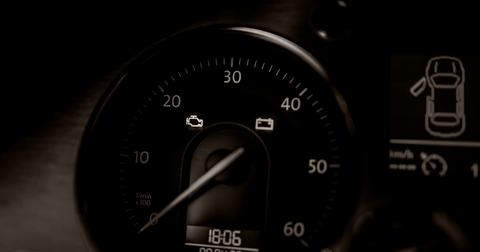
- Engine Power Reduced or a sudden loss of power. An engine fault can switch stability control off. Our engine power reduced guide covers the GM message.
- A flashing check engine light. That's a reason to slow down on its own. See what a flashing check engine light means.
What does the car with squiggly lines mean?
It's the traction and stability control light: a yellow car with two wavy skid marks under it, the symbol federal rules set for stability control. Some cars use the letters TC, TCS or ESC instead, or TC inside a tire outline, the international symbol for traction control.
The same car with OFF under it, or with a line or slash through it, means the system has been switched off. Your owner's manual's warning light page shows which one your car uses, and our dashboard symbols page shows them side by side.
Why is my traction control light on?
Because the system has been switched off, or because a reading it depends on has gone missing. It compares each wheel's speed with where you're steering and how the car is turning, and when one of those readings drops out, it switches itself off and lights the lamp.
Eight causes come up in carmakers' documents and the parts makers' guides, and each one below says what to check or ask. Start with the first, the button, since it costs nothing.

Use this image
Free to republish under CC BY 4.0: credit Oil & Miles and link to this page. The snippet does both.
<a href="https://oilandmiles.com/articles/traction-control-light"><img src="https://oilandmiles.com/assets/img/diagrams/traction-control-light-signals.svg" alt="Where the traction control light gets its signals: the four wheel speed sensors, the steering angle sensor in the column, the yaw sensor, the brake light switch and the engine all feed one stability module, which lights one yellow lamp" width="1600" height="1314"></a> <p>Diagram: <a href="https://oilandmiles.com/articles/traction-control-light">Oil & Miles</a>, CC BY 4.0</p>It was switched off
It's the simplest cause: someone pressed the traction button. The lamp then shows OFF, or a separate OFF light comes on, and the system stays off until you press it again or restart, though on some cars part of it comes back on as speed rises.
Press the button once and watch the light. If it goes out, that was all it was, and the on or off section below says when to switch it off yourself.
A wheel speed sensor
Delphi, a sensor maker, says a failed wheel speed sensor, its wiring or the toothed ring it reads can light the traction light as well as the ABS light. All three systems read the same four sensors, and Hella says that signal feeds traction and stability control.
If the ABS light is on too, start here. Our ABS light guide covers the sensor, its wiring and ring, the recalls, and what the sensor costs car by car.

A chafed wheel speed sensor wire
The steering angle sensor or clockspring
A steering angle sensor that reads wrong leaves the system unable to tell a slide from a turn, so it switches off and lights the lamp. The sensor sits in the steering column. On some cars it's inside the clockspring, the coiled strip behind the steering wheel.
Delphi says the sensor can need a reset after an alignment, steering or suspension work, and on some cars after the battery is disconnected. The clockspring also carries the airbag wiring.
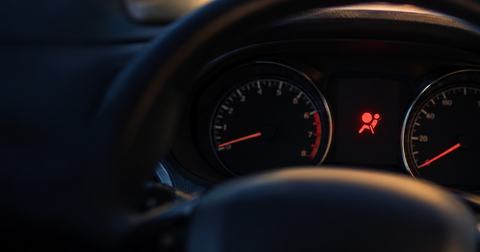
A failing clockspring can turn on the airbag (SRS) light as well. On some Jeeps a warranty extension covers a new one, so ask a dealer first.
If the light came on after an alignment, steering work or a battery change, ask for the steering angle sensor to be reset before anyone replaces a part. A reset is labor only, as the cost section shows.
The brake light switch
A brake light switch that's out of adjustment or has dirty contacts sends a signal the system can't trust, so it switches off. The switch sits at the brake pedal and tells the system, and your brake lights, when you press it.
A clue can be at the back of the car: brake lights that stay on, or don't come on when you press the pedal. Ask someone to watch while you press, and mention it to the shop, since a recall has fixed this free on some older cars.
A weak battery or low voltage
The sensors and the module that runs the system need steady voltage. A weak battery, a loose cable or a bad fuse contact can make the light and its messages come and go, and a short dip can leave the steering angle sensor needing a reset.
Ask for the battery and its cables to be tested before anything else is replaced. Our guide to a bad alternator or battery explains how the two are told apart.
Tires that don't match
The system spots a spinning wheel by comparing the speeds of all four. A tire of a different size, or with very different tread, turns at a different speed, which can look like a slip that isn't there.
If the light started after new tires, a flat or the small spare, check that all four match in size and type. Michelin, a tire maker, says traction control can need tires with matching diameters.
An engine or steering fault
Stability control works partly by cutting engine power. When the engine or the power steering has its own fault, the traction light or message can come on alongside it, even though no traction part has failed.
Fix the other fault first, and the traction light may go out with it. On GM cars, the pairing with Engine Power Reduced has its own article on this site.
A module or software fault
The system is run by a computer, which Delphi places inside the ABS module on many cars, and its software can fail too. When it does, carmakers have fixed it with recalls and software updates, and on some trucks with new parts.
Before paying for a module, have the VIN checked for open recalls. A dealer can also tell you whether a software update applies.
What does "Service Traction Control" or "Service StabiliTrak" mean?
It's the written version of a steady light: the car has found a fault and switched traction control off. You can usually drive on with care until it's checked, though GM's 2010 Malibu manual says to pull off the road.
GM's manuals give a restart to try first, the same 15-second reset the fix steps use. If the message comes back, the fault is still there, and a scan of the brake and stability module is the next step.
Service Brake Assist with it is a separate fault, which our Service Brake Assist page covers. Ask for both to be scanned, starting with the wheel speed sensors if the ABS light is on too.
Outside the US
In the UK, a stability control fault fails the MOT. A warning light that shows an ESC malfunction is a Major defect, and so are damaged wheel speed sensors and an ESC switch that doesn't work, under section 7.12 of the GOV.UK MOT inspection manual.
Should traction control be on or off?
On, for normal driving. The manuals say to switch traction control off only when the car is stuck in snow, mud, ice or sand and needs its wheels to spin to get free.
It also turns itself back on every time you restart, in most cases. On GM cars, cruise control cancels while the system is off or working.
So a light that stays on after a restart is a fault, not a forgotten button. The exception is a car started in low-range four-wheel drive, the gear for off-road crawling, which can leave the system off.
Don't switch it off while the light is flashing. Repeated hard braking or acceleration with it off can also damage the driveline, the parts that carry power to the wheels.
Is StabiliTrak the same as traction control?
Not quite: StabiliTrak is GM's name for stability control, also called ESC, and GM calls its traction control TCS. Every carmaker names the pair its own way, which is why the letters on the dash vary:
- GM (Chevrolet, GMC, Buick, Cadillac). StabiliTrak for stability control and TCS for traction control.
- Ford. AdvanceTrac.
- Toyota and Lexus. VSC and TRAC, shown on a lamp Toyota calls the slip indicator.
- Honda and Acura. VSA, for Vehicle Stability Assist.
- Nissan, Infiniti and Subaru. VDC, for Vehicle Dynamic Control.
- Hyundai and Jeep. ESC, the standard name.
Whatever the name, it's the same traction and stability control light, so a message such as Service StabiliTrak gets the same checks. The button's name differs too, so your manual's controls page shows which one switches it off.
How do you fix or reset the traction control light?
By fixing whatever switched the system off, because the light goes out on its own at the next start once the fault is gone. To fix the traction control light, work through the 6 steps below, in order:
- Check it isn't just switched off. Press the traction button once, or restart the car, since the system comes back on at every start.
- Restart after 15 seconds off. That's the reset GM's manuals give. If the light comes back, the fault is still there.
- Look at what else is lit. The ABS light points to a wheel speed sensor, Engine Power Reduced to the engine, and a steering warning to the power steering.
- Check that the tires match. The sizes your manual lists, and the same type on all four. GM's manual notes that the small spare can set the traction system working until the car recognizes it.
- Have the stability and ABS module scanned, not just the engine. Ask for the codes, a battery test, and a steering angle reset if the car had an alignment or battery work.
- Run the VIN before paying. Our free VIN decoder shows the car's details, and a recall or a warranty extension may cover it.
After a repair, the light should go out at the next start once the fault is corrected. A light that goes off and comes back later means the fault comes and goes, so note when it happens for the shop.
How much does it cost to fix the traction control light?
Often little or nothing, since recalls are free and GM allows 0.3 hours for a steering angle sensor reset, about $30 to $42 in labor on the 2016 Malibu. Adjusting the brake light switch on a Subaru Forester, Legacy or Outback is booked at 0.5 hours, about $50 to $70, with no part to buy.
A wheel speed sensor, the part this light shares with the ABS light, runs about $95–$108 on a 2016 Subaru Outback, parts and labor, at an independent shop. On a 2011–2016 Wrangler, ask a Jeep dealer about the clockspring warranty extension before paying for one.
A shop's diagnosis time comes on top, so a scan of the stability and ABS module, plus a battery test, is worth paying for before any part. Labor here is priced at $100 to $139 an hour, what nearly half of independent shops charge. Ask for the hours and the rate on the written quote.

Use this image
Free to republish under CC BY 4.0: credit Oil & Miles and link to this page. The snippet does both.
<a href="https://oilandmiles.com/articles/traction-control-light"><img src="https://oilandmiles.com/assets/img/diagrams/traction-control-light-checklist.jpg" alt="Traction control light checklist: press the button once, restart after 15 seconds off, look at what else is lit and pull over if the red brake light or heavy steering comes with it. Ask for a scan of the stability and ABS module, a battery test, a steering angle reset and a brake light check. Run the VIN for the Wrangler clockspring extension and recalls. Don't pay for parts before a reset or battery test, or for hard launches with it off." width="1200" height="1516"></a> <p>Infographic: <a href="https://oilandmiles.com/articles/traction-control-light">Oil & Miles</a>, CC BY 4.0</p>From the carmakers
What the rule and the manuals say
The federal rule decides when the light must go out, and the carmakers decide how worried you should be. Every quote below is in the carmaker's own words.
Warranty extension 08-005-17 Rev. A
Vehicles included in this Service Bulletin have a 15 Year, Unlimited Miles/Kilometers Warranty for this repair.FCA US, 2017
Federal standard FMVSS 126, S5.3.7
The ESC malfunction telltale must extinguish at the next ignition cycle after the malfunction has been corrected.49 CFR 571.126, S5.3.7
Owner's manual 2019 Silverado 1500, page 245
The vehicle is safe to drive, but driving should be adjusted accordingly.General Motors, page 245
- 2020 Chevrolet Equinox. The light flashes when traction control is limiting wheel spin, and stays on when either system isn't working (owner's manual, pages 121 and 210).
- 2021 Toyota Avalon. The slip indicator flashes while the systems work. Steady, it means a fault, and Toyota says to have the car inspected immediately (owner's manual, pages 312 and 439).
- 2016 Honda Odyssey. The VSA light blinks when the system is active. If it stays on, Honda says to have the car checked by a dealer immediately (owner's manual, pages 75 and 427).
- 2023 Hyundai Sonata. The ESC light blinks whenever the system is working. If it stays on, the system may have a malfunction (owner's manual, pages 104 and 346).
- 2013 Nissan Altima. The slip indicator blinks when the stability or traction control system is working (owner's manual, page 87).
- 2019 Chevrolet Silverado 1500. Stop, turn the engine off for 15 seconds and restart. If it stays on, see the dealer (owner's manual, page 245).
- 2012 Chevrolet Cruze. The car is safe to drive, but the system isn't working (owner's manual, pages 235 and 237).
- 2010 Chevrolet Malibu. With a SERVICE ESC message, pull off the road as soon as possible, stop carefully and restart. If it stays, the car needs service (owner's manual, page 202).
- 2016 Honda Odyssey and 2013 Accord. It may not affect normal driving, but have the car checked by a dealer immediately (owner's manuals, Odyssey page 427, Accord page 466).
- 2015 Jeep Wrangler. If it stays on after several restarts and several miles above 30 mph, see a dealer as soon as possible (owner's manual, page 484).
- 2016 Chevrolet Malibu. The traction light comes on after a brief drop in voltage. GM says not to replace any parts, but to turn the wheel lock to lock and clear the code, 0.3 hours (16-NA-151).
- 2012–2013 Toyota Camry, 2013 Avalon, 2014 Corolla. The VSC warning light with a steering angle stuck at one reading. Toyota tells technicians to inspect the spiral cable, its name for the clockspring (T-TT-0277-13).
- Honda Accord, CR-V, Civic, Odyssey and Pilot. The VSA light can come on if the sensor moves while the clockspring is removed and refitted (ServiceNews A19050B, covering models from 2012 to 2019).
- 2013–2018 Mazda CX-5. The traction and tire pressure lights, when the learned steering angle doesn't match driving straight. Mazda fits a modified control unit (04-003/19).
- 2004–2012 Chevrolet Malibu, 2004–2007 Malibu Maxx, 2005–2010 Pontiac G6 and 2007–2010 Saturn Aura. Recall 14V252000: a bad connection in the brake apply sensor circuit can make the brake lights misbehave and switch off traction and stability control. The recall repairs the connector and relearns the pedal position, free of charge.
- Subaru Forester, Impreza, Crosstrek, WRX, Legacy and Outback. A switch out of adjustment, or contacts coated by a silicone lubricant, lights the ABS or VDC lamp. Adjusted in 0.5 to 0.8 hours, or a redesigned switch in 0.7 hours (06-46-14, 06-55-16R, 07-131-18R).
- 2007–2011 Acura MDX. The VSA light from the brake pedal position switch, replaced in 0.2 hours (11-014).
- 2013 Infiniti JX35, 2014–2017 QX60 without Intelligent Cruise Control. The VDC light with a stop lamp switch code when the switch tests fine. A jumper harness fixes the circuit (ITB18-006B).
- 2019–2020 Jeep Wrangler. The ESC light with a stop lamp code, sometimes after other service work, from a pinched factory accessory harness (STAR S2008000097).
- 2011–2015 Chevrolet Cruze. A negative battery cable with high resistance can set Service Traction and Service StabiliTrak messages that come and go. GM covered the cable for 10 years or 120,000 miles from the date the car was first sold, so it has run out for any Cruze first sold more than 10 years ago (special coverage 14311, last revised as 14311B).
- 2018 Chevrolet Equinox and GMC Terrain. A Service Stability message at start-up. GM asks dealers for a battery test while the cause is still under investigation (PIT5739).
- 2021–2024 Chevrolet Tahoe and Suburban, GMC Yukon, Cadillac Escalade. Service StabiliTrak with other brake messages. On 2021–2022 models, if normal checks find nothing, GM has dealers test the battery, cables and fuse block (PIT6347B).
- 2018 Honda Accord and CR-V. The VSA and other lights can come on after the battery is reconnected, in amber on the Accord (owner's manuals, Accord page 496, CR-V page 512).
- GM cars and trucks, 2009 to 2017. The traction control light flashes under hard acceleration after a new set of tires that don't match in tread wear, traction or temperature ratings (16-NA-223).
- 2007–2013 Chevrolet Silverado and other GM trucks. StabiliTrak Off and Traction Control Off messages from an add-on device that recalibrates the speedometer for different wheel or tire sizes, not covered under warranty (PIT5120A).
- 2021 Toyota Avalon. The ABS, TRAC and VSC systems won't work correctly with different tires fitted (owner's manual, page 318).
- 2020 Nissan Altima. Wheels or tires other than Nissan's recommended ones can make the light flash or stay on (owner's manual, page 420).
- 2016 Honda Odyssey. The VSA system may not work properly with mixed tire types and sizes (owner's manual, page 427).
- 2013 Chevrolet Malibu, 2010–2013 Cadillac SRX, 2013 XTS. Reduced Engine Power, a no-start or Service StabiliTrak, one or more of them and on and off, from a poor fuse contact in the fuse block (PI1026).
- Ford Fusion and Explorer. In owners' federal complaints about these models from the 2010s, a Service AdvanceTrac message comes with a loss of power steering, so the steering is the fault to chase.
- 2011–2012 Hyundai Elantra. Recall 15V871000: a sensor fault can brake a wheel and cut power, with the ESC light on. Calibration update, free.
- 2012 Toyota RAV4, 2012–2013 Tacoma, Lexus RX 350. Recall 14V054000: the VSC, ABS and traction lights, and the systems may stop working. Software update, free.
- 2013 Ram 1500 4x4. Recall 13V287000: stability control software may switch the system off at start. Free fix.
- 2014 Jeep Grand Cherokee and Dodge Durango. Recall 14V636000: steering column module software may disable stability control. Free fix.
- 2018 Toyota Tundra and Sequoia. Recall 18V122000: interference in the power supply may switch stability control off. Free fix.
- 2025 Ram 1500. Recall 24V794000: damaged front hub encoder rings can disable stability control. The hub bearing is replaced, free.
- 2011–2015 Honda Odyssey. Several warning lights with VSA codes. Honda updates the VSA unit's software in 0.3 hours (16-005).
- 2012 Chevrolet Cruze. SERVICE TRACTION CONTROL and SERVICE STABILITRAK (owner's manual, page 140).
- 2010 Chevrolet Malibu. SERVICE ESC and SERVICE TRACTION, each with a chime (owner's manual, pages 200 to 203).
- 2019 Chevrolet Silverado 1500. A message shows in the driver information display. The manual doesn't print its wording (owner's manual, page 245).
- 2019 Chevrolet Silverado 1500. Press and release to turn traction control off. Press and hold to turn stability control off too. Stability control comes back on above 35 mph (owner's manual, page 247).
- 2023 Hyundai Sonata. A short press turns traction control off. Holding it for over 3 seconds turns stability control off as well (owner's manual, page 346).
- 2021 Toyota Avalon. A quick press turns TRAC off. Holding it for over 3 seconds while stopped turns TRAC and VSC off. If TRAC OFF comes on without a press, the car has switched it off, and Toyota says to see a dealer if it stays (owner's manual, pages 313 and 314).
- 2016 Honda Odyssey and 2013 Accord. Press and hold until it beeps, and VSA stops. With the tire pressure light on, you can't turn it off (owner's manuals, Odyssey page 428, Accord page 467).
- 2015 Jeep Wrangler. A quick press gives Partial Off. Holding it for 5 seconds gives Full Off, for off-road use. It's back on at each start unless the Jeep was started in 4-Low (owner's manual, pages 479 to 484).
- 2013 Nissan Altima. A VDC OFF switch. Press it again or restart to turn the system back on (owner's manual, pages 108 and 309).
Conclusion
What to do next about a traction control light
A flashing light is the system doing its job, and a steady light with OFF is the button. A steady light on its own is a fault, so drive gently, look at what else is lit and get it checked.
A steering angle reset, a battery test or matching tires can clear it before any part is replaced. Run the VIN before paying, since a recall or a warranty extension may cover it.
Oil & Miles checks each step here against the federal rule, 14 owner's manuals and the carmakers' bulletins.
Common questions
Asked most often
What does TC or TCS mean on a car?
Traction control, the system that stops the drive wheels spinning. TCS is traction control system, and some carmakers use their own names, such as StabiliTrak, VSC, VSA or VDC.
Why are my ABS and traction control lights on at the same time?
Both systems read the same wheel speed sensors, so a failed sensor, its wiring or its ring can switch both off. The ABS module is the other shared part.
Does traction control damage the transmission?
We found no document that says it does. GM's manuals warn about the opposite: with traction control off, repeated hard acceleration or braking can damage the driveline, the parts that carry power to the wheels.
What people ask next
Sources
- FMVSS 126, electronic stability control (49 CFR 571.126), for what the lamp must show, when it must go out, flashing, the off button and the restart rule. Code of Federal Regulations, read September 28, 2026
- FMVSS 101, controls and displays (49 CFR 571.101), Table 1, for the stability control symbol, its OFF form and its yellow color. Code of Federal Regulations, read September 28, 2026
- Owner's manuals: Chevrolet (2019 Silverado 1500, 2020 Equinox, 2012 Cruze, 2010 Malibu), Honda (2018 Accord and CR-V, 2016 Odyssey, 2013 Accord), Hyundai (2023 Sonata), Nissan (2020 and 2013 Altima), Toyota (2021 Avalon) and Jeep (2015 Wrangler). Read September 28 and 29, 2026
- Service bulletins and coverages: 18 from GM, FCA, Toyota, Honda, Mazda, Subaru, Acura and Infiniti, each numbered where the article cites it. Carmakers via NHTSA, read September 28, 2026
- NHTSA recalls 14V252000, 15V871000, 14V054000, 13V287000, 14V636000, 18V122000 and 24V794000, from NHTSA's recall records. NHTSA, read September 28 and 29, 2026
- Parts makers: Delphi on the wheel speed and steering angle sensors, Hella on wheel speed sensors, and Michelin on mixing tires. Read September 28, 2026
- PartsTech's September 2025 survey of about 700 US independent shops, as reported by Ratchet+Wrench (August 19, 2026), for the $100 to $139 an hour that nearly half of them charge. Ratchet+Wrench, read October 17, 2026
- RockAuto catalog, every listing for the cars priced. Read September 29, 2026
- NHTSA's consumer complaint database, for the Fusion and Explorer complaints that pair Service AdvanceTrac with a loss of power steering. US Department of Transportation, published August 25, 2026, read September 28, 2026
- MOT inspection manual, section 7.12 (electronic stability control), for the UK MOT result on a stability control fault. GOV.UK, read November 4, 2026
AI illustration by Oil & Miles
How this was compiled
The sections follow what the light is telling you and whether to keep driving, then the causes, the costs and how to get it off. The cars priced are common models with this light, plus a 2010 Malibu for its brake sensor recall, each in its peak complaint year.
The recalls come from NHTSA's records for 50 popular models from 2010 to 2025, and the bulletins from NHTSA's archive of carmaker service documents, read in full where we quote them.
What we didn't do
We didn't test or scan a car ourselves. We didn't publish a complaint count, because owners' complaints mix this light with other faults.
We found no document behind Toyota's TRAC OFF light coming on with the check engine light, or Subaru's three-light pattern with cruise control, so we left both out.
Prices are ranges compiled in November 2026 for the US market and vary by region, engine and shop rate. Prices from $10 up are rounded to the nearest dollar, so $14.13 reads as $14 and $14.52 as $15. Below $10 they're exact. This article is general information, not advice about your specific vehicle. See the disclaimer.