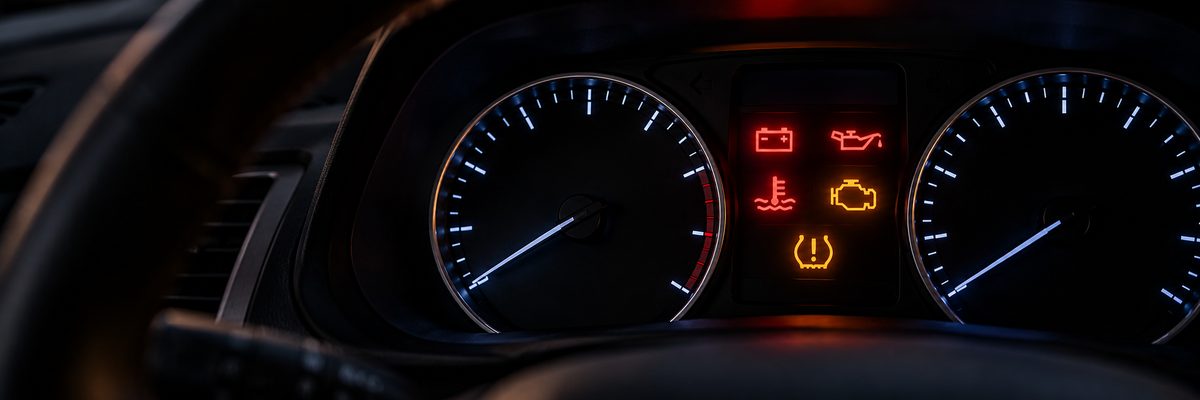

Plenty of dashboard lights only show that a system is switched on, and the warnings come in amber or red. Read the symbol as well as the color.
To match a symbol by its picture, use our dashboard symbols board. Your owner's manual has the final word for your car.
Which dashboard warning lights mean stop driving?
Oil pressure, engine temperature and the red brake light mean find somewhere safe and stop. A flashing or blinking check engine light joins them, because the damage grows while you drive.
For oil pressure, engine temperature, the brake light and a flashing check engine light, the carmakers' manuals say to do this:
- Oil pressure. Hyundai says to drive carefully to the nearest safe place, stop and check the oil level, and warns of severe damage if you don't. GM's manual says to check the level as soon as possible, because the engine could be low on oil.
- Engine temperature. Toyota says to stop immediately in a safe place, and GM says to pull off and switch the engine off. Let it cool before you open anything.
- Brake. Make sure the parking brake is fully released, since on many cars the same light covers it. If it stays on, the brake fluid may be low, and GM, Hyundai and Nissan all say to stop.
- Check engine, flashing. GM says it means a fault that could damage the emission control system. Slow down, and if it keeps flashing, find a safe place to park.
Our guides cover the oil light, the brake warning light and a flashing check engine light in full. For an engine running hot, start with finding a coolant leak.
Which warning light means stop soon?
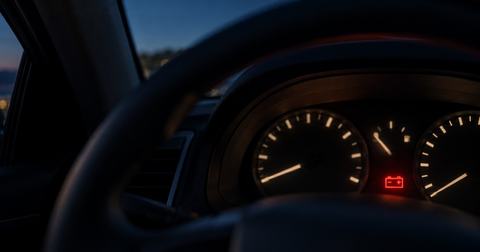
The charging light. The battery isn't being charged, so the car runs on what's left in it, and Nissan says to turn the engine off and check the drive belt.
GM says to find a safe place to stop, and to turn off accessories such as the radio and air conditioner if you must drive a short distance first. Read the battery light guide before you book.
What do the colors of dashboard warning lights mean?
The color is the first clue to a dashboard warning light's meaning. Red means act now, amber, yellow or orange means attend to it soon, and green or blue means a system is switched on, though Mazda's blue engine light means the engine is still cold. Toyota's own page says red needs immediate attention and yellow isn't necessarily a warning.
Some colors are set by law. A federal safety standard, FMVSS 101, sets the color of some lights, such as the yellow stability control light and the blue or green high beam, but not the oil pressure, temperature or charging lights.
Red doesn't only mean damage, though. Toyota's two red examples are an open door and low engine oil pressure, so read the symbol as well as the color.
| What you see | What it means | What to do |
|---|---|---|
| Green, blue or white | A system is on, or the engine is still cold | Nothing. High beams, cruise control and turn signals use these colors |
| Amber or yellow | Attend to it soon | Drive carefully to a shop. Book a check and have the code read |
| Red | Act now | Stop for oil, temperature or brakes. The airbag light is the exception: the car still drives, so have it checked as soon as possible |
| Flashing | Depends on the light | A flashing check engine light means slow down and park. A flashing traction light means the system is working |
| Most warning lights, for a moment | The bulb check | Nothing. Many lights come on briefly at start-up to show they work |
Color sets the urgency, and the symbol names the system. From Toyota's warning light page and GM's 2022 Equinox owner's manual.
Stop now Damage grows with every mile
- Oil pressure
- Engine temperature
- Brake
- Check engine, flashing
Stop soon Find a safe place to stop
- Charging
Book it Drive carefully to a shop
- Check engine, steady
- Anti-lock brakes
- Tire pressure
- Airbag
What does each dashboard warning light symbol mean?
Each symbol names the system that raised the warning, and the eight that matter most look like this:
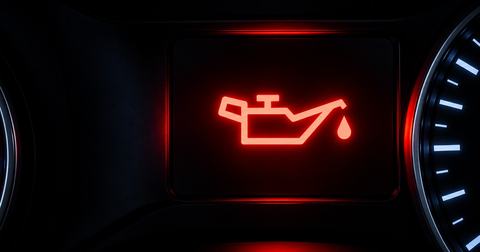
- An oil can. Oil pressure, a stop light.
- A thermometer in water. Engine temperature, a stop light.
- An exclamation mark in a circle. The brake system, a stop light, and on many cars the parking brake too.
- An engine outline. Check engine, a stop light when it flashes and a book-it light when it's steady.
- A battery outline. Charging, a stop-soon light.
- The letters ABS in a circle. Anti-lock brakes, a book-it light.
- A tire with an exclamation mark. Tire pressure, a book-it light once you've checked the tires.
- A seated figure with a bag. The airbag, a book-it light.
A triangle with an exclamation mark is a master warning light, and it points you to a message on the cluster screen. Nissan's manual lists low fuel, an open door and a loose fuel cap among those messages.
Read any other symbol by its color first, then by whether it flashes. Our board of dashboard symbols names the rest, one card per light.
Some red messages aren't in the lists above. GM's manuals say to stop and idle the engine when a transmission hot message appears, so read any red message before driving on.
Traction and stability control lights have their own guides. Read the one on the traction control light, or the VSA light on a Honda or Acura.
A light that should come on at start-up and doesn't is a warning too. Toyota tells hybrid owners to have the car inspected right away if the ABS or airbag light stays dark at start-up.
What should you do when a warning light comes on?
When a dashboard warning light comes on, start with the first three steps, which cost nothing:
- Decide whether it's a stop light. Red oil, temperature or brake, or a flashing check engine light, means pull off carefully, switch on your hazard lights and switch off. For any other red light or message, check your manual before you drive on.
- Rule out the free explanations. Release the parking brake for the brake light, and tighten a loose fuel cap for a check engine light.
- Check all four tires with a gauge while they're cold. Compare each reading with the pressure on the door placard, and add air to that pressure before you book anything for the tire light.
- Have the code read before you agree to a repair. The light names a system, and the code narrows it to a fault the shop then has to test. ABS and airbag codes need a scanner that reads those systems. Ask what the code says and how the shop confirmed the part. If the check engine light came on right after refueling from a can, GM's first check is that the capless funnel adapter was removed.
If a stop light comes back after you restart, don't drive on, and GM says to tow the car if the brake light stays on. If no code is stored, ask the shop what it tested before it quotes. Our guide to reading a repair estimate covers the questions to ask about a quote.
What to say to the shop
When a quote names a part for a warning light:
“My [color] [name] light is on [steady or flashing]. Can you read the stored code, tell me what fault it describes, and show me how you confirmed the part before you replace anything?”
A good answer: the stored code, the fault it describes, and the test that confirmed the part.
Which dashboard warning lights can you still drive with?
A steady check engine light and the ABS, tire pressure and airbag lights mean you can drive carefully to a shop. Book the check soon, but stop and check the tires as soon as you can when the tire light comes on.
Each of those lights has a catch that changes how long you can wait:
- Check engine, steady. A fault is stored, and you can drive carefully to a shop. GM says diagnosis and service may be needed, so the code read comes first.
- ABS. GM says the regular brakes still work when ABS is the only light on. If the red brake light is on too, the regular brakes have a problem as well.
- Tire pressure. Stop and check your tires as soon as possible, because an underinflated tire overheats, and the federal rule makes manuals say so. It lights when a tire is 25% below the pressure on the door placard, or at a set minimum if that's higher, and a tire can be that low and still look fine.
- Airbag. The car drives, but the airbags may not work in a crash. Have the system checked as soon as possible, which GM puts as serviced right away. A passenger airbag off light is a different signal.
Read the ABS light and the airbag light guides before you book. A recall can make an airbag repair free, so check for open recalls before you pay for one.
Our free VIN lookup tool lists the recalls issued for your model year. NHTSA's recall lookup then confirms whether one is still open on your car.
Why did all my dashboard lights come on at once?
One fault, such as low battery voltage or a brake problem, can reach more than one system, and the most urgent light decides what you do. A red brake light together with the ABS light means the regular brakes have a problem as well, GM says, so stop.
A weak battery can light a warning by itself. Hyundai says low voltage can turn the ABS light on after a jump start with no ABS fault, so have the battery recharged before you drive. If the charging light is on too, treat it as the stop-soon light above.
Repair shops add that dash lights that flicker or dim point to the alternator, which isn't holding the voltage steady. Have the charging system tested before any other part is replaced.
How do you clear or reset a warning light?
For a warning light, fix the fault first, and the light goes out once the car's self-check passes or the shop clears the code. Clearing a code with a scanner only hides the light until the car finds the fault again.
Clearing also resets the emissions self-tests the car runs. GM says a car that hasn't finished them may fail an inspection, and they can take several days of normal driving after a battery change or a repair.
A maintenance reminder is different, because nothing is broken. GM tells owners to reset the oil life system themselves each time the oil is changed.
Why did the warning light come on and then go off?
The condition that set it may have gone away, such as a fuel cap that was tightened. A light that keeps coming back still needs a check, and the manuals say so for each light below.
Nissan says a check engine light from a loose fuel cap should go off after a few driving trips once the cap is tight. GM says bad fuel can need a full tank of the right fuel before the light goes off.
An ABS light can go out after a restart, since GM tells owners to stop, switch off and restart to reset it, and says the car needs service if it stays on or comes back. For a check engine light, our guide to a light that comes and goes covers the rest.
How much does it cost to fix a dashboard warning light?
You pay for the fault behind the light, not the light, and that runs from nothing for air in a low tire to a full brake or airbag repair. Each row below gives the free or cheap first check and the page where that repair is priced:
| The light | First check | Where the cost is |
|---|---|---|
| Oil pressure | The oil level | Oil light guide |
| Engine temperature | Coolant level, engine cold | Coolant leak repair cost |
| Brake | Parking brake, then fluid | Brake fluid leak repair cost |
| Check engine | The stored code | Check engine light codes |
| Charging | Battery and alternator test | Alternator or battery |
| ABS | The ABS code | ABS sensor replacement cost |
| Tire pressure | A gauge on all four | Air first, a repair only for a damaged tire |
| Airbag | Open recalls | Airbag light guide |
Do the first check in your row before you book. It's free or cheap, and it tells you which repair the quote should be for.

Use this image
Free to republish under CC BY 4.0: credit Oil & Miles and link to this page. The snippet does both.
<a href="https://oilandmiles.com/articles/dashboard-warning-lights"><img src="https://oilandmiles.com/assets/img/diagrams/dashboard-warning-lights-checklist.jpg" alt="Dashboard warning lights checklist: stop somewhere safe for a red oil, temperature or brake light and a flashing check engine light, and stop soon for the charging light. Before you book, make sure the parking brake is released and check the tires cold with a gauge. At the shop, have the code read and ask how the part was confirmed. Don't drive on with a red oil, heat or brake light, keep driving with the charging light on or clear a code to hide it." width="1200" height="1378"></a> <p>Infographic: <a href="https://oilandmiles.com/articles/dashboard-warning-lights">Oil & Miles</a>, CC BY 4.0</p>From the carmakers
What do carmakers' manuals say about warning lights?
These are the carmakers' own words for their owners, plus the federal rule on colors. Each card quotes the document, and none is a recall or a free repair.
They agree on what each light reads and differ on what to do first. The cards below show each maker's own instruction.
Federal standard 49 CFR 571.101, S5.4.1
The light of each telltale listed in Table 1 must be of the color specified for that telltale in column 6 of that table.
Owner's manual 2022 Chevrolet Equinox, Brake System Warning Light
If the light comes on while driving, pull off the road and stop carefully.
Owner's manual 2019 Hyundai Tucson, Engine Oil Pressure Warning Light
Drive carefully to the nearest safe location and stop your vehicle.
Owner's manual 2018 Nissan Rogue, Charge warning light
Turn the engine off and check the generator belt.
Owner's page Warning lights, High Coolant Temperature
Immediately stop the vehicle in a safe place.
Conclusion
What to do next about a dashboard warning light
If the light is a red oil, temperature or brake light, or the check engine light is flashing, stop somewhere safe and switch off. For the brake light, make sure the parking brake is fully released before you call for a tow.
If the charging light comes on, switch off the radio and air conditioner and stop where you safely can to check the drive belt. If the car drives normally with an amber light, check the tires with a gauge and have the code read before any part is replaced.
If you don't know the symbol, go by its color and your owner's manual. Oil & Miles checks each light here against the carmakers' own manuals.
Common questions
Asked most often
Does the oil light mean I'm low on oil?
The red oil can warns of low oil pressure, which low oil can cause. Hyundai says to check the level, and if the light stays on with the level correct, switch off and have the car inspected.
Why is my tire pressure light on when the tires look fine?
The federal rule sets the light at 25% below the placard pressure, which a tire can reach while it still looks normal. Check all four with a gauge.
What does it mean if the tire light flashes, then stays on?
On cars that use one light for both jobs, the federal rule has it flash for 60 to 90 seconds at start-up when the system itself has a fault. Air won't clear it.
Will a check engine light fail an emissions inspection?
It can. GM's manual says a car may not pass if the light is on with the engine running, or if its self-tests haven't finished after a battery change or repair.
What people ask next

Sources
- 2022 Chevrolet Equinox owner's manual, for the brake, ABS, charging, oil pressure, check engine and traction lights, the passenger airbag light, the temperature gauge and the bulb check. General Motors, read October 27, 2026
- 2019 Chevrolet Silverado 1500 and 2020 Chevrolet Equinox owner's manuals, for the transmission hot message. General Motors, read October 2, 2026
- 2019 Hyundai Tucson owner's manual, for the oil pressure, low brake fluid and airbag lights, the ABS light after a jump start and the temperature gauge. Hyundai, read October 27, 2026
- 2018 Nissan Rogue owner's manual, for the brake, charge and master warning lights and the check engine light after a loose fuel cap. Nissan, read October 27, 2026
- Firestone Complete Auto Care, Why Are My Dashboard Lights Flickering?, and Meineke, 8 Signs of a Bad Alternator, for flickering dash lights and the alternator. Firestone and Meineke, read October 28, 2026
- Mazda 2016 CX-5 owner's manual, for the blue low engine coolant temperature light (page 4-42). Mazda, read October 2, 2026
- Toyota warning lights page, the maker's own page for owners, for the high coolant temperature light and what red and yellow mean. toyota.com, read October 27, 2026
- 49 CFR 571.101, Federal Motor Vehicle Safety Standard No. 101, Controls and Displays, for S5.4.1 on telltale colors. govinfo.gov, 2024 edition, read October 27, 2026
- 49 CFR 571.101, Table 1, the same standard's list of telltales, for which lights have a set color and which don't. govinfo.gov, 2024 edition, read November 4, 2026
- 49 CFR 571.138, Federal Motor Vehicle Safety Standard No. 138, for the tire pressure threshold, the start-up flash and the owner's manual line on stopping to check the tires. govinfo.gov, October 1, 2024 edition, read October 28, 2026
AI illustration by Oil & Miles
How this was compiled
Each light sits in the stop group or the wait group by what the carmakers' manuals tell owners to do, not by its color. Where the manuals differ, the page says so and names both.
The manuals quoted are four makers' own, and their wording is kept as theirs. Your own owner's manual has the final word for your car.
What we didn't do
We didn't catalog every symbol on this page, because a list of every light says nothing about urgency. Our dashboard symbols board does the naming, and this page sorts the ones that need a decision.
We didn't price the repairs here. Each one is priced on its own page, linked from the cost table.
This article is general information, not advice about your specific vehicle. See the disclaimer.